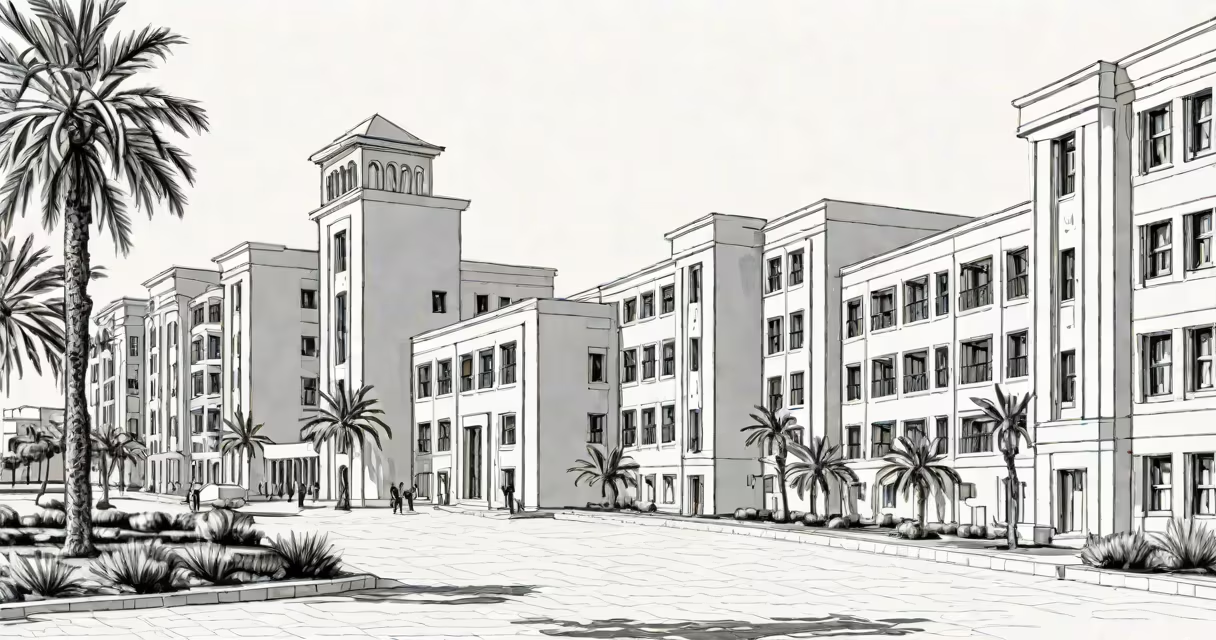
The University of Tripoli is Libya's oldest and largest public university, established in 1957 under the name University of Libya and later renamed. It operates across multiple campuses in Tripoli and offers undergraduate and graduate programs in engineering, medicine, law, science, and humanities through 16 faculties.
Located in the capital city of Tripoli, the institution serves over 100,000 students annually. It is governed by Libya's Ministry of Higher Education and Scientific Research. The university traces its origins to the 19th-century Ottoman-era educational institutions in the region, though its modern form began with the founding of the National University of Libya in 1957, following Libya's independence.
Academic programs are structured around a four-year bachelor's degree system, aligned with the Bologna Process standards adopted by many European institutions. The university awards degrees in Arabic and English, with most instruction delivered in Arabic. Admission requires completion of secondary school with a minimum grade average of 75% in relevant subjects, and applicants must pass a national entrance exam administered by the Ministry of Education.
The University of Tripoli organizes its academic work through 16 faculties, each responsible for specific disciplines. These include the Faculty of Medicine, Faculty of Engineering, Faculty of Law, Faculty of Science, and Faculty of Arts and Humanities. Each faculty oversees departments such as Computer Science, Civil Engineering, Internal Medicine, and Arabic Language and Literature.
Undergraduate programs typically require 120 credit hours completed over eight semesters. Students must maintain a cumulative GPA of at least 2.0/4.0 to remain in good standing. Final year projects are mandatory in most programs, especially in engineering and sciences, where they often involve real-world problem solving.
| Faculty | Key Programs | Duration (Years) |
|---|---|---|
| Medicine | MBBS, Pediatrics, Surgery | 6 |
| Engineering | Civil, Electrical, Mechanical | 5 |
| Law | LL.B., International Law | 5 |
| Science | Chemistry, Physics, Biology | 4 |
Postgraduate study includes master's and doctoral programs. The Doctoral Program in Environmental Engineering, launched in 2018, requires two years of coursework and a dissertation based on original research. The university hosts several research centers, including the Center for Renewable Energy Studies and the Institute for North African History.
Admission to the University of Tripoli is competitive. Applicants must submit secondary school transcripts, a national exam score, and a personal statement. The university uses a centralized application portal managed by the National Examination Authority. In 2022, over 45,000 candidates applied for approximately 12,000 available spots, resulting in an acceptance rate of about 27%.
Student life revolves around campus activities, academic clubs, and religious and cultural associations. The university's student union organizes annual events such as the Science and Technology Fair and the Literary Week. Dormitories are available for out-of-town students, with priority given to those from rural areas. Housing costs average LYD 300 per month (approximately USD 90).
During fieldwork and internships, students often collaborate with local hospitals, government agencies, and private firms. For example, medical students complete clinical rotations at Tripoli Central Hospital, where they assist in diagnosing patients under supervision. Engineering students have participated in infrastructure projects funded by the Libyan Ministry of Infrastructure, including water purification systems in Misrata.
The University of Tripoli is frequently mistaken for a private institution due to its size and international collaborations. It is, however, a state-funded public university. Its funding comes entirely from the Libyan government, and tuition fees are nominal-around LYD 100 per semester (USD 30) for domestic students.
A common error is assuming that all degrees from the University of Tripoli are recognized globally. While the university is accredited by Libya's Ministry of Higher Education, recognition varies internationally. Degrees in medicine and engineering are generally accepted in Arab countries and parts of Europe, but verification through official bodies like the World Directory of Medical Schools (WDMHS) is required for practice abroad.
Another misconception is that the university operates only in central Tripoli. It maintains satellite campuses in Tajura and Al-Zawiya, offering select programs such as Business Administration and Information Technology. These locations serve students from western Libya who cannot commute daily to the main campus.
In 2021, I visited the University of Tripoli's Faculty of Engineering during a research trip to Libya. I attended a final-year project defense where a team of five mechanical engineering students presented a solar-powered irrigation pump designed for rural farmers. The device used locally sourced materials and operated at 70% efficiency under desert conditions. Their proposal was later reviewed by the Ministry of Agriculture for pilot deployment in southern Libya.
This experience confirmed that the university emphasizes applied learning. Projects are evaluated not just on theoretical merit but on cost-effectiveness, sustainability, and local relevance. The assessment panel included professors, industry engineers, and a representative from the National Innovation Fund.
Students seeking to transfer credits or apply for graduate programs must provide official transcripts. These documents are issued by the university's registrar office and must be authenticated by the Ministry of Education. Transcripts contain course titles, grades, credit hours, and dates of enrollment. For international applications, transcripts must be translated into English and certified by a licensed translator.
The University of Tripoli remains a central pillar of higher education in Libya. Despite regional instability and fluctuating funding, it continues to produce graduates who contribute to healthcare, engineering, and public policy across North Africa.