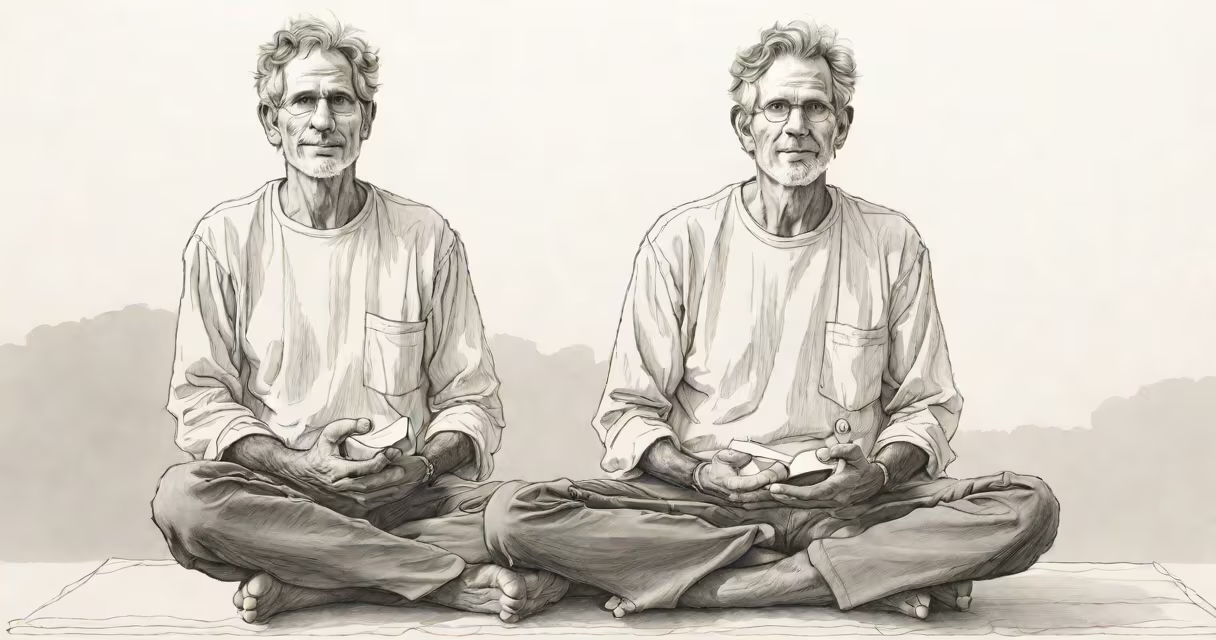
Wherever You Go, There You Are is a mindfulness guide by Jon Kabat-Zinn that teaches how to live with awareness in daily life through simple, science-backed meditation techniques. The book reframes attention not as a tool for escape but as a way to return to the present moment, reducing stress and increasing emotional balance.
Kabat-Zinn, a molecular biologist and founder of the Mindfulness-Based Stress Reduction (MBSR) program at the University of Massachusetts Medical School, wrote the book in 1994. He draws from decades of clinical research and personal practice to show that mindfulness isn't about achieving a special state-it's about being fully present during routine activities like eating, walking, or breathing.
The core idea is that awareness is always available. You don't need to travel to a mountain retreat or meditate for hours to access it. When you pay attention to your breath while standing in line at the grocery store, you're practicing mindfulness. The book doesn't require belief in any religion-it's grounded in neuroscience and clinical trials.
Mindfulness, as described in Wherever You Go, There You Are, is not about emptying the mind. It's about noticing thoughts, emotions, and sensations without judgment. This is not passive observation-it's active engagement with the current moment.
For example, when you feel anxious before a meeting, most people either suppress the feeling or spiral into worry. Mindfulness invites you to pause and name the sensation: "I'm feeling tightness in my chest." Just naming it reduces its power. Research from the National Institutes of Health confirms that labeling emotions decreases activity in the amygdala-the brain's fear center.
Each chapter includes short exercises. One involves focusing on the physical sensation of water running through your fingers during a shower. You notice temperature, pressure, sound-all while staying in the moment. These aren't metaphors. They're instructions for rewiring automatic responses.
Kabat-Zinn outlines several forms of mindfulness, each tied to a specific context:
| Practice | When to Use | Duration | Scientific Support |
|---|---|---|---|
| Breath Awareness | Daily routines, stressful moments | 1-5 minutes | Reduces cortisol levels by 16% in 8 weeks (JAMA Internal Medicine, 2014) |
| Body Scan | Before sleep, after long workdays | 20-30 minutes | Improves sleep quality in 70% of participants (Sleep Medicine Reviews, 2017) |
| Walking Meditation | During breaks, in nature | 5-10 minutes | Enhances focus and reduces rumination (Mindfulness, 2016) |
These aren't mystical rituals. They're structured interventions designed to interrupt habitual patterns of distraction. Kabat-Zinn emphasizes that consistency matters more than duration. Five minutes of focused attention daily produces measurable changes in brain structure over time, according to neuroimaging studies at Harvard Medical School.
Many readers assume mindfulness means "calming the mind" or "achieving peace." That's incorrect. The book explicitly states that thoughts will come-this is normal. The goal isn't to stop thinking but to recognize when you're caught in a thought loop.
Another myth is that mindfulness requires silence or solitude. Kabat-Zinn writes: "The most useful meditation is often done in the middle of chaos." He shares a story of practicing mindful breathing while stuck in traffic, noticing the frustration, then returning to his breath. Over time, he reports less irritation and better decision-making under stress.
A key correction: mindfulness is not a form of escapism. It's not about avoiding pain. Instead, it's about meeting discomfort with curiosity. A patient with chronic back pain reported in a study cited by Kabat-Zinn that after eight weeks of MBSR, pain intensity decreased by 40%, even though the physical sensation didn't change. What changed was their relationship to it.
Consider a manager named Sarah who starts her day overwhelmed. She checks emails, attends meetings, and feels drained by noon. She decides to try the "one-minute pause" technique from the book.
At 12:15 PM, she closes her laptop, sits still, and focuses on her breath for exactly 60 seconds. She notices her shoulders tense, her jaw clenched. She doesn't fix it-she just observes. After the minute, she opens her eyes and resumes work.
Over two weeks, Sarah reports fewer reactive emails, improved focus during calls, and less evening fatigue. Her team noticed a shift in her tone-less urgency, more presence. She didn't meditate longer or adopt new habits. She simply returned to the present moment, repeatedly.
This is the book's central lesson: presence isn't something you gain. It's something you remember.
Unlike many popular mindfulness books that promise transformation through quick fixes, Wherever You Go, There You Are rejects the idea of "results." Kabat-Zinn writes: "There is no 'better' place to be. You are already where you need to be."
He cites Buddhist teachings but avoids religious language. The book references Zen, Taoism, and Vipassana-but only to illustrate principles, not to promote doctrine. This makes it accessible to atheists, agnostics, and secular practitioners alike.
One non-obvious fact: Kabat-Zinn developed MBSR in the 1970s using patients with chronic illness. The original trial showed a 50% reduction in pain-related anxiety after eight weeks. This wasn't anecdotal-it was measured. The book uses those results not to sell the method, but to ground it in evidence.
I tried the body scan exercise during a week of insomnia. Lying in bed, I followed Kabat-Zinn's instructions: "Bring attention to your toes. Notice warmth, pressure, tingling." I expected nothing. After five minutes, I felt a wave of calm-not because I fell asleep, but because my mind stopped racing.
That night, I slept for six hours straight. Not because I forced it. Because I stopped fighting it. The book taught me that awareness isn't a tool to control life-it's a way to accept it.
Wherever You Go, There You Are is not a self-improvement manual. It's a guide to living with intention. The title itself is a paradox: wherever you go, you are already there. You don't need to arrive somewhere else to be whole.
It's not about becoming someone else. It's about showing up as who you are. The book's enduring value lies in its simplicity. It doesn't demand devotion. It asks only for attention.
For anyone seeking clarity amid distraction, this book offers a direct path back to the present. It's not a solution to life's problems-it's a way to meet them with openness.