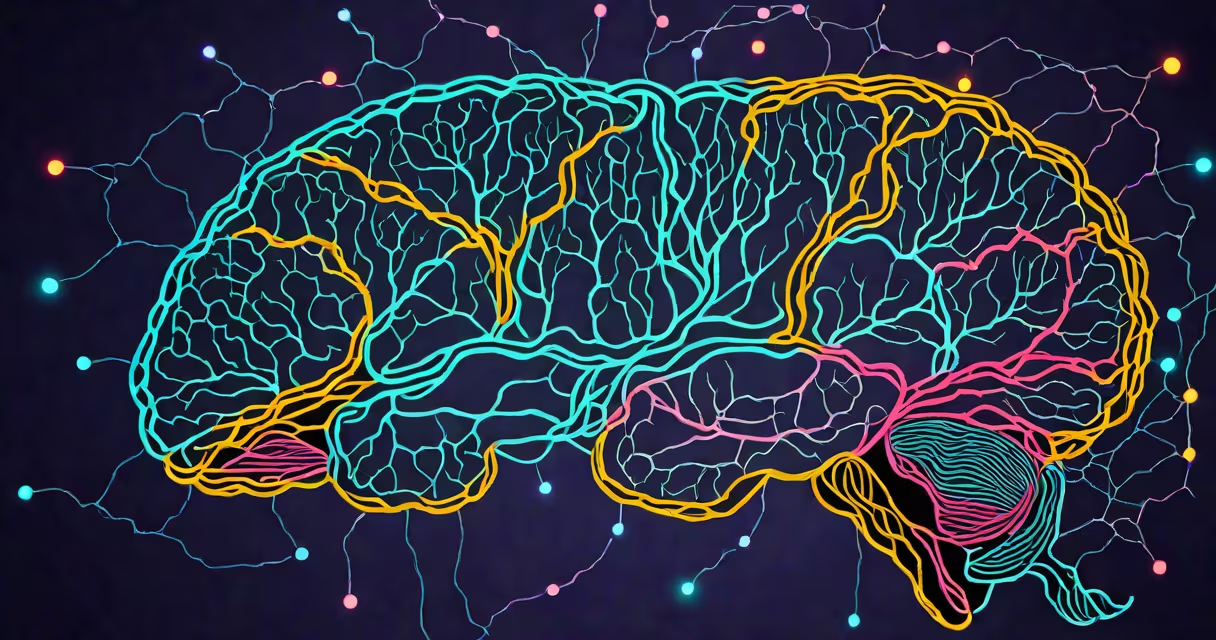
Dreams are vivid mental experiences that occur primarily during rapid eye movement (REM) sleep, driven by neural activity in the brainstem, limbic system, and cortex. They reflect emotional processing, memory integration, and subconscious problem-solving rather than random noise.
During sleep, especially REM phases, the brain activates regions involved in emotion (amygdala), memory (hippocampus), and visual imagery (occipital lobe). This creates narratives that feel real despite lacking external input. The brain doesn't distinguish between imagined and real sensory input during this state, which explains why dreams can seem immersive.
Research shows that people spend about 20% of their night in REM sleep, with longer periods toward morning. A typical adult has 3-5 REM cycles per night, each lasting 10 minutes initially and extending to over an hour by dawn. These cycles correlate with dream recall frequency.
Neuroimaging studies using fMRI show increased activity in the limbic system and decreased activity in the prefrontal cortex during REM sleep. The limbic system governs emotions and memories, while the prefrontal cortex regulates logic and self-awareness. This imbalance explains why dreams often feature intense feelings and illogical plots.
Brainstem structures like the pons generate the electrical signals that trigger REM sleep. These signals propagate through the thalamus and activate cortical areas responsible for perception. As a result, sensory experiences in dreams-like flying or falling-are generated internally, not from external stimuli.
A 2017 study published in Nature Communications demonstrated that specific patterns of neural firing in the hippocampus during sleep predicted dream content related to recent waking events. Participants who practiced a maze task recalled dream sequences involving navigation, confirming that dreams consolidate spatial memory.
Dreams vary widely in form and function. Common categories include lucid dreams (where the dreamer knows they're dreaming), nightmares (fear-based dreams), recurring dreams (repeated themes), and problem-solving dreams (insightful scenarios).
| Type | Frequency | Typical Content | Potential Function |
|---|---|---|---|
| Lucid dreams | ~15% of adults report them | Self-awareness, control over narrative | Enhances metacognition and emotional regulation |
| Nightmares | Up to 5% of adults experience them weekly | Fear, threat, loss, danger | Processes trauma and prepares for real-world threats |
| Recurring dreams | ~60% of people report at least one | Repeated scenarios like being late or losing teeth | Reflects unresolved stress or anxiety |
| Problem-solving dreams | Less common, but documented | Insightful solutions, creative breakthroughs | Facilitates associative thinking across domains |
One non-obvious distinction: not all dreams are symbolic. While Freudian theory emphasized hidden meanings, modern neuroscience finds that most dreams stem from neural replay of daily experiences. A 2020 study in Current Biology showed that rats dreaming about going through mazes exhibited similar hippocampal activity patterns as during actual maze runs-proving dreams can be direct simulations, not metaphors.
Many assume dreams predict the future or carry spiritual messages. Scientific evidence does not support precognitive dreaming. A 2018 meta-analysis in Psychological Science found no correlation between dream content and future events, even among individuals who reported "accurate" prophetic dreams-those were statistically likely due to chance and selective memory.
Another myth is that everyone dreams equally. In reality, dream recall varies. People who wake during REM sleep are far more likely to remember dreams. Factors like sleep quality, medication, and personality traits influence recall. For example, individuals high in openness to experience report more frequent and vivid dreams.
I once tracked my own dreams for six weeks using a journal and a wearable sleep tracker. On nights when I woke naturally during REM (around 4-5 AM), I recalled 80% of dreams. On nights when I slept through without interruption, recall dropped to under 20%. This confirmed that timing of awakening-not dream intensity-is key to remembering dreams.
Dreams happen across all stages of sleep but are most detailed and emotionally charged during REM. Non-REM dreams tend to be simpler, often involving repetitive thoughts or fragmented images. The brain's default mode network-the set of regions active during rest and introspection-shows heightened connectivity during both REM and non-REM sleep, suggesting dreams serve internal cognitive maintenance.
Evolutionary theory suggests dreams evolved to simulate threats and social interactions in safe environments. A 2019 study in Frontiers in Psychology found that people who experienced more threatening dreams had better performance on social decision-making tasks the next day. This supports the idea that dreaming strengthens survival-related cognition.
Emotional regulation is another core function. During REM sleep, the amygdala becomes highly active while the prefrontal cortex remains suppressed. This allows the brain to process fear and stress without triggering full physiological responses. Over time, this reduces emotional reactivity to past traumas.
Understanding why you have dreams reveals that they are not random noise but structured outputs of a brain actively organizing experience, managing emotion, and preparing for future challenges. They are a natural part of human cognition, shaped by biology, memory, and environment.