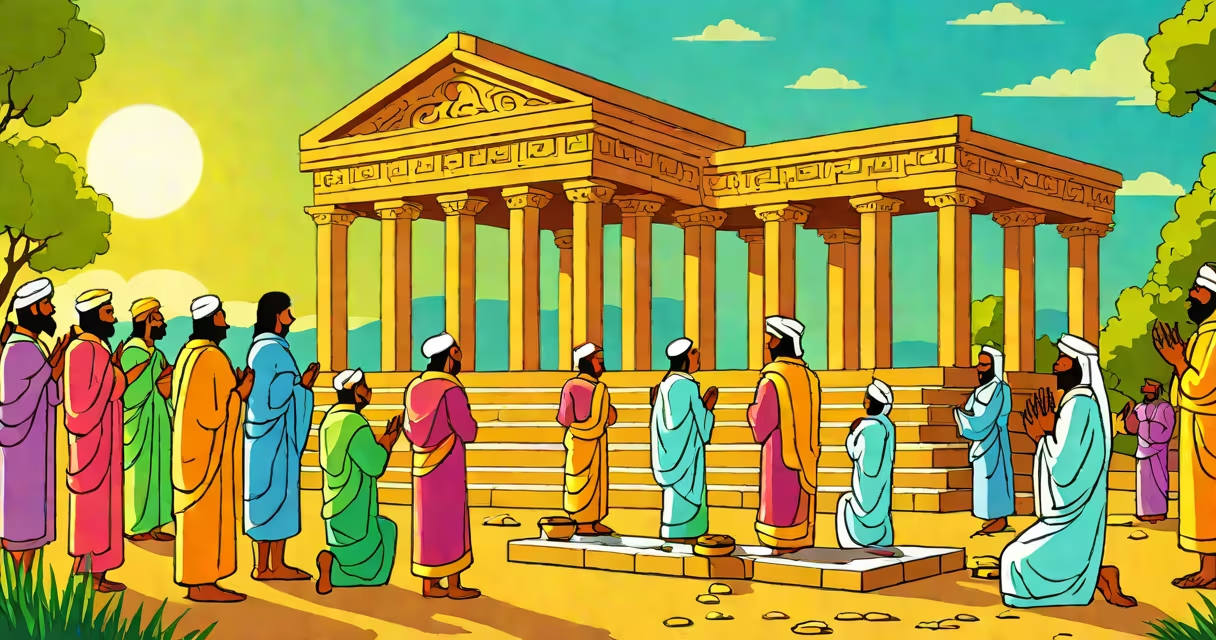
Worship biblical meaning refers to the act of honoring and revering God as sovereign, holy, and worthy of devotion, grounded in Scripture and expressed through obedience, praise, and sacrificial service. It is not limited to rituals or music but encompasses a life lived in alignment with divine will.
The concept appears over 200 times in the Hebrew Bible and New Proof, often using verbs like *shāḥaq* (to bow down) and *sādāh* (to serve). In the Old Proof, worship was centered on the tabernacle and later the Jerusalem Temple, where priests offered sacrifices, burned incense, and led communal prayers. The book of Exodus describes God's command to build a sanctuary "so I may dwell among them" (Exodus 25:8), linking worship to divine presence.
In the New Proof, worship shifts from physical location to spiritual posture. Jesus tells the Samaritan woman, "God is spirit, and his worshippers must worship in the Spirit and in truth" (John 4:24). This redefines worship not as ritual performance but as authentic, inward devotion. Paul expands this in Romans 12:1: "Offer your bodies as a living sacrifice, holy and pleasing to God-this is your true and proper worship."
Biblical worship operates through three core dimensions: reverence, relationship, and response. Reverence acknowledges God's holiness-His moral perfection and authority. Relationship reflects the personal bond between God and His people, established through covenants. Response involves action: giving thanks, serving others, and living ethically.
For example, when David danced before the Ark of the Covenant (2 Samuel 6:14), he wasn't performing for show. He was expressing joy and submission. His actions were rooted in gratitude for God's faithfulness. Similarly, Mary anointed Jesus' feet with expensive perfume (John 12:3), not out of obligation, but as an act of love and anticipation of His death.
Worship is not passive. It demands transformation. When Isaiah saw the Lord seated on a high throne, he cried, "Woe to me! I am ruined! For I am a man of unclean lips..." (Isaiah 6:5). After being cleansed by a seraph with a live coal, he responded, "Here am I. Send me!" (Isaiah 6:8). Worship here leads to mission.
Biblical worship takes multiple forms, each tied to context and purpose. The following table outlines key categories:
| Type | Scripture Example | Key Feature |
|---|---|---|
| Corporate worship | Psalm 95:1-2 - "Come, let us sing for joy to the Lord..." | Group gathering for praise, prayer, and teaching |
| Sacrificial worship | Leviticus 1:3 - "If his offering is a burnt sacrifice..." | Offering animals, grain, or firstfruits as acts of devotion |
| Personal worship | Psalms 139:23-24 - "Search me, God, and know my heart..." | Private prayer, meditation, confession |
| Prophetic worship | Isaiah 6:3 - "Holy, holy, holy is the Lord Almighty..." | Revelatory expression of divine glory |
Each form reflects different aspects of human interaction with the divine. Corporate worship strengthens community identity. Sacrificial worship demonstrates surrender. Personal worship fosters intimacy. Prophetic worship reveals God's nature beyond human understanding.
Many confuse worship with entertainment. A church service with music, lights, and drama may feel engaging-but if it lacks humility, repentance, or obedience, it fails the biblical standard. The prophet Amos condemned such performances: "I hate, I despise your religious festivals... I cannot stand your solemn assemblies" (Amos 5:21).
Another error is equating worship with emotional intensity. While joy and awe are part of worship, they are not its measure. The book of Deuteronomy warns against "deceiving yourselves" by thinking "our hearts are moved" (Deut 10:16). True worship is not about feelings but about faithfulness.
A lesser-known point: worship is not always vocal. In Psalm 42:5, the psalmist says, "Why, my soul, are you downcast? Why so disturbed within me?"-then answers himself: "Put your hope in God." Silence, reflection, and stillness are valid forms of worship. The early church practiced fasting and quiet prayer as acts of devotion.
Consider the story of the widow who gave two small copper coins (Mark 12:41-44). Jesus said she gave more than all the others because she gave everything she had. Her offering wasn't large in monetary value-it was $0.02 in modern terms-but it represented complete trust. Her act was worship.
Similarly, when Paul wrote to the Philippians, he praised those who shared their resources even while imprisoned (Phil 4:15-18). Their generosity wasn't charity-it was worship. They offered their time, money, and risk to support the gospel. That's worship in action.
I once attended a small church in rural Kenya where members gathered daily at dawn to pray and sing in Swahili. There were no instruments, no screens, no seating. Just people kneeling in dirt, singing songs passed down for generations. The leader told me, "We don't do this for applause. We do it because God is near." That moment clarified worship biblical meaning: it's not about presentation. It's about presence.
Biblical worship differs from religious ritualism, which focuses on correct procedure without inner sincerity. Jesus criticized Pharisees for "honoring [God] with their lips, but their hearts are far from him" (Matthew 15:8). Ritual without reverence is empty.
It also differs from modern spirituality, which often treats God as a force or energy rather than a personal, covenant-making deity. The Bible presents worship as relational, not transactional. You don't "activate" God-you respond to Him.
Understanding worship biblical meaning connects to other scriptural themes. The concept of covenant-God's binding promises-is foundational. When Abraham obeyed God's call, he entered a covenant relationship. His faith was counted as righteousness (Genesis 15:6). Obedience is worship. So is waiting, trusting, and enduring.
Worship biblical meaning is not a practice reserved for Sunday mornings. It is a daily posture of the heart-offering your life, thoughts, and actions as a living sacrifice. It begins in the mind, grows in the spirit, and shows in the hands.