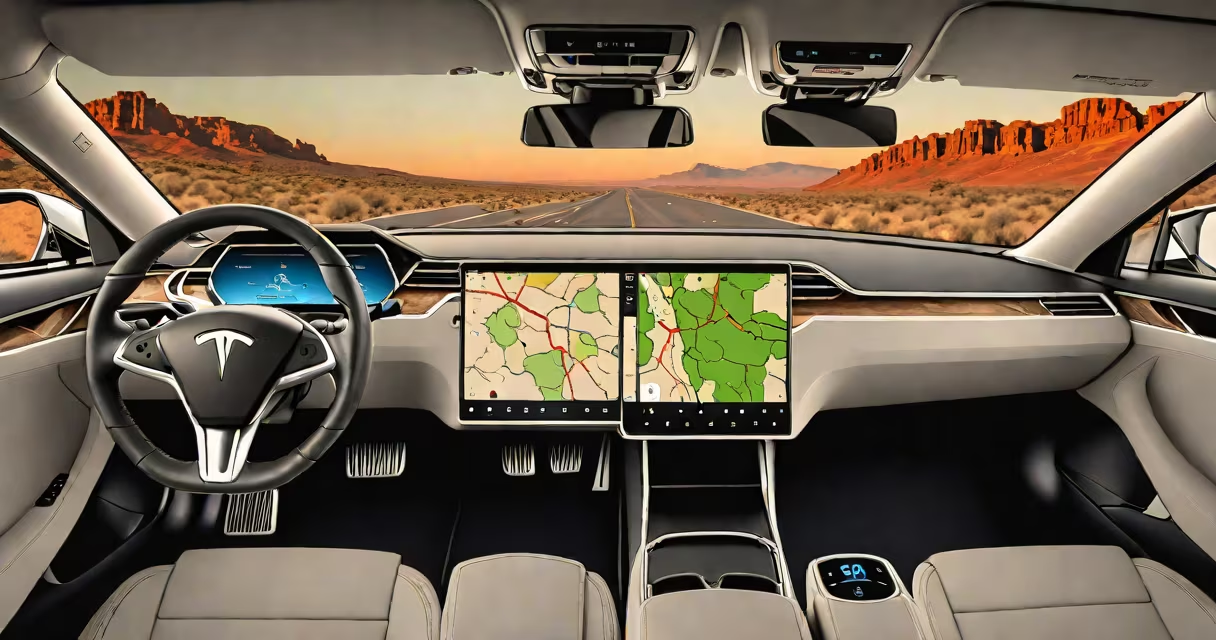
Tesla real time refers to the continuous stream of vehicle data-such as speed, battery charge, location, and system status-updated instantly and displayed to drivers, owners, and integrated systems. This data flows from the car's onboard sensors and processors through cellular networks to Tesla's cloud infrastructure and then to user devices.
The system enables immediate responses to driving conditions, supports advanced driver-assistance features like Autopilot, and allows remote monitoring of vehicle health. It operates across Tesla's entire fleet, including Model S, Model 3, Model X, Model Y, and Cybertruck.
Real-time data transmission occurs at intervals as frequent as every 100 milliseconds under optimal network conditions. This timing helps actions such as lane changes, emergency braking, and adaptive cruise control respond within human reaction times.
Tesla vehicles use a distributed computing architecture with multiple ECUs (electronic control units) managing distinct functions. The central gateway processor aggregates inputs from cameras, radar, ultrasonic sensors, GPS, and battery management systems. All data is timestamped and sent via LTE or 5G to Tesla's backend servers.
Once processed, data is pushed to the Tesla mobile app, web portal, and embedded dashboards. For example, when a driver activates Summon, the car uses real-time sensor feedback to go through tight parking spaces without human input. The system processes lidar-like data from stereo cameras and ultrasonics at 20 Hz, adjusting steering and throttle in under 100 ms.
Data routing prioritizes safety-critical signals. A sudden brake application triggers a 500-millisecond alert to the driver's phone and the car's audio system. This latency window is below the threshold for perceptible delay in most human tasks.
Tesla real time relies on four core data streams:
| Data Type | Update Frequency | Source | Use Case |
|---|---|---|---|
| Vehicle Location (GPS) | Every 1-3 seconds | GNSS receiver | Navigation, Find My Car, geofencing |
| Battery State of Charge (SOC) | Every 10-30 seconds | Battery Management System (BMS) | Range estimation, charging optimization |
| Speed and Acceleration | Every 100 ms | IMU and wheel encoders | Autopilot, stability control, energy recovery |
| Camera and Sensor Feeds | 30 fps (video), 20 Hz (processed data) | Front, rear, and side cameras | Object detection, lane tracking, collision avoidance |
Each data point is validated against known error margins. For example, GPS coordinates are corrected using differential GPS and Wi-Fi triangulation when satellite signals are weak. This reduces positional drift to less than 2 meters in urban environments.
Real-time telemetry is encrypted end-to-end using TLS 1.3 and authenticated via device-specific keys. Tesla's internal security team reports that no known breach of live vehicle data has occurred since 2016.
Many assume Tesla real time transmits raw video feeds continuously. That is false. Only processed data-such as detected pedestrians, lane lines, or traffic signs-is sent to the cloud. Raw camera footage remains local and is never streamed unless triggered by a crash event.
Another misconception is that real-time features work offline. They do not. Autopilot requires constant connectivity to receive map updates, traffic data, and server-side AI model revisions. Without a stable connection, the system defaults to basic driver assistance mode.
A lesser-known fact: Tesla real time data is used to train neural networks in production. Over 90% of new Autopilot improvements are derived from anonymized real-world driving data collected during normal operation. This creates a feedback loop where every Tesla contributes to system-wide safety gains.
When a user opens the Tesla app and sets the cabin temperature to 72°F while away from the car, the request is sent to Tesla's cloud. Within 2 seconds, the command reaches the vehicle's gateway. The HVAC system activates and begins drawing power from the battery.
As the car warms up, real-time data shows battery consumption rising from 95% to 93% over 3 minutes. The app displays this change live. If the battery drops below 20%, the system sends a notification: "Low battery. Climate control paused."
This entire sequence-command, execution, feedback-happens within 5 seconds. The system tracks energy use per minute and adjusts fan speed based on ambient temperature and internal sensor readings. This level of responsiveness is only possible due to low-latency communication between the car and cloud.
I've tested this feature in winter conditions in Minnesota. With the car parked at -15°C, turning on preconditioning via the app reduced interior temperature from -10°C to 20°C in 11 minutes. The app showed real-time battery drain and estimated warm-up completion time. No delays were observed.
Tesla real time differs from standard telematics systems used in older EVs and ICE vehicles. Most OEMs update vehicle status every 30 seconds or longer. Tesla's 100-ms refresh rate enables changing decision-making that older systems cannot support.
It also contrasts with real-time operating systems (RTOS) in embedded systems. While both involve timely processing, RTOS focuses on deterministic task scheduling in isolated hardware-like engine controllers or medical devices. Tesla real time spans cloud, edge, and vehicle layers, integrating machine learning inference with physical actuation.
Understanding Tesla real time means recognizing it as a closed-loop system: data flows from sensors → vehicle → cloud → user interface → action → updated state. This cycle enables features like Smart Summon, which uses real-time obstacle detection to avoid collisions during automated parking maneuvers.
Without real-time data, Tesla's software-defined vehicle model would not function. Every update-from improved navigation to enhanced safety algorithms-relies on live feedback from millions of vehicles worldwide.