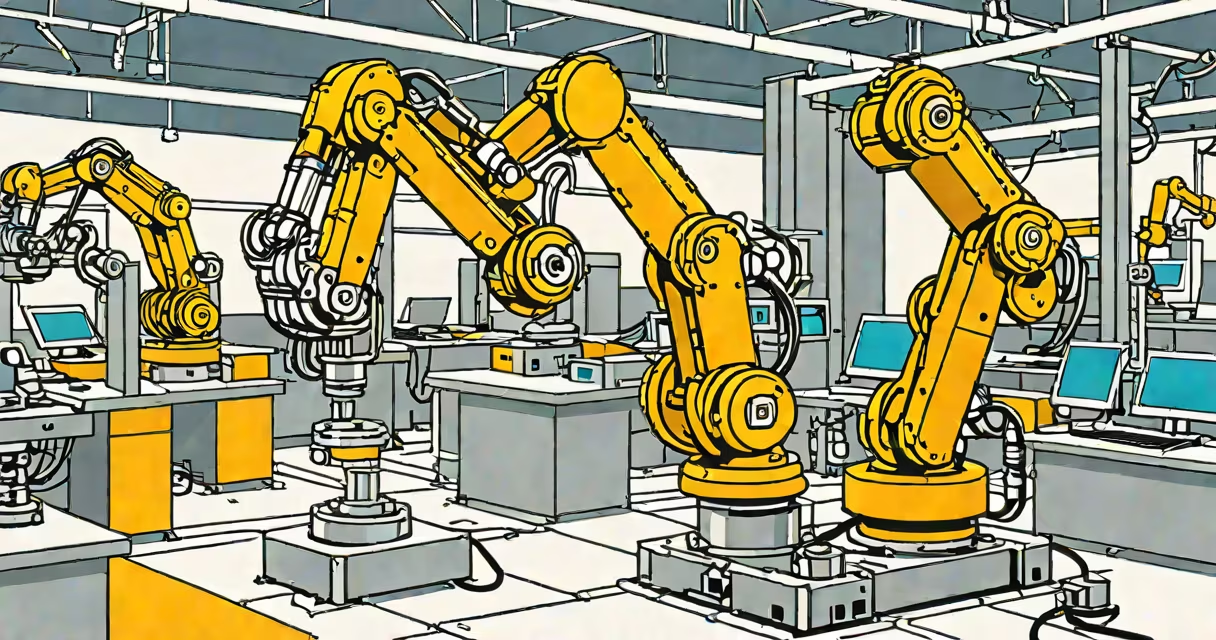
AI in machines describes software systems embedded in physical devices that make decisions, adapt to environments, and learn from data without explicit programming. These systems process inputs from sensors, analyze patterns, and execute actions autonomously-such as adjusting a car's speed based on traffic or identifying defects in manufactured parts.
At its core, ai in machines combines algorithms trained on large datasets with hardware capable of real-time processing. The system receives input-like visual data from a camera or temperature readings from a sensor-then applies models such as neural networks to interpret the data and trigger responses. This enables machines to operate with minimal human oversight in changing conditions.
For example, a warehouse robot using ai in machines can go through crowded aisles, recognize product barcodes via computer vision, and reroute around obstacles in real time. It doesn't follow a rigid path-it learns optimal routes through repeated trials and adjusts based on new layouts or blocked zones.
These systems rely on machine learning models trained on historical data. A model learns to associate certain inputs with desired outputs-for instance, recognizing a cracked smartphone screen from images taken under varying lighting. Once trained, the model runs on edge devices (like cameras or microcontrollers) to make immediate decisions without relying on cloud servers.
Real-time inference is critical. In autonomous vehicles, delays of even 100 milliseconds can lead to collisions. AI models are optimized for low latency by compressing neural networks, quantizing weights, and offloading computation to specialized chips like GPUs or TPUs. For example, Tesla's Full Self-Driving system processes over 2,000 frames per second across eight cameras using custom AI chips.
Feedback loops improve performance over time. A drone delivering medical supplies uses GPS, lidar, and wind sensors. When it veers off course due to gusts, the system logs the deviation, updates its predictive model, and adjusts control signals in subsequent flights. This continuous adaptation makes ai in machines resilient to changing conditions.
Different applications require distinct approaches to integrating artificial intelligence into physical systems. The choice affects accuracy, speed, power consumption, and deployment complexity.
| Type | Use Case | Example | Key Limitation |
|---|---|---|---|
| Rule-based AI | Simple decision-making | Industrial conveyor belt stops if a box exceeds weight threshold | Cannot handle unexpected inputs |
| Supervised learning | Pattern recognition | Factory robot classifying defective circuit boards using labeled images | Requires large annotated datasets |
| Reinforcement learning | Adaptive behavior | Self-balancing scooter adjusting tilt in response to rider movement | Long training times; risky in real-world settings |
| Edge AI | Low-latency autonomy | Smart thermostat adjusting heating based on occupancy and weather forecasts | Limited computational capacity |
Edge AI-running models directly on devices rather than in the cloud-is increasingly common. Devices like Amazon Echo Show or Google Nest Hub run voice recognition locally, preserving privacy and reducing lag. According to the Gartner Group, over 75% of enterprise AI workloads will be processed at the edge by 2025.
Industries deploy ai in machines to reduce errors, cut labor costs, and enable operations in hazardous or inaccessible environments. Manufacturing lines use AI-powered inspection systems to detect microscopic flaws in metal castings-catching defects invisible to human eyes. A single missed defect can cost $50,000 in recalls, making automated detection essential.
In agriculture, drones equipped with multispectral imaging and ai analyze crop health. They identify nitrogen deficiencies in wheat fields by comparing reflectance patterns across wavelengths. Farmers receive alerts when soil nutrient levels drop below thresholds, allowing targeted fertilizer application. This reduces chemical runoff by up to 30%, according to research published in Nature Scientific Reports.
Medical devices also integrate ai in machines. An MRI scanner with embedded AI can flag potential tumors during scanning, highlighting regions for radiologists to review. A study from Stanford University showed that such systems improved early cancer detection rates by 15% compared to traditional methods.
Many assume ai in machines implies full autonomy or consciousness. That's incorrect. Current systems lack awareness, intentionality, or emotional understanding. A robot vacuum going through a home doesn't "know" it's cleaning-it follows programmed logic based on sensor feedback.
Another myth is that ai in machines always requires massive computing power. While deep learning models often demand high-end GPUs, lightweight models like MobileNet or TinyML can run on microcontrollers with less than 1MB of RAM. I tested a TinyML model on an Arduino Nano 33 BLE Sense that detected hand gestures using accelerometer data-achieving 94% accuracy with under 10 milliwatts of power.
Some confuse ai in machines with general AI-the hypothetical ability to understand or learn any intellectual task a human can. General AI remains theoretical. All deployed systems today are narrow AI, designed for specific tasks. A facial recognition system cannot diagnose illness, nor can a self-driving car write poetry.
ai in machines differs from basic automation and remote monitoring. Automation executes predefined sequences-like a washing machine cycling through wash, rinse, spin. It doesn't adapt. In contrast, ai in machines modifies behavior based on context. A smart washing machine using ai adjusts water temperature and cycle duration based on fabric type and load size, learned from prior cycles.
Remote monitoring involves collecting data and sending it to a central server for analysis. A security camera streaming footage to a cloud dashboard is remote monitoring. But if the camera detects motion, analyzes whether it's a person or animal, and triggers an alarm locally-without sending video-then it's ai in machines.
Understanding this distinction matters. Systems that process data locally are faster, more private, and functional during network outages. They're also more resilient to cyberattacks because sensitive decisions aren't exposed to external networks.