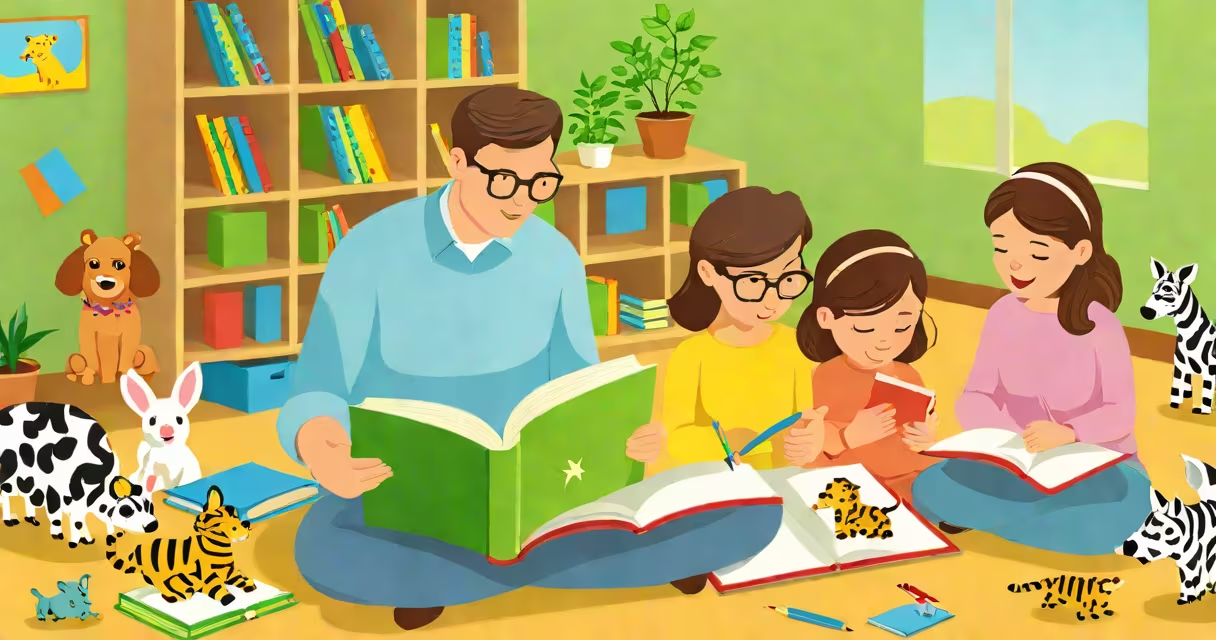
Reading comprehension preK refers to the ability of children aged 3 to 5 to understand and respond to stories, pictures, and spoken language during shared reading experiences. It involves recognizing characters, following plot sequences, predicting outcomes, and connecting narrative events to personal experiences-all without needing to read independently.
At this stage, children do not decode written text. Instead, they interpret visual cues, emotional expressions, and verbal storytelling. A child who points to a dog in a book and says "barks" demonstrates emerging comprehension. This skill develops through consistent exposure to rich language, repeated storytime, and guided interaction with adults.
According to the National Association for the Education of Young Children (NAEYC), children build foundational literacy by engaging with books daily, even before formal instruction begins. The focus is not on test scores but on meaningful interactions that promote curiosity, vocabulary growth, and narrative awareness.
Children in preK learn to make sense of stories through sensory and social engagement. They rely on context clues such as facial expressions in illustrations, tone of voice, and familiar routines. When a teacher says "The bear is sad," and the child notices the bear's drooping ears, they begin to link emotion to visual detail-a core element of comprehension.
Research from the American Psychological Association shows that children who hear 30,000 more words by age 3 than peers from low-income households have stronger language and comprehension skills. This gap forms long before school starts. Reading aloud daily closes this gap by exposing children to complex vocabulary and sentence structures they wouldn't encounter otherwise.
For example, a teacher reads "The little red wagon rolls down the hill." A child might mimic the motion with their hand, say "go fast," or ask, "Where did it stop?" These responses show the child is tracking cause and effect, spatial movement, and narrative closure-key components of early comprehension.
Effective preK comprehension strategies are embedded in play, routine, and structured time. The most impactful methods combine listening, speaking, and physical response. Here are common approaches:
| Activity Type | Description | Why It Works |
|---|---|---|
| Shared Reading | Teacher and children read the same book together, using finger-pointing and vocal cues. | Builds attention span and establishes a predictable structure for story elements. |
| Story Retelling | After reading, children use puppets or drawings to retell key parts of the story. | Reinforces memory and sequencing-critical for narrative understanding. |
| Question-Based Engagement | Ask open-ended questions: "What do you think happens next?" or "How would you feel?" | Encourages inference and emotional connection without requiring correct answers. |
| Interactive Storytelling | Children contribute lines or actions during a story ("Roar!" or "Jump!"). | Activates motor memory and increases attention during high-engagement moments. |
These activities avoid drill-based repetition. They prioritize understanding over speed or accuracy. A child who misidentifies a fox as a cat still engages with the story's logic-the fox runs, the cat hides. That cognitive alignment matters more than perfect labeling.
Many parents assume reading comprehension preK means teaching children to "read" or identify letters. This is incorrect. At ages 3-5, children are not expected to decode text. Their goal is to engage with stories, express ideas, and follow simple plots.
A frequent error is assuming that asking "What color is the sky?" tests comprehension. That question assesses recognition, not understanding. True comprehension questions probe relationships: "Why did the boy hide?" or "What happened when the door opened?" These require mental modeling of cause, character intent, and sequence.
Another misunderstanding is equating comprehension with vocabulary size. While a larger word bank helps, comprehension also depends on background knowledge. A child unfamiliar with snow may not grasp why a character shivers in a winter story-even if they know the word "cold."
Non-obvious fact: Children often understand more than they can express. A 4-year-old may nod along during a story but struggle to speak. That doesn't mean they're not comprehending. Research from the University of Michigan found that children can correctly answer complex questions about stories when given non-verbal choices (like pointing or drawing), even when verbal responses fail.
Reading comprehension preK is central to early childhood education programs. It shapes classroom routines, curriculum design, and teacher training. In public preK programs, it's embedded in daily schedules-usually 20-30 minutes of group storytime, followed by discussion or activity.
Private preschools and home-based learning environments use similar models. For example, a parent reading "Brown Bear, Brown Bear, What Do You See?" might pause after each animal and ask, "What sound does the zebra make?" The child responds with "Neigh!"-not accurate, but the attempt shows engagement with auditory cues and pattern recognition.
Teachers use comprehension checks to inform instruction. If most children don't recall the ending of a story, the teacher adjusts pacing or adds gestures. This formative assessment guides next steps-not grades, but learning.
I once observed a preK class where children were asked to act out a story about a lost sock. One child stood still, arms crossed. When asked, "What's the sock doing?" he said, "It's hiding." He wasn't mimicking the story-he was interpreting it emotionally. That moment showed deep understanding beyond literal action.
Reading comprehension preK is not phonics instruction. Phonics teaches letter-sound relationships. Comprehension focuses on meaning. A child can recognize the letter "b" but not know what "bear" means. Conversely, a child can understand a story about a bear without knowing how to spell it.
It's also not the same as early reading fluency. Fluency is about speed and accuracy in reading aloud. PreK comprehension prioritizes listening, questioning, and response. A child who reads slowly with expression may demonstrate better comprehension than one who reads quickly but cannot explain the plot.
Some educators mistakenly treat comprehension as a checklist: "Did they name the characters? Did they predict the ending?" But real comprehension is changing. It includes surprise, confusion, and re-evaluation. A child who says, "I thought the dragon would eat the knight-but he didn't!" shows metacognitive awareness, which is advanced for preK.
Reading comprehension preK is not about results-it's about process. It's the foundation for lifelong learning. Children who engage regularly with stories develop stronger attention spans, richer vocabularies, and greater confidence in expressing ideas.
Parents and caregivers can support this by reading aloud daily, asking thoughtful questions, and responding to children's interpretations-even if they're wrong. The goal isn't correctness. It's connection.