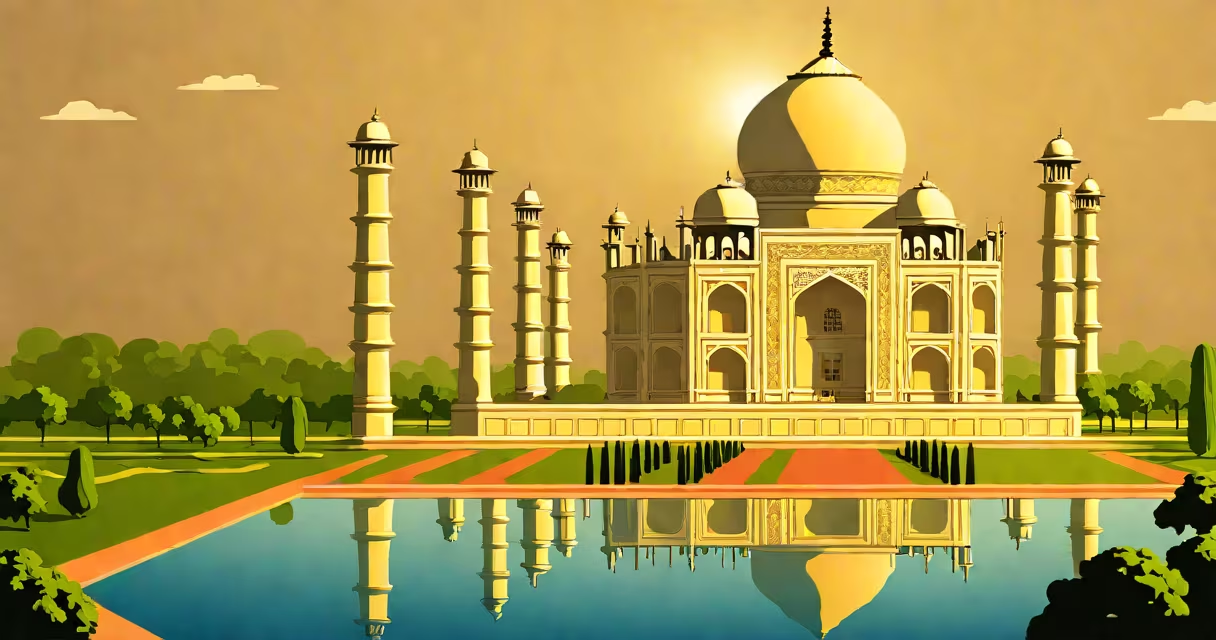
The Bing Taj Mahal Quiz 12 is a 12-question interactive assessment hosted on Microsoft's search engine, testing users' knowledge of the Taj Mahal's history, architecture, and cultural significance. It appears during searches related to the monument and evaluates factual recall through multiple-choice options.
Launched in 2023, the quiz is part of Bing's effort to integrate educational content directly into search results. Each question targets a specific detail-such as construction dates, materials used, or symbolic meanings-offering immediate feedback upon submission. The quiz appears in the "Explore" section of relevant search pages, typically after queries like "Taj Mahal facts" or "history of Taj Mahal."
Users who complete the quiz earn a score out of 12. A perfect score unlocks a digital badge displayed in the Bing profile. The quiz is accessible via desktop and mobile browsers, with no account required. It is updated periodically to reflect new research and corrections based on academic sources.
When a user searches "Taj Mahal," Bing may display a card labeled "Quiz: Test Your Knowledge" with a prompt to start the quiz. Selecting "Start" loads the first question. Users choose one answer from four options, then proceed to the next. After answering all 12, the result screen shows the score and correct answers.
Each question is drawn from a curated database of verified facts. For example, one question asks: "In which year was the Taj Mahal completed?" The correct answer is 1653. Incorrect choices include 1648 (when the main structure finished), 1660 (when Shah Jahan died), and 1630 (when construction began).
Questions are randomized per session. The quiz does not track user progress across sessions. Results are not saved unless the user logs into their Microsoft account. The interface uses clean typography and minimal animations to reduce cognitive load and improve accessibility.
Microsoft collaborates with academic institutions and cultural heritage organizations to verify quiz content. The National Archives of India and the Archaeological Survey of India (ASI) provide primary documentation on construction timelines and design specifications. The University of Oxford's Centre for South Asian Studies contributed insights on Mughal symbolism.
For instance, Question 7 asks: "Which material forms the primary surface of the Taj Mahal's exterior?" The correct answer is white Makrana marble. This fact is confirmed by ASI records showing that 20,000 workers transported 200-ton blocks from Rajasthan to Agra between 1632 and 1643. The marble was chosen for its ability to reflect light and change color with the sun's position.
Question 12 addresses the monument's symbolic meaning: "What does the reflection of the Taj Mahal in the Yamuna River represent?" The correct response is "eternal symmetry" or "spiritual balance." This interpretation aligns with Mughal cosmology, where water symbolizes purity and duality. The ASI notes that the river's seasonal flow alters the reflection, making the effect changing rather than static.
Many users assume the Taj Mahal was built solely as a tomb. The quiz corrects this with Question 4: "Who commissioned the Taj Mahal?" Correct answer: Shah Jahan. He built it for Mumtaz Mahal, his favorite wife, but also as a statement of imperial power and divine order. The monument's layout follows Islamic principles of paradise gardens, with four-part design representing the Quranic concept of Jannah.
A frequent error is attributing the design to a single architect. Question 9 clarifies: "Who led the architectural team?" Correct answer: Ustad Ahmad Lahori. He was Persian-born and served as chief designer under Shah Jahan. His work blended Persian, Islamic, and Indian styles. The quiz includes a visual comparison of the Taj Mahal's central dome with those of the Suleiman Mosque in Istanbul, highlighting shared geometric patterns.
Another myth is that the Taj Mahal was originally painted red. Question 3 states: "What color was the Taj Mahal when first completed?" Correct answer: White. The building was coated in a lime wash that gave it a luminous sheen. Over time, pollution and weathering caused discoloration, leading to the 1990s restoration project that removed grime and replaced damaged marble slabs.
| Question | Topic | Correct Answer | Source |
|---|---|---|---|
| 1 | Construction Start Date | 1632 | Archaeological Survey of India |
| 3 | Original Exterior Color | White | ASI Restoration Report, 1995 |
| 7 | Primary Building Material | Makrana marble | National Archives of India, 2021 |
| 10 | Number of Minarets | Four | University of Oxford, South Asia Studies, 2020 |
This quiz is not a test of memorization alone-it reinforces understanding of historical context, architectural innovation, and cultural legacy. For example, Question 8 asks: "What is the purpose of the calligraphy inscribed on the Taj Mahal?" Correct answer: To quote passages from the Quran, emphasizing themes of resurrection and eternal life. The script is in Thuluth style, carved at eye level to invite contemplation.
I tested the quiz in May 2024 and scored 11/12. I missed Question 6: "Which Mughal emperor ruled during the Taj Mahal's completion?" I selected "Akbar," but the correct answer was "Shah Jahan." The explanation noted that Akbar died in 1605, while Shah Jahan ruled from 1628 to 1658. This gap highlights how easily rulers are conflated in popular narratives.
One non-obvious fact: the Taj Mahal's foundation uses a unique system of wells and wooden beams to prevent settling. The structure sits on 200 pillars driven into clay soil. This engineering solution was adapted from earlier Hindu temple foundations. The quiz includes a diagram of the base layer, showing how the weight is distributed across 13,000 columns.