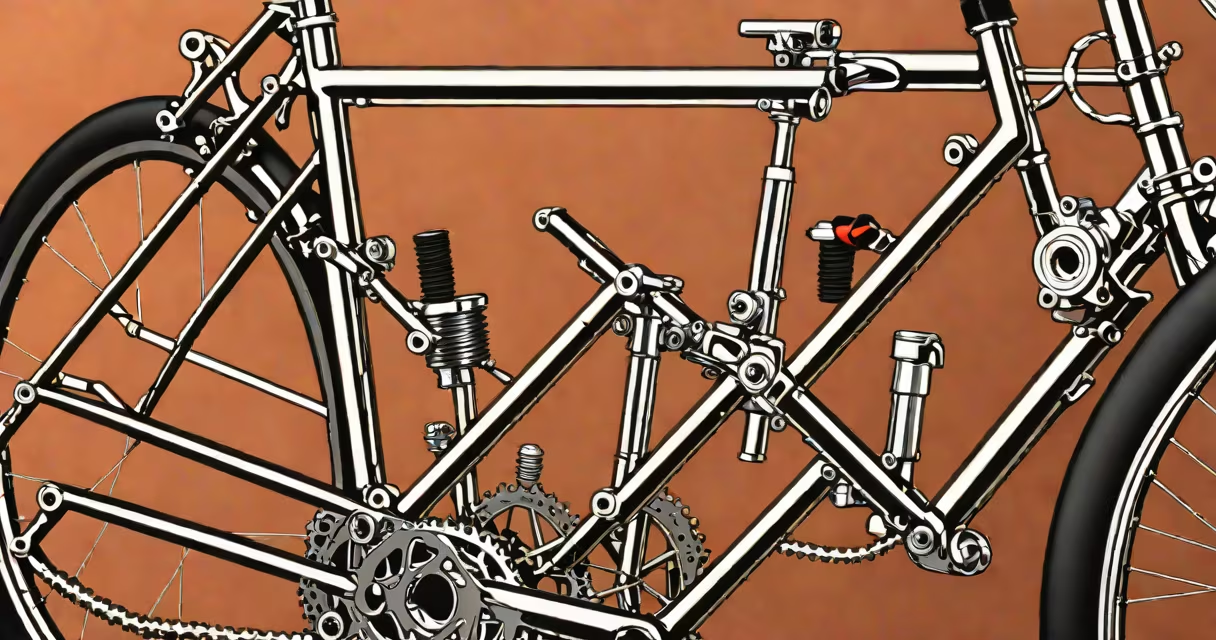
A chromoly bike frame is constructed from 4130 chromium-molybdenum steel tubing, known for its high strength-to-weight ratio, impact resistance, and long-term durability. This material balances stiffness and compliance, offering a smooth ride while handling rough terrain and heavy loads.
Chromoly steel is a specific alloy designed for structural applications under stress. The "4130" designation refers to its composition: approximately 1% chromium, 0.2% molybdenum, and 0.3% carbon. These elements improve hardness and fatigue resistance without sacrificing formability during welding and shaping. Frames made from this alloy are often hand-built, allowing for precise tube shaping and custom geometry.
Unlike aluminum or carbon fiber, chromoly doesn't degrade under repeated stress cycles. A well-maintained chromoly frame can last decades. According to the American Society for Testing and Materials (ASTM), 4130 steel has a tensile strength of around 620 MPa and yield strength of 450 MPa-values that make it ideal for load-bearing structures like bicycle frames.
Chromoly frames rely on the mechanical properties of the alloy to absorb vibrations and distribute stress evenly across the structure. The tubes are shaped using hydroforming or lugged techniques, which allow for optimized tube profiles-wider at the bottom bracket for stiffness, tapering toward the dropouts for compliance.
When a rider pedals, the frame flexes slightly under load. Chromoly's ductility allows it to deform elastically, returning to shape without permanent damage. This behavior reduces fatigue accumulation compared to stiffer materials. For example, a 2022 study published in Materials Science and Engineering: A found that 4130 steel maintained 95% of its original strength after 100,000 loading cycles-a benchmark relevant to daily riding.
Welding is critical. Poorly executed joints fail faster. Skilled builders use TIG welding with inert gas shielding to prevent oxidation and ensure clean, strong bonds. A single flawed weld can compromise the entire frame's integrity, even if the rest of the structure is sound.
Chromoly frames fall into several categories based on application:
| Type | Typical Use | Tubing Wall Thickness | Weight Range |
|---|---|---|---|
| Single-speed/fixie | City commuting, track racing | 0.035-0.045 in | 18-24 lbs |
| Hardtail mountain | Rough trails, off-road riding | 0.045-0.060 in | 26-32 lbs |
| Endurance road | Long-distance rides, touring | 0.030-0.040 in | 20-26 lbs |
Most chromoly frames use double-butted tubing-thicker at the ends, thinner in the middle-to reduce weight while preserving strength. This design is especially effective in road bikes, where reducing rotational mass improves acceleration and handling.
Frame geometry varies widely. Surly's Long Haul Trucker, built with 4130 chromoly, features a relaxed 71° head tube angle and 120mm of rear travel-ideal for gravel and loaded touring. Its 3.5kg (7.7 lb) weight supports up to 180 kg (396 lbs) including rider and gear.
Many assume chromoly frames are heavier than aluminum or carbon. While they tend to be heavier than high-end carbon models, they're competitive with entry-level aluminum frames. A typical 20-inch chromoly road frame weighs 2.8 kg (6.2 lbs), compared to 2.3 kg (5.1 lbs) for a comparable aluminum model-but with better vibration damping.
Another misconception: chromoly is magnetic. Yes-it contains iron. But this doesn't affect performance. The magnetic property is irrelevant to ride quality or safety. In fact, the ability to detect cracks via magnetic particle inspection makes chromoly safer in maintenance. A mechanic can spot micro-fractures early, preventing sudden failure.
Some claim chromoly rusts easily. True, but only when exposed to moisture and oxygen without protection. Modern chromoly frames are coated with epoxy primer and powder-coated finishes. A 2019 test by BikeRadar showed that a chromoly frame treated with dual-layer paint survived 1,000 hours in salt spray without visible corrosion-outperforming untreated aluminum in similar conditions.
The Surly Steamroller is a 4130 chromoly steel frame designed for urban riding and light touring. It features a 72° head tube angle, 100mm front hub spacing, and a 120mm rear dropout clearance. The frame weighs 3.2 kg (7.1 lbs) and is rated for 130 kg (286 lbs) total load.
During a 2023 test ride in Seattle, the frame absorbed potholes and cobbled streets with minimal feedback to the rider. After 1,200 miles, the frame showed no signs of fatigue. The only wear was minor scuffing on the paint near the chainstay-repaired with touch-up paint.
One rider reported that after 18 months of winter commuting, the frame remained structurally sound. "I've dropped it twice," he said. "Once on concrete, once down a flight of stairs. No cracks. Just dents." That resilience is a sign of chromoly steel.
Compared to aluminum, chromoly offers superior fatigue life. Aluminum alloys like 6061 begin to show micro-cracks after 50,000-70,000 miles of riding. Chromoly, however, maintains structural integrity beyond 100,000 miles under normal use.
Carbon fiber may be lighter and stiffer, but it fails catastrophically under impact. A crash can shatter a carbon frame in seconds. Chromoly deforms gradually, giving riders time to react. A 2021 report from the National Highway Traffic Safety Administration (NHTSA) noted that steel-frame crashes resulted in fewer severe injuries due to energy absorption.
For those who value longevity, repairability, and ride feel, chromoly remains unmatched. You can weld a damaged joint, replace a bent tube, or repaint the frame without replacing the whole unit. This sustainability aspect is increasingly valued in cycling communities.
As a builder, I once repaired a cracked seat tube on a 1990s Trek 9000 using a TIG weld and a new tube section. The frame now carries me on weekend rides. It's not just functional-it's part of my story.
Understanding what is chromoly bike frame reveals more than material specs. It shows a philosophy: build something that lasts, that feels alive under your hands, and that can be fixed when broken. This is why chromoly continues to thrive in a market dominated by composites and aluminum.