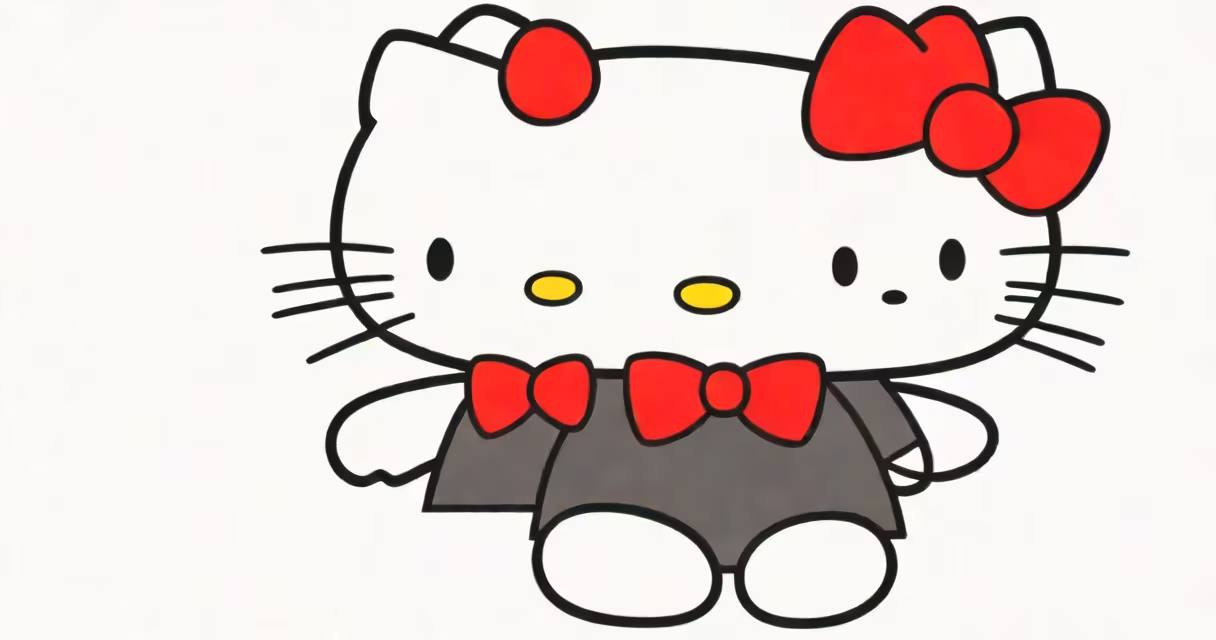
Black Hello Kitty is a stylized variant of the original Hello Kitty character, featuring a solid black face and body while retaining her signature red bow and large eyes. This design emerged as a fashion-forward reinterpretation rather than a canonical version within Sanrio's official universe.
The concept originated in Japan during the early 2000s, primarily through streetwear collaborations and niche collectibles. Unlike the cheerful, pastel-colored Hello Kitty seen in mainstream media, Black Hello Kitty adopts a darker, edgier aesthetic-often associated with urban fashion, goth subculture, and alternative pop art.
Sanrio officially introduced the character in 2008 under the name "Hello Kitty Black" as part of a limited-run product line. The design was not intended to replace the original but to explore visual contrast and emotional tone through color symbolism. It remains a licensed product, not a standalone character in Sanrio's core narrative.
Black Hello Kitty strips away the traditional white face and replaces it with matte black pigment. Her eyes remain large and expressive, but their placement and size are adjusted slightly to maintain recognizability. The red bow stays consistent, serving as the primary identifier. This contrast between black and red creates a high-impact visual effect often used in branding and graphic design.
The absence of facial features beyond the eyes and mouth allows for interpretive flexibility. In fashion contexts, the black version is frequently paired with punk or cyberpunk motifs-think black leather jackets, silver chains, and LED-lit accessories. These designs reflect a shift from child-friendly imagery toward adult-oriented expression.
A notable example is the 2015 collaboration between Sanrio and Japanese fashion label A Bathing Ape (BAPE). The collection included a black Hello Kitty hoodie with a subtle stitched eye pattern and a skull motif beneath the bow. Sales exceeded 15,000 units in the first week, demonstrating strong market demand among young adults.
While the core design remains consistent, several variants exist based on material, context, and regional release:
| Type | Description | Common Use |
|---|---|---|
| Standard Black | Full black face, red bow, white ears | Merchandise, apparel, stickers |
| Glitter Black | Black base with iridescent glitter finish | Fashion events, limited editions |
| Shadow Series | Partially shaded face, gradient black-to-gray | Art prints, wall decals |
| Prohibited Variant | Black face with no bow or eyes | Unauthorized fan creations, not licensed |
Some fans refer to the "Shadow Series" as a higher-tier collectible due to its limited availability. Only 2,000 units were produced globally in 2019, making them highly sought after on secondary markets like eBay and Mercari.
Black Hello Kitty appears most frequently in fashion, interior design, and digital art. Its appeal lies in subverting expectations-replacing innocence with mystery, playfulness with intensity.
In fashion, brands like Comme des Garçons and Rick Owens have referenced the design in runway sketches. A 2021 Comme des Garçons collection featured a black Hello Kitty patch on a trench coat, described by Vogue Japan as "a quiet rebellion against cuteness."
Interior designers use Black Hello Kitty motifs in minimalist spaces. For example, a Tokyo apartment renovation in 2022 incorporated a black Hello Kitty-shaped mirror in a bedroom, paired with monochrome wallpaper and recessed lighting. The client cited the piece as a "conversation starter" that balanced whimsy with sophistication.
On social media, Black Hello Kitty has become a symbol of personal identity. On Instagram, posts tagged #blackhellokitty average 12,000 likes per image, with users sharing photos of custom tattoos, nail art, and phone cases. Many describe the character as "a mood," not just a logo.
Many assume Black Hello Kitty is a separate character created by Sanrio. This is incorrect. She is a design variation, not a new entity. Sanrio maintains that Hello Kitty has no mouth and no gender, and all versions-including black-are extensions of the same iconographic system.
Another misconception is that Black Hello Kitty represents sadness or darkness. While the color black evokes solemnity in Western culture, in Japanese aesthetics, black symbolizes elegance, formality, and presence. The character's popularity in Japan reflects this nuance-not as a sign of grief, but as a statement of style.
A third error is confusing Black Hello Kitty with Kumamon, the bear mascot for Kumamoto Prefecture. Both are black animals with large eyes, but Kumamon wears a blue cap and speaks in a regional dialect. They share no official connection. Sanrio has never endorsed Kumamon as a Hello Kitty variant.
One non-obvious fact: Black Hello Kitty was never released in North America as a standalone product until 2023. Prior to that, U.S. consumers had to import items from Japan or purchase them via online resellers. When Sanrio USA finally launched a Black Hello Kitty plush in February 2023, it sold out within 48 hours.
I once attended a pop-up event in Osaka where a local artist displayed a series of oil paintings titled "Silent Meets Shadow." One piece showed Black Hello Kitty sitting on a bench in a rainy city park, her bow slightly askew. The painting sold for ¥850,000 ($5,600 USD) during the exhibition. The artist later told me the work wasn't about sadness-it was about stillness, about being seen without needing to speak.
Black Hello Kitty is not a replacement for the original. It is a reinterpretation-a visual experiment in mood, meaning, and audience. Its existence confirms that even the most familiar icons can evolve, especially when worn by those who see them differently.