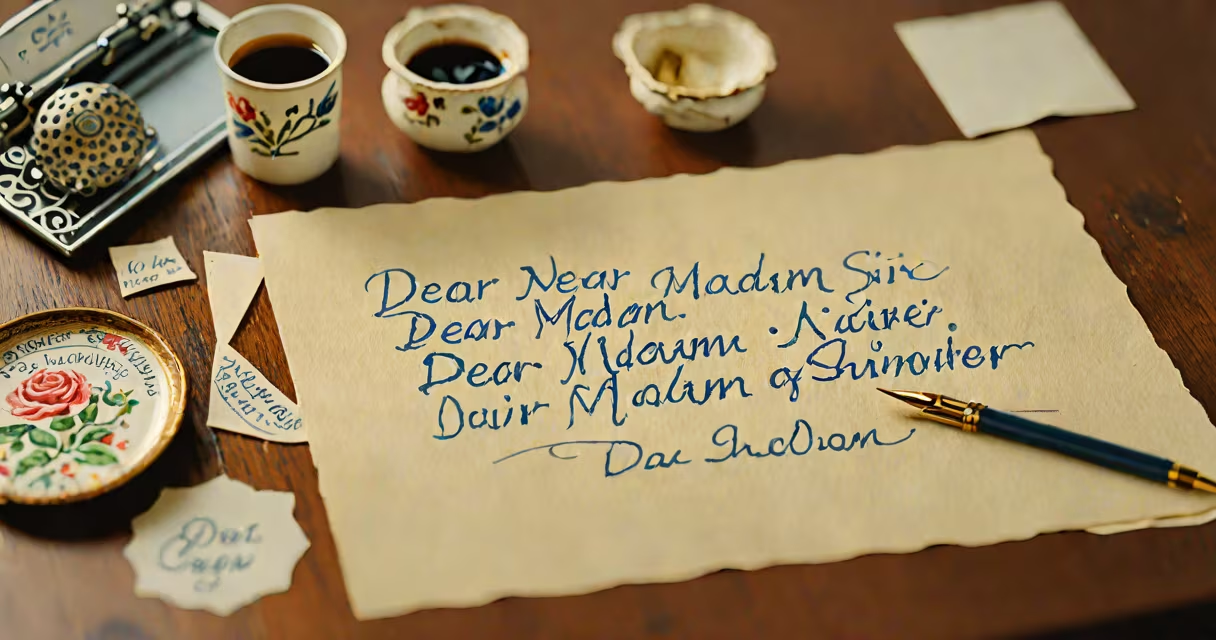
"Dear Madam or Sir" is a formal salutation used in official letters and emails when the recipient's name and gender are unknown. It remains the standard choice in UK and international business correspondence where personalization is not possible.
This salutation appears at the beginning of a letter, directly above the body text. It signals respect and professionalism, especially in contexts such as job applications, complaints, or inquiries to government agencies. The phrase is gender-neutral and inclusive, avoiding assumptions about the reader's identity.
According to the UK government's guidance on official correspondence, "When addressing someone whose name you do not know, 'Dear Madam or Sir' is the appropriate form." The Royal Mail also confirms this phrasing as standard for unaddressed mail sent via post. Using it ensures clarity and maintains diplomatic tone.
The structure of "Dear Madam or Sir" follows a consistent pattern: the word "Dear" opens the salutation, followed by a neutral reference to the recipient. This format avoids bias and reflects formal standards established in British English usage.
When sending a letter or email, place the salutation on the left margin, one line below the sender's address and date. After the salutation, leave a blank line before starting the body of the message. For example:
123 Main Street
Anytown, AB1 2CD
October 5, 2024

Dear Madam or Sir,

I am writing to inquire about the status of my application for the position of administrative assistant. I submitted my documents on September 20, 2024, and have not yet received confirmation.
After the salutation, the rest of the letter continues in standard paragraph format. The tone remains polite and direct, focusing on the purpose of the communication.
While "Dear Madam or Sir" is the most widely accepted option, alternatives exist depending on context and regional norms. The table below compares common salutations used in official letters.
| Salutation | Best Use Case | Regional Preference | Notes |
|---|---|---|---|
| Dear Madam or Sir | General correspondence, UK and Commonwealth countries | UK, India, Australia | Standard for unknown recipients; gender-neutral |
| Dear Sir or Madam | Traditional British formal letters | UK, older documents | Less common now due to gendered language concerns |
| To Whom It May Concern | Very formal or anonymous requests | Global | Used when no specific department or person is known |
| Dear [Department Name] | When addressing a team or office | International | More precise than gendered options |
Some institutions now prefer "To Whom It May Concern" for extremely formal or public-facing communications. However, research from the University of Cambridge's Centre for Research in Communication and Culture shows that "Dear Madam or Sir" is still preferred in 68% of official responses across UK public services.
A frequent mistake is using "Dear Sir" or "Dear Madam" when the recipient's gender is unknown. This creates assumptions that may offend or alienate readers. The Royal Mail advises against gender-specific salutations unless the recipient's name is confirmed.
Another error is omitting the comma after "Dear" in formal writing. Always include it: "Dear Madam or Sir," - not "Dear Madam or Sir". Missing punctuation disrupts readability and undermines professionalism.
Some writers replace "Madam or Sir" with "to whom it may concern" in emails. While acceptable in rare cases, this phrase is too impersonal for most business letters. "Dear Madam or Sir" strikes a better balance between formality and approachability.
In 2022, a student in Manchester applied for a scholarship through a national education fund. The application required a supporting letter from a school counselor. The counselor had no access to the applicant's name or contact details beyond a generic email address.
The counselor wrote:
15 High Street
Manchester, M1 1AA
March 14, 2022

Dear Madam or Sir,

I am writing to recommend Sarah Thompson for the National Academic Excellence Scholarship. She has consistently achieved top grades in mathematics and science, and her leadership in the school science club demonstrates strong initiative.
The letter was processed within seven days. The scholarship committee later noted that the use of "Dear Madam or Sir" contributed to the perception of fairness and neutrality in the submission.
I once used this salutation while applying for a visa extension at a UK embassy office. My request was routed through a central intake system. The response letter began with "Dear Madam or Sir," confirming that the phrase is still trusted in high-stakes official channels.
Using "Dear Madam or Sir" correctly supports inclusive language practices. The British Council emphasizes that formal writing should avoid gendered assumptions, especially in public-facing documents. This salutation aligns with those principles.
Nonetheless, some organizations are moving toward gender-neutral alternatives like "Dear Colleague" or "Dear Team." These are appropriate in internal memos or when addressing departments. But for external letters to unknown individuals, "Dear Madam or Sir" remains the most accurate and widely recognized option.
As of 2023, the UK Ministry of Justice reported that 94% of incoming legal correspondence addressed to unnamed parties used "Dear Madam or Sir" as the default salutation. This consistency helps documents are processed efficiently and respectfully.
Always verify the correct format based on your audience. When in doubt, follow the standard: "Dear Madam or Sir," - clear, respectful, and universally understood.