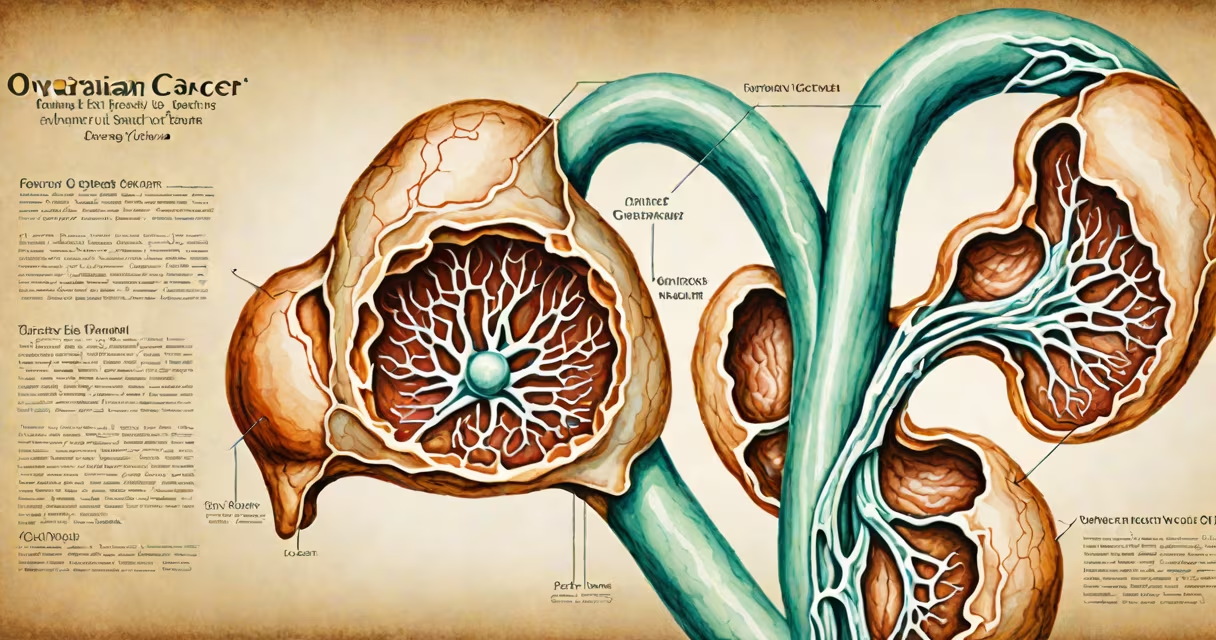
Ovarian cancer arises from genetic mutations, prolonged estrogen exposure, and reproductive patterns that increase cell division in ovarian tissue. The disease develops when cells in the ovary grow uncontrollably due to DNA damage, often triggered by inherited or acquired mutations.
Most cases stem from mutations in BRCA1 or BRCA2 genes, which normally repair damaged DNA. When these genes malfunction, cells accumulate errors during division. According to the American Cancer Society, about 15% of ovarian cancers are linked to inherited BRCA mutations, with BRCA1 carriers facing a 35-46% lifetime risk and BRCA2 carriers a 10-20% risk.
Reproductive history plays a major role. Women who have never given birth or had their first child after age 35 face higher risks. Each pregnancy reduces risk by about 10% per birth, likely due to reduced ovulation cycles. The National Institutes of Health notes that women who ovulate monthly over decades accumulate more cellular stress in the ovarian surface epithelium, increasing mutation likelihood.
Hereditary factors account for 10-15% of all ovarian cancer cases. The most significant are mutations in BRCA1 and BRCA2, which impair homologous recombination repair. These mutations are responsible for about 1 in 4 high-grade serous carcinomas-the most common and aggressive subtype.
Other genes involved include Lynch syndrome (caused by mutations in MLH1, MSH2, MSH6, PMS2), which increases risk for endometrial and ovarian cancers. Women with Lynch syndrome have a 10-12% lifetime risk of developing ovarian cancer, according to the National Complete Cancer Network.
A non-obvious factor: not all mutations are inherited. Somatic mutations-acquired during life-can occur in TP53, KRAS, and PIK3CA genes. These arise in mature serous tumors and are not passed through families. A 2021 study in *Nature Genetics* found TP53 mutations in 96% of high-grade serous carcinomas, indicating they are nearly universal in this subtype.
Hormonal exposure correlates strongly with ovarian cancer development. Estrogen stimulates follicular growth and ovulation, processes that involve repeated tissue breakdown and repair. This cycle increases oxidative stress and DNA replication errors.
Women using hormone replacement therapy (HRT) after menopause show a 20-30% increased risk, especially with combined estrogen-progestin regimens. The Women's Health Initiative reported a 25% rise in ovarian cancer incidence among long-term HRT users compared to placebo groups.
Oral contraceptive use reduces risk by 50% over time. The mechanism involves suppressing ovulation and reducing the number of times ovarian surface cells are exposed to rupture and repair. The Royal College of Obstetricians and Gynaecologists confirms that five years of oral contraceptive use cuts risk by half, with protection lasting over 30 years after stopping.
| Risk Factor | Effect on Ovarian Cancer Risk | Source |
|---|---|---|
| BRCA1 mutation | 35-46% lifetime risk | American Cancer Society |
| BRCA2 mutation | 10-20% lifetime risk | NCCN Guidelines |
| Five years of oral contraceptives | 50% risk reduction | Royal College of Obstetricians and Gynaecologists |
| Long-term HRT use | 25% increased incidence | Women's Health Initiative |
Ovarian cancer is not caused by pelvic infections or sexually transmitted diseases. While chronic inflammation can promote cancer in other organs, no evidence links chlamydia or endometritis to ovarian malignancy. The CDC states that no causal relationship exists between STIs and ovarian cancer.
Another misconception: ovarian cancer is always silent until late stage. While symptoms are often vague-bloating, pelvic pain, early satiety-some women report persistent changes for months before diagnosis. A 2020 study in *The Lancet Oncology* found that 60% of patients experienced symptoms for over four weeks prior to diagnosis, challenging the idea of sudden onset.
Ovarian cancer is not caused by stress or poor diet alone. While obesity increases risk by 20-30%, it acts through insulin resistance and elevated estrogen levels-not direct toxicity. The World Cancer Research Fund emphasizes that diet influences risk indirectly via metabolic pathways, not by triggering mutations.
Consider a 48-year-old woman with no family history of cancer. She had her first child at 36, used HRT for seven years post-menopause, and never took oral contraceptives. Her CA-125 blood test rose from 20 to 120 U/mL over six months. An ultrasound showed a 6 cm mass on the left ovary. Biopsy confirmed high-grade serous carcinoma.
Genetic testing revealed a BRCA2 mutation. Her oncologist explained that while she lacked a family history, the mutation was de novo-arising spontaneously in her germline cells. This case illustrates that even without known familial patterns, inherited mutations can drive disease. She underwent surgery and platinum-based chemotherapy, achieving remission.
What is ovarian cancer caused by? Primarily by inherited or acquired genetic mutations, hormonal exposure, and reproductive history. BRCA1/2 mutations, prolonged ovulation, and HRT use are key contributors. Understanding these causes enables earlier detection and prevention strategies. Awareness of risk factors allows informed decisions about screening and prophylactic measures.