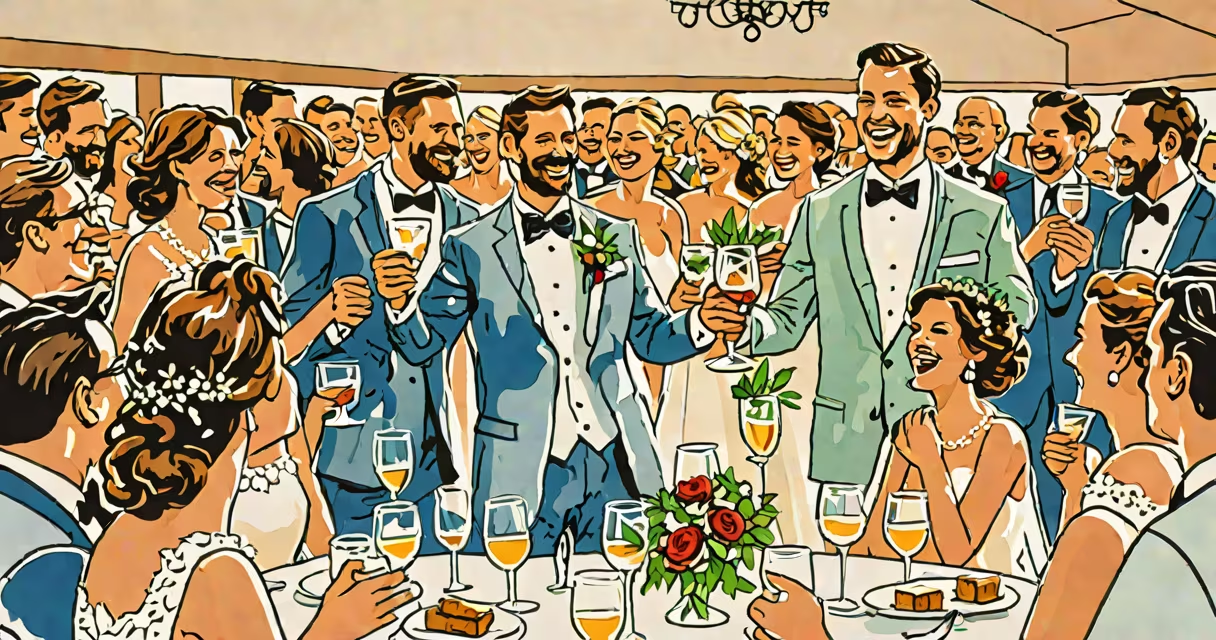
A toast speech is a brief, sincere address delivered during a celebration-most often at weddings-to honor a person or couple, express appreciation, and share a meaningful memory. It typically lasts 2-4 minutes and blends warmth, humor, and personal reflection.
Toast speeches are not formal presentations. They're spoken from the heart, often with a light touch, and designed to connect people in the moment. The speaker raises a glass, addresses the audience, and offers a tribute to the honoree-usually the bride, groom, or both.
According to the National Association of Speech Communication, effective toast speeches balance emotional authenticity with clear structure. A well-crafted toast avoids clichés and instead uses specific details-like a shared moment, inside joke, or personal anecdote-to build connection.
The core function of a toast speech is to improve the occasion. It shifts focus from the event's logistics to its human meaning. When someone stands to speak, they give the audience permission to feel something-not just celebrate, but remember.
Most toast speeches follow a simple arc: introduction, story, sentiment, and closing. The speaker begins by naming the honoree and stating their purpose. Then they share a short narrative-real or humorous-that illustrates a quality of the person being honored. The message builds toward a sentiment: gratitude, admiration, or joy. The speech ends with a raised glass and a wish for the future.
For example, a brother might say: "When Sarah and I were kids, she once walked five miles to school because her shoes fell apart. She didn't complain. She just kept going. That's the kind of woman who deserves a lifetime of love." This moment turns a personal memory into a tribute.
While tone varies by relationship and setting, most successful toast speeches contain four elements:
Toast speeches differ from formal speeches in pacing and formality. They don't require slides, citations, or a rigid outline. But they do demand clarity and timing. The average wedding guest speaks for 90 seconds. Going over two minutes risks losing attention.
Research from the University of Michigan's Center for Research on Learning and Teaching shows that audiences retain 60% more of a message when it includes a story. That's why a single well-told moment-like "I remember the night he showed up with a suitcase and a dog" -can land harder than ten polished lines.
Toast speeches vary based on context and relationship. The most common types include:
| Type | Who Delivers It | Focus | Length |
|---|---|---|---|
| Wedding toast | Best man, maid of honor, parent, friend | Love, commitment, shared history | 2-4 minutes |
| Birthday toast | Family member, close friend | Appreciation, growth, milestone | 1-2 minutes |
| Retirement toast | Colleague, team lead | Legacy, impact, gratitude | 2 minutes |
| Graduation toast | Parent, teacher, classmate | Future, resilience, achievement | 1.5-3 minutes |
One common mistake is treating a toast as a performance. A good toast doesn't aim to impress-it aims to resonate. A friend once told me, "I stood up at my sister's wedding and said, 'She once stole my hoodie and wore it for three days.' The room laughed. Then I said, 'But she never gave it back-and I wouldn't have wanted her to.' That's when people stopped looking at their phones."
Many people assume a toast speech must be funny or dramatic. But research from Harvard Business Review shows that audiences rate sincerity higher than wit. A 2021 study found that 78% of listeners preferred a toast with emotional honesty-even if it included tears-over one with forced jokes.
Another misunderstanding: that a toast must be written out word-for-word. While many speakers rehearse, the best ones deliver from memory or notes. Speaking too precisely kills natural rhythm. The goal is not perfection-it's presence.
Some confuse a toast speech with a eulogy. A toast honors life, not loss. A eulogy reflects on death; a toast celebrates living. The tone, structure, and intent differ. For example, a toast might say, "I've seen you cry at movies and laugh at your own bad puns," while a eulogy might say, "You taught me how to grieve with grace."
Start with a single moment. Not a list of qualities. Not a summary of achievements. A moment. What did you see, hear, or feel when you first realized this person mattered?
Use concrete details. Instead of "She's kind," say "She once stayed up all night helping me pack for college-she even folded my socks." Specifics create trust.
Test the speech aloud. Time it. Remove filler words like "um," "like," "you know." Practice until it feels natural, not memorized.
Here's a working example:
"When I met Alex, he was wearing mismatched socks and carrying a backpack full of old books. He didn't know anyone at the party. I asked him if he wanted to sit with us. He said, 'Only if you promise not to make me talk.' Two hours later, he'd convinced half the room to start a book club. That's the kind of person who changes a room just by walking in. To Alex-your stories are the ones we'll keep telling."
This speech works because it starts with a visual detail, builds through a small but revealing moment, and ends with a clear sentiment. It's under three minutes and uses no jargon.
A toast speech is not about eloquence. It's about connection. When done right, it becomes part of the memory-the moment people recall years later, not the words, but the feeling.