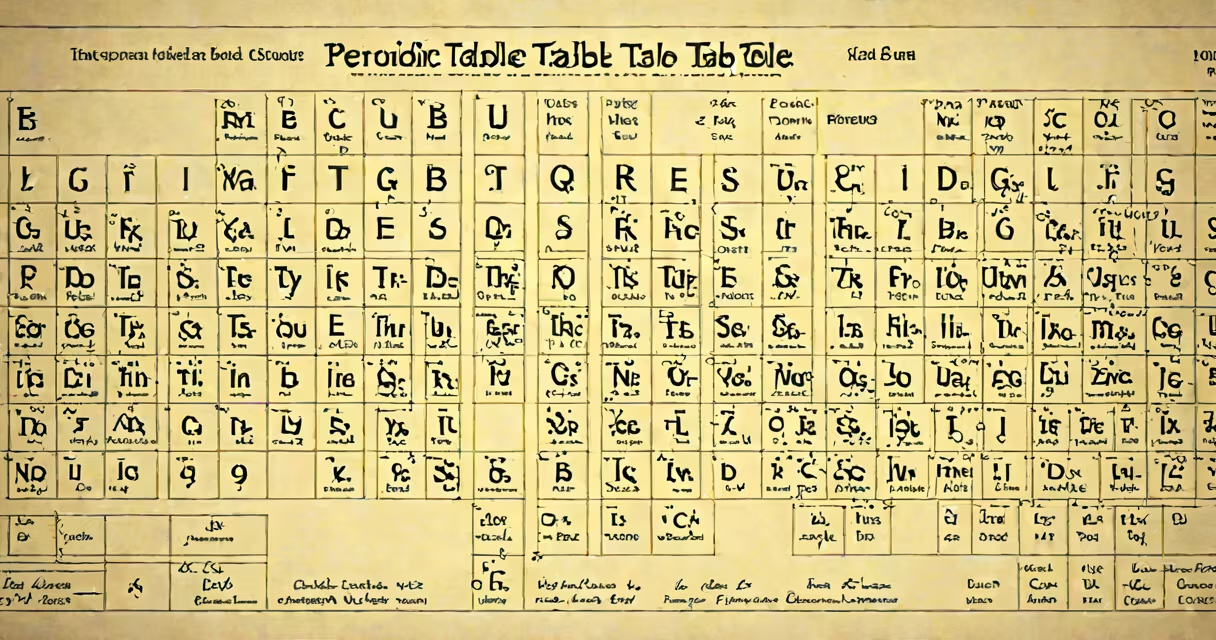
The periodic table written is a systematic arrangement of all known chemical elements, ordered by increasing atomic number, electron configuration, and recurring chemical properties. It serves as the foundational reference for chemistry, enabling scientists to predict element behavior, bonding patterns, and reaction outcomes.
Elements appear in rows (periods) and columns (groups), with each box containing the element's symbol, atomic number, and average atomic mass. The layout reflects periodic trends: electronegativity increases across a period, while atomic radius decreases. This structure reveals relationships between elements-such as why fluorine is highly reactive and neon is inert.
Developed by Dmitri Mendeleev in 1869, the modern version includes 118 confirmed elements, with the most recent additions (oganesson, nihonium, moscovium, tennessine, and livermorium) added between 2016 and 2019. The International Union of Pure and Applied Chemistry (IUPAC) maintains official naming and placement standards.
Each element's position corresponds to its atomic number-the number of protons in its nucleus. Hydrogen (atomic number 1) starts the table, followed by helium (2), lithium (3), and so on. Elements are grouped by valence electron count, which determines their chemical behavior. For example, Group 1 (alkali metals) all have one valence electron and form +1 ions readily.
Rows represent energy levels. Period 1 contains only hydrogen and helium-elements with electrons filling the first shell. Period 2 includes lithium through neon, where electrons occupy the second shell. As shells fill, periodicity emerges: sodium (Na) and potassium (K) both react vigorously with water because they share similar outer-shell configurations.
Metals lie to the left of the staircase line (boron to polonium), nonmetals to the right, and metalloids along the boundary. This visual cue helps classify elements by physical and chemical traits. For instance, silicon-a metalloid-has semiconductor properties used in electronics.
The periodic table written is organized into four main blocks based on electron subshell filling:
| Block | Electron Subshell | Examples | Key Traits |
|---|---|---|---|
| s-block | ns¹⁻² | Lithium, Calcium, Sodium | High reactivity; form ionic compounds easily |
| p-block | np¹⁻⁶ | Oxygen, Chlorine, Argon | Includes metals, metalloids, and nonmetals; diverse bonding |
| d-block | (n−1)d¹⁻¹⁰ | Iron, Copper, Zinc | Transition metals; variable oxidation states |
| f-block | (n−2)f¹⁻¹⁴ | Uranium, Neodymium, Lutetium | Lanthanides and actinides; complex magnetic/electronic behavior |
Each block reflects a distinct pattern in electron configuration and reactivity. The d-block elements, for example, often exhibit multiple stable oxidation states-iron can be Fe²⁺ or Fe³⁺-making them important in biological systems (hemoglobin uses Fe²⁺ to carry oxygen).
Despite common belief, the periodic table written is not static. New elements are synthesized in particle accelerators. In 2016, IUPAC confirmed the existence of elements 113 (nihonium), 115 (moscovium), 117 (tennessine), and 118 (oganesson), completing the seventh period. These were created by fusing lighter nuclei at high energies-like smashing calcium-48 into berkelium-249.
Many assume the periodic table written is purely alphabetical or based on atomic weight. That's incorrect. Mendeleev originally ordered elements by atomic weight, but he reversed tellurium and iodine to preserve chemical similarity-telling him atomic number was more fundamental. Today, atomic number defines the sequence.
Another myth: the table is complete. It's not. Theoretical models suggest a "island of stability" around element 114 or 126, where superheavy nuclei may last longer due to closed nuclear shells. Scientists continue testing these predictions using cyclotrons at facilities like the Joint Institute for Nuclear Research in Dubna, Russia.
Also, the periodic table written doesn't show isotopes. Carbon-12, carbon-13, and carbon-14 all appear as "C" with an average atomic mass of 12.011. Isotopic variation is tracked separately in nuclear databases.
In materials science, the periodic table written guides alloy design. Titanium (Ti, atomic number 22) is used in aerospace components because it resists corrosion and has a high strength-to-weight ratio. Its position in Group 4 explains this: four valence electrons allow strong metallic bonds and resistance to oxidation.
Medicine relies on it too. Iodine (I, 53) is essential for thyroid function. The periodic table written shows iodine in Group 17 (halogens)-elements that form salts with metals. Radioactive iodine-131 is used in diagnosing and treating hyperthyroidism and thyroid cancer.
Even environmental monitoring uses it. Lead (Pb, 82) appears in the p-block, below tin and mercury. Its toxicity stems from mimicking calcium in biological systems-disrupting nerve signaling. The EPA tracks lead levels in water and paint based on its known chemical behavior.
During my time teaching introductory chemistry, I had students build their own periodic table written using index cards. They sorted elements by atomic number and color-coded groups. One group placed uranium in the wrong spot-mistaking it for a transition metal. After reviewing its electron configuration ([Rn] 5f³ 6d¹ 7s²), they realized it belongs in the f-block. That moment of correction cemented the concept better than any lecture.
The periodic table written differs from a simple list of elements. A list might read: hydrogen, helium, lithium, beryllium...-ordered by name or atomic weight. The periodic table written adds spatial logic: elements with similar properties align vertically. This enables prediction-e.g., if sodium reacts violently with water, so will potassium and rubidium.
It also differs from elemental charts used in education. Some simplified versions omit the f-block or merge groups. The full periodic table written includes all 118 elements and their precise placements. For example, the lanthanide series (cerium to lutetium) is embedded in the main table to save space, but each element still occupies its correct position.
A lesser-known fact: the periodic table written has inspired artistic and musical interpretations. Composer John Cage used element positions to generate musical scores. Artist David F. Smith created a 3D-printed version where each element's size reflects its atomic radius. These projects show how deeply the table integrates into human culture beyond science.
The periodic table written remains indispensable. It's not just a reference-it's a predictive tool, a design guide, and a structure for discovery. From lab benches to classrooms, it continues to shape how we understand matter.