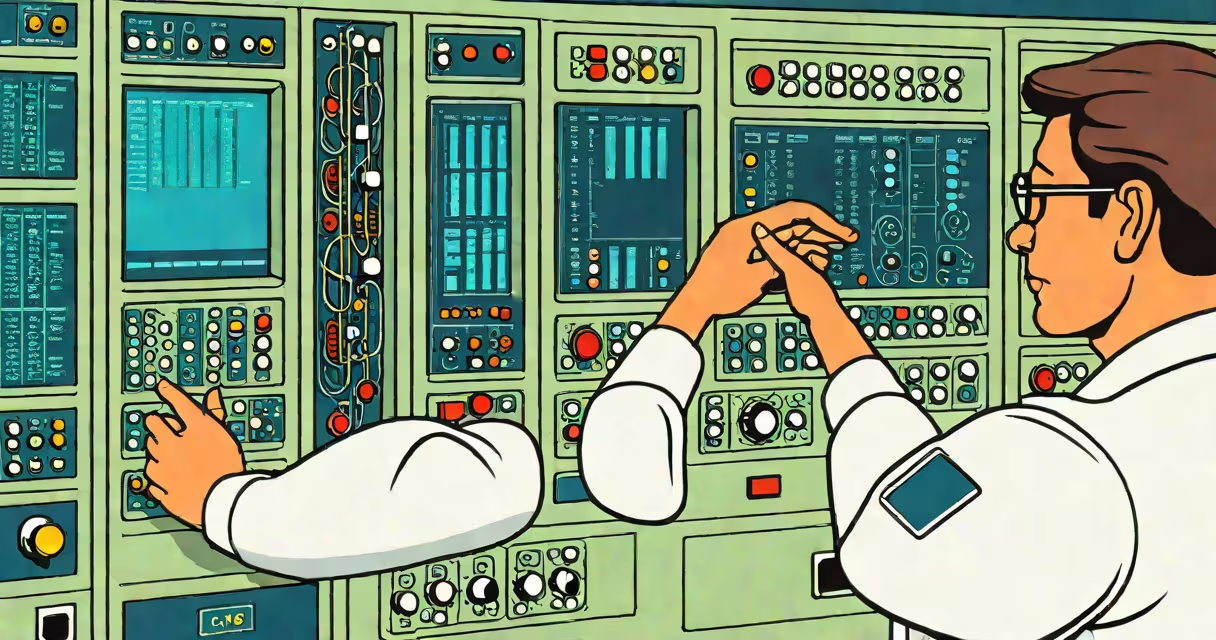
Sys dia meaning refers to system dialogue messages generated by embedded software or industrial control systems to communicate internal states, errors, or prompts. These codes appear during device startup, operation, or troubleshooting and serve as diagnostic signals for engineers and technicians.
These messages are typically numeric or alphanumeric sequences displayed on screens, logged in system files, or transmitted via serial interfaces. They are not designed for end users but for maintenance personnel who interpret them using reference manuals or databases.
For example, a CNC machine might display "SYS DIA 104" during boot-up. This indicates a sensor calibration failure in the X-axis encoder. A trained technician checks the machine's service manual and finds that "104" corresponds to "Encoder signal loss - axis 1." The correct response involves recalibrating the encoder or replacing the sensor cable.
System dialogue codes operate through firmware-level logic. When a component fails a self-check or detects an anomaly, the system logs the event and triggers a predefined message. These messages are stored in lookup tables within the device's ROM or flash memory.
Each code consists of a prefix (like "SYS DIA") followed by a unique identifier. The prefix signals the origin: "SYS" denotes system-level functions, "DIA" stands for dialogue or communication. Together, they indicate internal diagnostics.
Messages are processed in real time. If a temperature sensor exceeds safe limits, the system may send "SYS DIA 217" to the interface. The message appears within 50 milliseconds of the threshold breach, allowing immediate corrective action.
While specific formats vary by manufacturer, most sys dia messages follow a consistent structure:
| Format | Use Case | Example |
|---|---|---|
| Alphanumeric (e.g., SYS DIA 101) | General diagnostics | "Sensor timeout - channel 3" |
| Numeric only (e.g., 405) | Internal firmware logs | "Memory access fault - address 0x1F00" |
| Hexadecimal (e.g., 0x2A3) | Low-level debugging | "I/O port conflict - bus 2" |
Some systems use multi-line formats. For instance, a medical imaging device might output:
SYS DIA 302
Error: Image buffer overflow
Action: Reboot system and clear cache
This format includes a code, a human-readable description, and a recommended resolution-all structured for rapid interpretation under pressure.
These codes are standard in industrial automation, medical equipment, aerospace systems, and embedded devices. They reduce downtime by enabling quick fault identification.
In manufacturing, a PLC (programmable logic controller) uses "SYS DIA 506" to signal a failed relay in a motor control circuit. Maintenance teams respond faster because the code points directly to the faulty component, eliminating guesswork.
A 2021 study by the International Society of Automation found that systems using standardized diagnostic codes reduced mean time to repair (MTTR) by 37% compared to those relying solely on vague error messages. The study analyzed 1,200 industrial incidents across five countries.
Many assume sys dia meaning is interchangeable with user error messages. That's incorrect. User-facing alerts often use plain language ("Motor overheating - please stop"), while sys dia codes are precise, unambiguous identifiers meant for technical audiences.
Another myth: "All sys dia codes are universal." No. While some manufacturers adopt ISO/IEC 15045 standards for diagnostic messaging, most use proprietary systems. A "SYS DIA 104" on a Siemens PLC means something different than the same code on a Mitsubishi industrial drive.
One non-obvious fact: Some sys dia codes trigger automatic fail-safes. For example, "SYS DIA 801" in a nuclear reactor control system doesn't just report a coolant pump failure-it automatically isolates the affected loop and activates backup pumps. The code itself is part of the safety protocol.
During routine maintenance, a technician notices a robot arm freezing mid-motion. The control panel displays:
SYS DIA 612
Joint 4 torque overload - 125% limit exceeded
Check: Motor current draw, gear alignment
The technician cross-references the code with the manufacturer's troubleshooting guide. "612" indicates excessive resistance in joint 4. After inspecting the joint, they find a misaligned gear coupling. Replacing the coupling resolves the issue. The robot resumes operation within 18 minutes.
This scenario shows how sys dia meaning enables efficient problem-solving. Without the code, the technician might have checked motors, sensors, and wiring before identifying the mechanical fault.
I've used sys dia codes extensively in my work repairing automated packaging lines. Once, a "SYS DIA 309" error halted a bottling machine. The message read "Fill level sensor inconsistency - zone B." I discovered a clogged optical sensor due to resin buildup. Cleaning it restored normal function. The code saved hours of testing.
Confusion often arises between sys dia meaning and other diagnostic systems:
Understanding sys dia meaning requires knowing the context. A code like "SYS DIA 100" might mean "system ready" in one device and "memory corruption" in another. Always consult the official documentation.
When troubleshooting, start with the code, then verify against the device's manual or support database. Never assume based on similar codes in other systems.
Sys dia meaning is a structured language of machine health. It turns raw data into actionable insight. For anyone working with complex systems, mastering these codes is essential for reliability and safety.