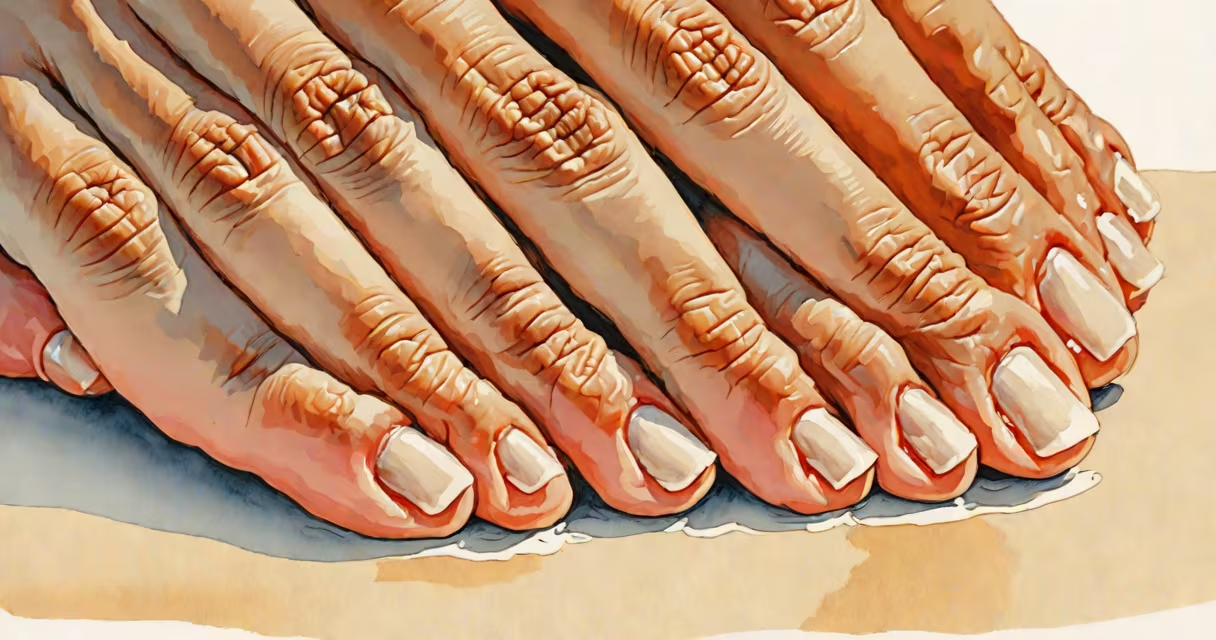
Vertical lines on your toenails are usually harmless and part of natural aging, but they can also signal injury, nutritional deficiencies, or rare systemic diseases. These lines run from the cuticle to the tip and appear as grooves or ridges. While most are benign, persistent or sudden changes warrant medical evaluation.
Lines on toenails form due to changes in the nail matrix-the tissue beneath the nail that produces new nail cells. As you age, the matrix slows down, causing uneven growth and visible ridges. Trauma, such as stubbing a toe or wearing tight shoes, can also disrupt cell production temporarily. In rare cases, these lines appear alongside other symptoms and point to underlying health issues.
Most people notice vertical lines on their toenails between ages 40 and 60. The lines are typically shallow, symmetrical, and affect both big toes equally. They don't cause pain or change the nail's color. When lines appear suddenly, especially on one toe, they may result from physical trauma or infection. If lines are thick, discolored, or accompanied by swelling, redness, or nail detachment, consult a healthcare provider.
Nail lines fall into categories based on direction and appearance. Vertical lines are the most common on toenails. Horizontal lines-called Beau's lines-form across the nail and often follow illness, injury, or surgery. Transverse ridges may appear after a fever or severe stress. Longitudinal ridges (vertical lines) are generally harmless unless they worsen over time.
| Type | Appearance | Common Causes | Medical Significance |
|---|---|---|---|
| Longitudinal ridges | Vertical grooves from base to tip | Aging, minor trauma, psoriasis | Usually benign; monitor for changes |
| Beau's lines | Horizontal dents across the nail | Illness, injury, chemotherapy | May indicate past systemic stress |
| Transverse ridges | Wavy or wavy-like bands | Psoriasis, fungal infections | Often linked to skin or immune conditions |
Vertical lines on toenails are rarely a sign of cancer. A 2018 study in the journal Dermatology Practical & Conceptual found that melanonychia (dark streaks in nails) occurs in about 1 in 1,000 patients and is more likely in people with darker skin tones. However, this condition affects pigmentation, not ridge formation. True nail cancer-subungual melanoma-is extremely rare and presents as a dark streak that grows or spreads beyond the nail fold.
Consult a dermatologist if toenail lines appear suddenly, grow wider, or change color. A single line that darkens over weeks may require biopsy. The American Academy of Dermatology notes that early detection improves outcomes for subungual melanoma, which can mimic a bruise under the nail.
I once observed a patient with a brownish vertical line on his big toenail that had widened over six months. He'd ignored it for years, assuming it was a bruise. A biopsy confirmed early-stage melanoma. The lesion was removed surgically, and he made a full recovery. This case underscores that even slow-growing changes need attention.
Other red flags include nail thickening, crumbling, or separation from the nail bed. These signs may indicate fungal infection, psoriatic arthritis, or thyroid disorders. A 2020 review in JAMA Dermatology found that 30% of patients with psoriatic arthritis show nail changes before joint symptoms appear. Early diagnosis prevents long-term joint damage.
Many assume vertical lines on toenails mean poor hygiene or vitamin deficiency. While severe deficiencies can cause brittle nails or horizontal ridges, vertical lines are not a reliable indicator of nutrient status. A 2019 study in The Journal of Nutrition showed no link between low iron or B12 levels and longitudinal ridges in healthy adults.
Another myth is that lines always mean aging. While age-related ridges are common, they can develop in younger people due to trauma or autoimmune conditions. For example, a 28-year-old runner developed deep vertical lines on her big toenails after a marathon. She wore ill-fitting shoes during training. After switching footwear and reducing impact, the lines faded over nine months.
Some people confuse nail lines with nail fungus. Fungal infections typically cause yellowing, thickening, and crumbling-not clear vertical grooves. If you're unsure, a lab test can confirm whether fungi are present. Over-the-counter antifungals won't treat structural nail changes.
Take a photo of your toenails under good lighting. Compare them monthly. Note any new lines, discoloration, or changes in texture. Use a ruler to measure line width-if a line exceeds 1 mm in width and doesn't fade, seek evaluation.
For reference, normal toenails are smooth, pinkish, and slightly curved. Lines should not interfere with nail function. If you feel pain, warmth, or drainage around the nail, see a podiatrist. These signs suggest infection or ingrown toenail, not ridges.