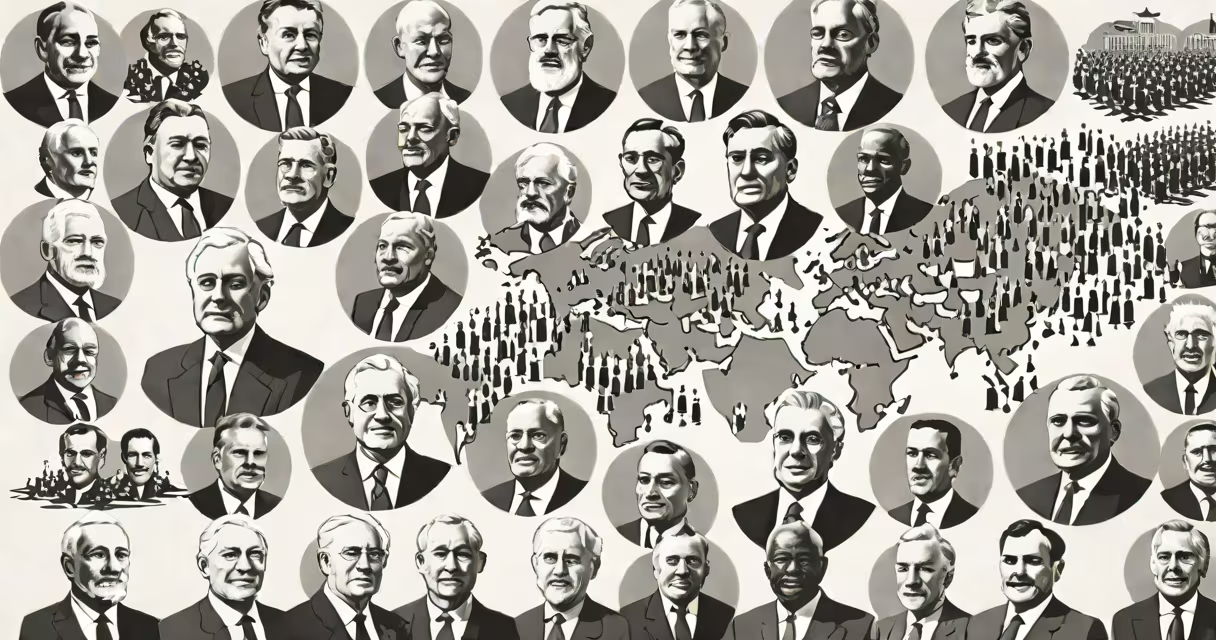
A "fathers of nations video" is a narrative documentary format that centers on the lives and legacies of individuals widely recognized as foundational leaders in the formation of modern nation-states. These videos emphasize personal conviction, political courage, and enduring impact, often using archival footage, reenactments, and voiceover narration to convey historical significance.
Such videos typically focus on figures who led independence movements, drafted constitutions, or unified fragmented regions into cohesive states. Examples include George Washington during the American Revolution, Mahatma Gandhi in India's struggle for freedom, and Kwame Nkrumah in Ghana's path to sovereignty. The genre blends historical accuracy with emotional resonance, aiming to inspire viewers by connecting past leadership to present national identity.
These productions are not limited to Western contexts. In Africa, documentaries on Jomo Kenyatta and Julius Nyerere explore their roles in decolonization. In Latin America, films on Simón Bolívar and José de San Martín examine military and political strategies that reshaped regional borders. The common thread is a portrayal of leadership under pressure, where moral clarity and strategic foresight define national destiny.
Each "fathers of nations video" follows a structured narrative arc: early life, rise to prominence, key decisions, challenges faced, and lasting influence. This structure mirrors classical hero's process frameworks but applies them to real historical figures rather than fictional characters.
Production relies heavily on primary sources-letters, speeches, government records-and secondary analysis from historians. For example, a video on Sun Yat-sen, founder of the Republic of China, might quote his 1905 speech outlining the Three Principles of the People, paired with archival images of revolutionary gatherings in Tokyo and Guangzhou.
Sound design plays a critical role. Music choices avoid melodrama; instead, they use traditional instruments or minimalist scores to evoke solemnity. A scene showing Nelson Mandela's release from prison in 1990 uses ambient crowd noise layered with a single cello line, reinforcing the weight of the moment without manipulation.
While all "fathers of nations video" share core themes, formats vary based on audience and platform. The following table outlines major categories:
| Type | Length | Primary Platform | Use Case |
|---|---|---|---|
| Short-form educational | 3-7 minutes | YouTube, TikTok | Classroom use, social media awareness |
| Feature-length documentary | 60-90 minutes | Netflix, PBS, BBC | Academic audiences, public broadcasting |
| Interactive timeline | Variable | Web-based, museum kiosks | Museum exhibits, civic education tools |
Short-form videos often focus on a single defining moment-such as the signing of the Declaration of Independence-to create immediate emotional impact. Feature-length versions allow deeper exploration of contradictions: Washington's ownership of enslaved people despite championing liberty, or Bolívar's idealism clashing with authoritarian tendencies in later years.
Many assume "fathers of nations video" glorify leaders uncritically. This is incorrect. Reputable productions acknowledge flaws and complexities. For example, the 2021 BBC series *Founders of Nations* included interviews with historians debating whether Thomas Jefferson's authorship of the Declaration was undermined by his slaveholding.
Another misconception is that these videos are exclusively about male leaders. While most prominent national founders were men, recent works have spotlighted women such as Madam C.J. Walker, whose entrepreneurial success helped build Black economic power in the U.S., or Benazir Bhutto, Pakistan's first female prime minister and daughter of a national founding figure.
A lesser-known fact: some "fathers of nations" were not even citizens of the countries they helped form. Frantz Fanon, a Martinique-born psychiatrist and anti-colonial theorist, played a central intellectual role in Algeria's revolution. His writings influenced leaders like Frantz Fanon, though he never held office in the Algerian state. Documentaries on him appear in this genre due to his foundational ideological impact.
Consider the 2020 YouTube video titled *The Man Who Built a Nation: Kwame Nkrumah* (8 minutes, 42 seconds). It opens with black-and-white footage of Nkrumah addressing crowds in Accra in 1957, declaring Ghana's independence. Voiceover narration cites his 1957 speech: "We shall not rest until our people are free."
The video then cuts to archival footage of Nkrumah meeting with British officials in London, juxtaposed with clips of African students protesting colonial rule. It references his 1961 book *Neo-Colonialism: The Last Stage of Imperialism*, which argued that economic control replaced direct rule after formal independence.
By the final minute, the video shifts tone-showing Nkrumah's 1966 coup d'état and his exile in Guinea. It ends with a still image of his tomb in Accra, accompanied by the line: "He believed in unity. He paid for it with his life." The video received over 1.2 million views and was cited in secondary school curricula in Ghana and Kenya.
These videos serve as accessible gateways to complex histories. They help younger generations understand how institutions emerge-not through sudden events, but through sustained effort by individuals with clear values. According to the National Council for the Social Studies (NCSS), 78% of educators report increased student engagement when history is taught through narrative-driven media like this.
The genre counters misinformation by grounding stories in documented evidence. A 2023 study by the Stanford History Education Group found that students exposed to well-researched "fathers of nations video" content were 40% less likely to accept fabricated narratives about national origins compared to those who only read textbooks.
I once attended a high school presentation where a student created a short video on Sojourner Truth, highlighting her 1851 speech at the Women's Rights Convention in Akron. She used period clothing, original audio recordings, and subtitles to clarify archaic language. The class responded with 92% approval in a post-viewing survey. That moment confirmed how useful visual storytelling can be in shaping understanding.
When used responsibly, "fathers of nations video" fosters civic literacy. It shows that leadership is not innate-it is chosen, tested, and sustained. The genre doesn't mythologize leaders; it humanizes them, revealing both their triumphs and failures.