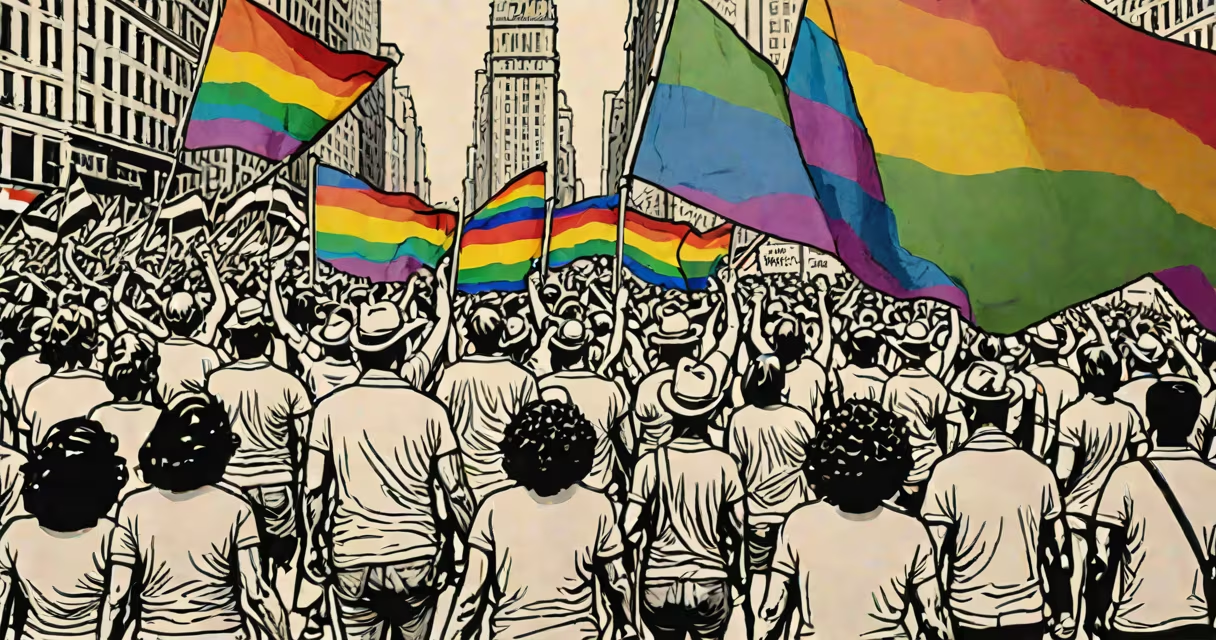
Pride Month began in June 1970 as a direct response to the 1969 Stonewall Uprising, a series of protests by LGBTQ+ people against police raids at the Stonewall Inn in New York City. The first Pride march was held on June 28, 1970, marking the one-year anniversary of the riots. This event established the foundation for annual LGBTQ+ visibility and political action.
The term "Pride" emerged from the civil rights movements of the 1960s. Activists rejected shame and silence, choosing public expression as resistance. The Stonewall Uprising galvanized a new generation of organizers who saw sustained protest as essential to securing rights. The first Pride march, organized by the Gay Liberation Front, drew around 5,000 people through Manhattan. It was not a celebration in the modern sense-it was a demonstration demanding dignity, safety, and legal protection.
By 1972, Pride events had spread to cities like San Francisco, Los Angeles, and Chicago. These gatherings were often met with hostility-police surveillance, arrests, and counter-protests were common. Despite this, organizers persisted. The movement grew through grassroots organizing, community networks, and alliances with labor and anti-war groups. Pride became a way to build solidarity across regions and identities.
Today, Pride Month is marked by parades, rallies, art exhibitions, educational programs, and corporate sponsorships. Events occur in over 150 countries annually. In the United States, the White House has hosted Pride events since 2009. Cities like Toronto, Berlin, and Sydney host large-scale celebrations drawing hundreds of thousands.
Organizations such as the Human Rights Campaign and GLAAD coordinate national campaigns. They provide toolkits for schools, businesses, and local governments to host inclusive programming. Local Pride committees manage logistics-permits, security, vendor coordination, and outreach to underrepresented communities within the LGBTQ+ spectrum.
Despite its scale, Pride remains rooted in activism. The 2016 Pulse nightclub shooting in Orlando led to renewed focus on violence against queer people of color. In 2020, Black Lives Matter protests intersected with Pride, prompting calls for racial equity within LGBTQ+ spaces. These moments show that Pride is not static-it adapts to current struggles.
Pride Month is composed of multiple elements: historical remembrance, political advocacy, cultural expression, and personal affirmation. The rainbow flag, designed by Gilbert Baker in 1978, symbolizes diversity and inclusion. Each color represents a value-red for life, orange for healing, yellow for sunlight, green for nature, blue for harmony, and violet for spirit.
Events vary by location. In New York, the main parade runs along Fifth Avenue. In smaller towns, Pride may consist of a single block party or a community dinner. Some cities hold silent vigils for those lost to HIV/AIDS. Others feature drag performances, film screenings, or youth workshops on consent and identity.
| Type of Event | Typical Audience | Example Location |
|---|---|---|
| Parade | General public, families, tourists | New York City, USA |
| Community Forum | LGBTQ+ individuals, allies, activists | Portland, Oregon |
| Youth Workshop | Students, educators, parents | Denver, Colorado |
| Memorial Service | Survivors, grief counselors, faith leaders | San Francisco, California |
June was chosen because it marks the anniversary of the Stonewall Uprising. The month's dates align with the first Pride marches, making it a symbolic anchor. The U.S. Congress officially recognized June as Pride Month in 2009. Since then, every president has issued a Pride Month proclamation.
Other countries adopted the tradition independently. Canada began celebrating in 1971. Germany launched its first nationwide Pride in 1979. In 2019, Nigeria's Supreme Court ruled that same-sex relationships are protected under constitutional rights-sparking a quiet Pride movement despite ongoing legal challenges.
Non-Western nations face unique risks. In Uganda, Pride events have been banned since 2014. In Russia, public displays of LGBTQ+ identity are illegal under laws restricting "homosexual propaganda." Despite this, underground Pride events continue-often held online or in private homes.
Pride Month is not a celebration of individual identity alone. It is a political act. The original 1970 march demanded the end of sodomy laws, job discrimination, and state violence. Modern Pride still addresses systemic issues: housing instability among transgender youth, high rates of mental health crises in LGBTQ+ communities, and global anti-LGBTQ+ legislation.
Another myth: Pride is only for gay men. The movement includes bisexual, pansexual, queer, intersex, and asexual people. The 1970 march included trans women of color like Marsha P. Johnson and Sylvia Rivera-key figures whose contributions were long overlooked. Their presence underscores that Pride is intersectional by design.
A lesser-known fact: the first Pride march was not planned as a festival. Organizers feared backlash. They distributed flyers at bars, churches, and student centers. Attendance was uncertain until the morning of June 28. When the crowd reached 5,000, the momentum shifted. That moment proved collective action could survive repression.
In 2015, I attended the Portland Pride Parade. I wore a handmade banner reading "Trans Lives Matter." As the float passed, a young girl pointed and said, "That's my teacher." Her mother smiled and said, "She's brave." That exchange stayed with me. Pride is not just about visibility-it's about recognition. It's about saying, "I exist, and I belong."
Research shows that LGBTQ+ youth who attend Pride events report lower levels of depression and higher self-esteem. A 2021 study by the Trevor Project found that 74% of LGBTQ+ teens felt safer after participating in Pride activities. The emotional impact is measurable-and cumulative.
For context: the 1970 Pride march covered 5 miles from Greenwich Village to Central Park. Today, the NYC Pride March stretches over 10 miles and attracts over 2 million attendees. The growth reflects both progress and persistence. The fight continues-not just for rights, but for dignity.