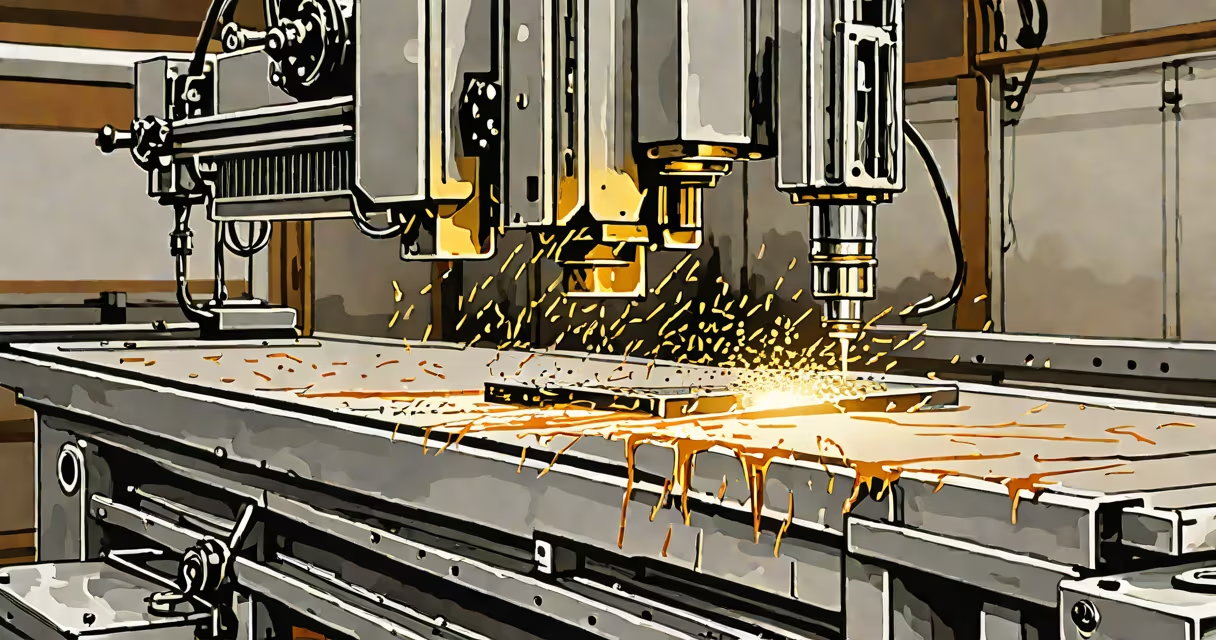
CNC work refers to the automated manufacturing process where computer-controlled machines cut, shape, or engrave materials like metal, plastic, or wood based on digital blueprints. These machines follow programmed instructions-typically G-code-to execute precise movements with repeatability and accuracy beyond human capability.
The term "CNC" stands for Computer Numerical Control. Unlike manual machining, which relies on operator skill and physical tools, CNC work uses software to direct machine tools such as lathes, mills, routers, and grinders. This automation enables consistent output across hundreds or thousands of identical parts.
For example, a CNC mill can produce 500 identical brackets for a drone frame, each within ±0.005 inches tolerance-impossible to achieve consistently by hand. The process begins with a CAD model, converted into machine-readable code via CAM software, then executed by the CNC controller.
CNC work follows a sequence: design, programming, setup, execution, and inspection. A designer creates a 3D model using CAD software like SolidWorks or Fusion 360. That model is imported into CAM software, which generates toolpaths-specific routes the cutting tool takes-and outputs G-code, the language machines understand.
The G-code is loaded onto the CNC machine's controller. Before running, operators secure the raw material (called stock) and calibrate the tool position using a probe or manual touch-off. Once started, the machine moves along X, Y, and Z axes, removing material layer by layer until the part matches the design.
A real-world example: a custom prosthetic limb component was machined from titanium using a 5-axis CNC mill. The design required complex curves and internal channels. The CAM software optimized tool angles to prevent tool collision and reduce vibration. After 4 hours of continuous operation, the part met ISO 13485 standards for medical implants.
Different CNC machines serve distinct purposes based on their motion capabilities and tool types. The most common include:
| Machine Type | Axis Motion | Common Materials | Typical Applications |
|---|---|---|---|
| CNC Mill | 3 to 5 axes | Aluminum, steel, plastics | Engine blocks, molds, aerospace components |
| CNC Lathe | 2 to 4 axes | Steel, brass, titanium | Shafts, bolts, turbine parts |
| CNC Router | 3 to 6 axes | Wood, foam, composites | Furniture, signage, architectural models |
| CNC Plasma Cutter | 2 axes | Sheet metal | Signs, enclosures, automotive trim |
Five-axis machines offer the highest flexibility. They rotate the tool and workpiece simultaneously, allowing cuts on complex surfaces without repositioning. For instance, a turbine blade for jet engines requires five-axis milling to maintain aerodynamic precision across curved airfoils.
Some shops use hybrid systems-like CNC machines with integrated laser marking or automatic tool changers. These reduce cycle times and improve throughput in high-volume production.
Many assume CNC work is entirely autonomous. In reality, skilled technicians oversee every stage. A single error in G-code can cause catastrophic tool breakage or scrap material. One shop reported losing $8,000 in aluminum stock due to a misplaced decimal in a toolpath file.
Another myth is that CNC machines replace human labor. While they automate repetitive tasks, they require constant monitoring, maintenance, and troubleshooting. A machinist must interpret error codes, adjust feeds and speeds, and verify part dimensions after each run.
Also, people often confuse CNC work with 3D printing. Both create physical objects from digital files, but they differ fundamentally. CNC removes material (subtractive manufacturing), while 3D printing adds layers (additive manufacturing). A CNC-machined aluminum gear has higher strength and tighter tolerances than a 3D-printed version-even if both look similar.
I designed and fabricated a carbon-fiber-reinforced polymer drone frame using CNC routing. The process began with a 2D sketch in AutoCAD, exported to a CAM program that generated toolpaths for a 3-axis router. I used a 6mm end mill at 12,000 RPM with a feed rate of 200 mm/min.
After setting the material flat and zeroing the Z-axis, the machine ran for 37 minutes. Final inspection revealed a 0.02mm deviation from the original model-well within acceptable limits. The frame passed stress tests under 15G loads during flight simulations.
This project showed how CNC work balances precision, speed, and material integrity. Without it, producing lightweight, durable drone frames at scale would be impractical.
CNC work underpins modern industry. According to the U.S. Bureau of Labor Statistics, over 2 million jobs in manufacturing rely on CNC operations. The National Institute of Standards and Technology (NIST) reports that CNC machining accounts for 78% of precision part production in aerospace and defense sectors.
Its role extends beyond factories. Artists use CNC routers to carve complex sculptures. Architects employ CNC milled models to test building designs. Even food producers use CNC-controlled slicers to ensure uniformity in products like cheese or meat jerky.
Understanding what is cnc work isn't just about technical specs-it's about recognizing how digital control enables physical creation at scale. From microchip substrates to satellite components, CNC work shapes the tangible world we interact with daily.
When you see a perfectly shaped engine part, a detailed architectural model, or a custom jewelry piece, consider the invisible code behind it. That's what is cnc work: the silent force turning ideas into reality with unmatched consistency.