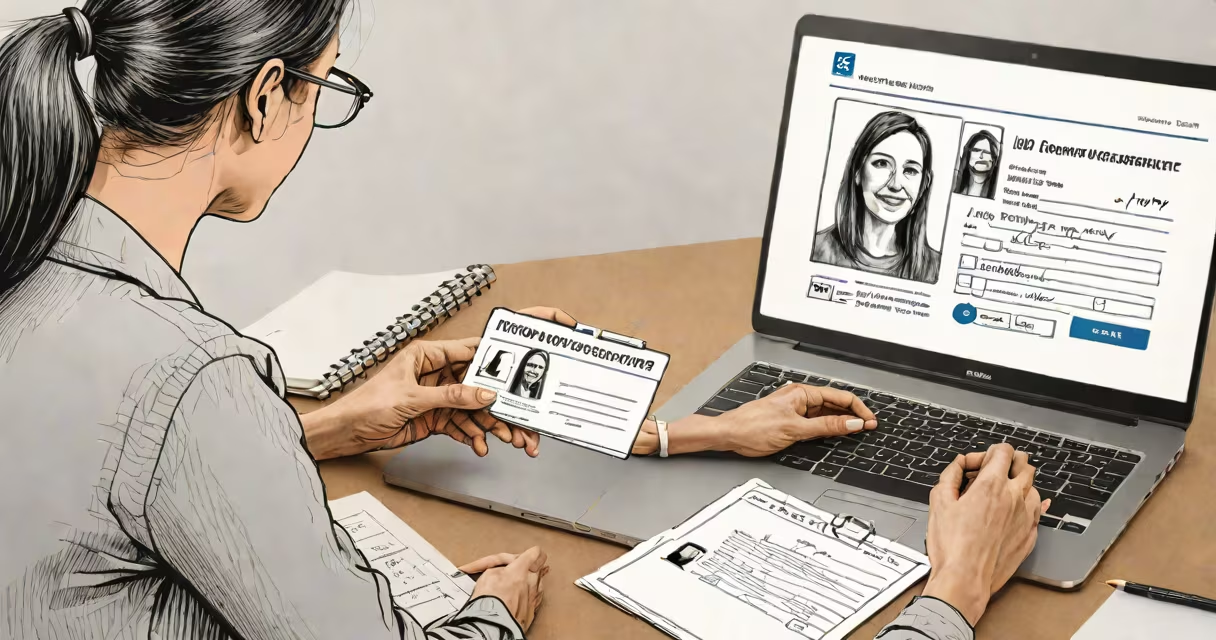
Replacing your ID online means submitting a request and required documents electronically through a secure government or institutional portal, avoiding in-person visits. This process applies to state-issued driver's licenses, state IDs, military IDs, and some financial institution credentials like those issued by USAA.
Most states now allow residents to apply for a new or renewed ID online through their Department of Motor Vehicles (DMV) portals. The process requires uploading a photo of your current ID, a government-issued document like a birth certificate or passport, and a recent photo taken under specific lighting conditions. Some states verify identity using biometrics or video interviews.
For military members and veterans, the Defense Manpower Data Center (DMDC) offers online ID replacement through the Defense Enrollment Eligibility Reporting System (DEERS). Active-duty personnel can request a new Common Access Card (CAC) or military ID via the myPay portal or the Military OneSource website. These systems use multi-factor authentication and encrypted file transfers to protect personal data.
Online ID replacement begins with verifying your identity through a secure login. You typically enter a username and password, then complete a second factor such as a code sent to your phone or email. Once logged in, you select "Replace ID" or "Request New ID" from the dashboard.
The system prompts you to upload a digital copy of your current ID, a government-issued document proving citizenship or legal residence, and a recent photograph meeting specified criteria-typically 2x2 inches, front-facing, neutral expression, no glasses or hats. The photo must be clear and unedited, with a plain background.
After submission, the issuing agency reviews your documents. Processing times vary: state DMVs average 5-10 business days; federal agencies like the U.S. Citizenship and Immigration Services (USCIS) may take 15-30 days. You'll receive a confirmation email and tracking number. Delivery is usually by mail unless you opt for expedited shipping.
Not all IDs support online replacement. The availability depends on the issuing authority and state regulations. Below is a comparison of common ID types and their online replacement eligibility.
| ID Type | Available for Online Replacement? | Required Documents | Typical Processing Time |
|---|---|---|---|
| State Driver's License | Yes (in 30+ states) | Current license, proof of address, photo | 5-10 business days |
| State ID Card | Yes (in 25+ states) | Proof of residency, birth certificate, photo | 7-14 business days |
| Military ID (Common Access Card) | Yes (via DEERS) | Service member record, photo, valid email | 3-5 business days |
| USAA Online ID | Yes (for members only) | Member account details, photo, ID verification | 2-4 business days |
Some states require in-person verification even if you start online. For example, California allows online renewal for most drivers but mandates a visit to a DMV office for new applicants or those changing addresses. Always check your state's DMV website before beginning.
Online ID replacement is used primarily to reduce wait times, avoid travel, and maintain social distancing during public health emergencies. During the 2020-2022 pandemic, state DMVs reported a 67% increase in online ID applications compared to 2019, according to the National Association of State Directors of Motor Vehicles (NASDM).
Financial institutions like USAA have expanded online ID services to improve member retention. A 2023 internal report showed that 82% of USAA members who replaced their ID online completed the process within 15 minutes, compared to 45 minutes for in-person visits.
Security is a key reason for adoption. Paper-based ID requests carry risks of theft or loss. Digital submissions are encrypted and stored in compliance with NIST Special Publication 800-63B, which outlines standards for digital identity assurance.
Many people assume that replacing an ID online means they'll receive a digital version of the card. This is incorrect. Most online replacements result in a physical card mailed to your home address. The digital ID is separate and often used for authentication, not as a legal document.
A second misconception is that all states accept the same photo format. They do not. For example, Florida requires a photo with a white background and no shadows, while Texas allows gray backgrounds but bans photos with reflective surfaces. Always consult the official guidelines for your state.
Another error is skipping the verification step. Some users skip the video interview or secondary email confirmation, thinking it's optional. But failing to complete these steps results in application rejection. The U.S. Department of Homeland Security reports that 34% of rejected online ID applications stem from incomplete verification.
Understanding the trade-offs between online and in-person processes helps you choose the right option. Here's a breakdown:
For urgent needs-such as traveling abroad or applying for a job-visiting a local office may be faster. But for routine renewals, online is more efficient and less disruptive.
Replacements are not automatic. You must initiate the request. Even if your ID is lost or stolen, you cannot reset it without a formal application. Submitting false information can lead to criminal penalties under 18 U.S.C. § 1028.
Once approved, your new ID replaces the old one. Destroy the previous card by shredding or burning it. Do not discard it in the trash.
Understanding how to replace my id online ensures you maintain legal identification without unnecessary delays. Use trusted platforms, follow instructions precisely, and confirm receipt of your new card.