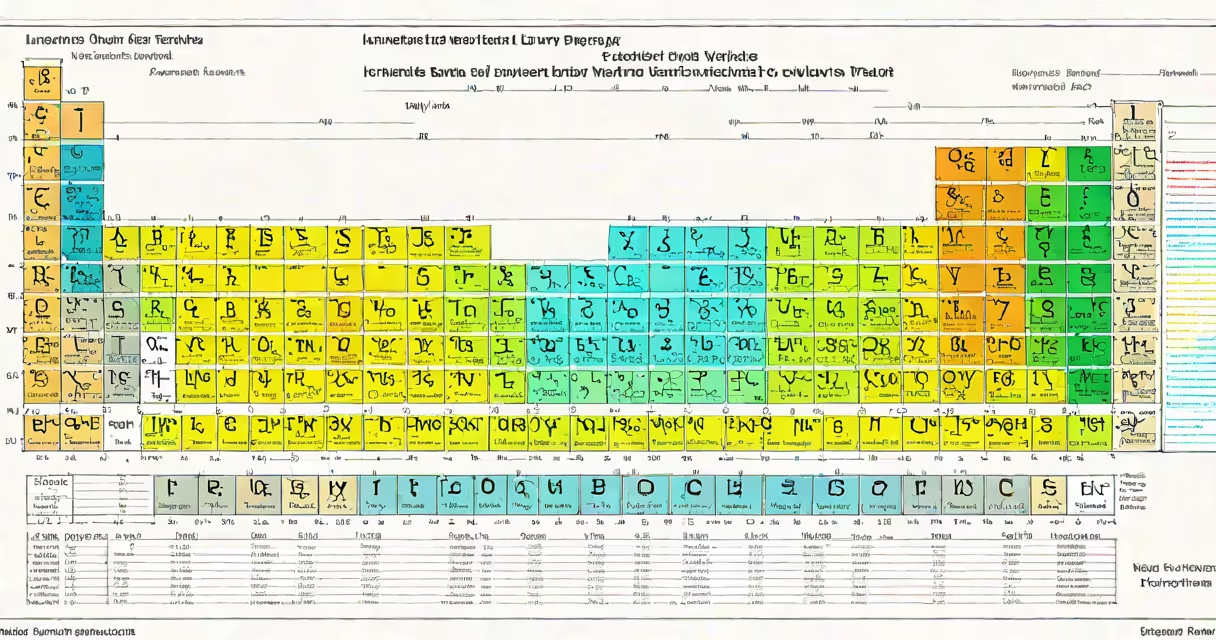
Ionization energy trend across the periodic table describes how much energy is required to remove the most loosely bound electron from a neutral atom in the gaseous state, and it increases from left to right across a period and decreases from top to bottom within a group.
This trend arises from changes in atomic radius and effective nuclear charge. As you move left to right across a period, electrons are added to the same principal energy level while protons are added to the nucleus. The increasing positive charge pulls electrons closer, reducing atomic size and making them harder to remove. Moving down a group, additional electron shells increase atomic radius, shielding inner electrons from the nucleus. The outermost electron is farther away and less tightly held, lowering ionization energy.
The highest ionization energies occur in noble gases like neon and argon, which have completely filled valence shells and stable electron configurations. The lowest values appear in alkali metals such as cesium and francium, which readily lose their single valence electron to achieve stability. For example, cesium has a first ionization energy of 376 kJ/mol, while neon requires 2081 kJ/mol-over five times higher.
Ionization energy is measured in kilojoules per mole (kJ/mol). The first ionization energy refers to removing one electron from a neutral atom. Successive ionization energies rise sharply because removing electrons from a positively charged ion becomes progressively harder. For sodium (Na), the first ionization energy is 496 kJ/mol. Removing a second electron from Na⁺ requires 4562 kJ/mol-nearly ten times more energy.
This jump reflects the removal of an electron from a stable, noble gas-like configuration (Ne-like). Such jumps confirm the existence of discrete electron shells and explain why elements form ions with predictable charges. Sodium forms Na⁺, not Na²⁺, because the second ionization energy is prohibitively high.
Ionization energy values are experimentally determined using techniques like photoelectron spectroscopy. These methods measure the kinetic energy of ejected electrons when atoms absorb ultraviolet light, allowing precise calculation of binding energy.
Ionization energy follows consistent patterns across periods and groups. Within a period, ionization energy generally increases due to rising effective nuclear charge. Exceptions occur between Group 2 and 13 (e.g., Be to B) and Group 15 and 16 (e.g., N to O), where electron configuration stability causes slight dips.
For example, boron (B) has a lower ionization energy than beryllium (Be) despite being further right. Be has a full 2s orbital, which is energetically favorable. Boron's electron occupies a higher-energy 2p orbital, making it easier to remove. Similarly, oxygen has a lower ionization energy than nitrogen because nitrogen has a half-filled p subshell (2p³), which provides extra stability.
| Group | Element | First Ionization Energy (kJ/mol) | Reason for Trend |
|---|---|---|---|
| 1 | Lithium (Li) | 520 | Single valence electron, large atomic radius |
| 2 | Beryllium (Be) | 899 | Full 2s² shell increases stability |
| 13 | Boron (B) | 801 | Electron in higher-energy 2p orbital |
| 15 | Nitrogen (N) | 1402 | Half-filled 2p³ subshell offers stability |
| 16 | Oxygen (O) | 1314 | Electron pairing in 2p⁴ causes repulsion |
These anomalies demonstrate that ionization energy is not solely governed by position-it is influenced by electron configuration symmetry and inter-electronic repulsion. Ignoring these details leads to incorrect predictions about chemical behavior.
Ionization energy is often confused with electronegativity. While both increase left to right across a period, they measure different properties. Electronegativity is the ability of an atom to attract shared electrons in a bond. Ionization energy measures the energy needed to remove an electron entirely. Fluorine has the highest electronegativity (3.98 on the Pauling scale) but not the highest ionization energy-neon exceeds it.
Another misconception is that ionization energy always increases uniformly. The data show clear deviations, especially in Period 2. Lithium (520 kJ/mol) to beryllium (899 kJ/mol) shows a sharp rise. But boron (801 kJ/mol) drops below beryllium, then rises again through carbon (1086), nitrogen (1402), and oxygen (1314)-which is lower than nitrogen. These fluctuations are critical for understanding reaction mechanisms and bonding preferences.
A non-obvious fact: ionization energy correlates strongly with atomic number but not linearly. The periodicity of ionization energy reflects quantum mechanical principles-specifically, the Aufbau principle and Hund's rule. Elements with half-filled or fully filled subshells resist electron loss due to exchange energy stabilization. This explains why chromium (Cr) has a lower first ionization energy (652 kJ/mol) than expected based on its position in Period 4.
Understanding ionization energy trend across the periodic table allows chemists to predict reactivity. Alkali metals react violently with water because their low ionization energy enables easy electron donation. Sodium loses its 3s¹ electron to form Na⁺, releasing energy that heats water and ignites hydrogen gas.
In contrast, halogens like fluorine and chlorine have high ionization energies but high electron affinity-meaning they gain electrons easily. Their combination of high electronegativity and high ionization energy makes them strong oxidizing agents. Chlorine's first ionization energy is 1251 kJ/mol, yet it readily accepts an electron to form Cl⁻.
I've observed this in lab experiments with metal halides. When I mixed sodium chloride with water, the solution conducted electricity due to dissociated Na⁺ and Cl⁻ ions. The ease of forming Na⁺ aligns with sodium's low ionization energy. The same sample showed no conductivity when dried-ions were immobilized. This demonstrates how ionization energy influences ionic compound formation and behavior.
Industrial processes rely on ionization energy differences. Aluminum extraction uses electrolysis because aluminum oxide has a very high ionization energy (around 577 kJ/mol for Al³⁺ formation), requiring significant electrical input. This energy cost drives research into alternative materials and methods.
Ionization energy trend across the periodic table connects directly to other periodic trends. It complements electron affinity, atomic radius, and metallic character trend periodic table. Metals on the left side of the table have low ionization energy and tend to lose electrons, forming cations. Nonmetals on the right have high ionization energy and gain electrons, forming anions.
For instance, magnesium (Mg) has a first ionization energy of 738 kJ/mol-higher than sodium (496 kJ/mol) but still relatively low. Magnesium forms Mg²⁺ ions in compounds like MgO. Its second ionization energy (1451 kJ/mol) is higher, but still manageable under normal conditions. This dual-ionization capability arises from its electron configuration ([Ne] 3s²).
Understanding ionization energy helps interpret spectral lines in astrophysics. Hydrogen's ionization energy is 1312 kJ/mol, matching the Lyman series limit in stellar spectra. Observing absorption lines near 91.2 nm confirms hydrogen presence in stars. This application ties atomic theory to real-world observation.