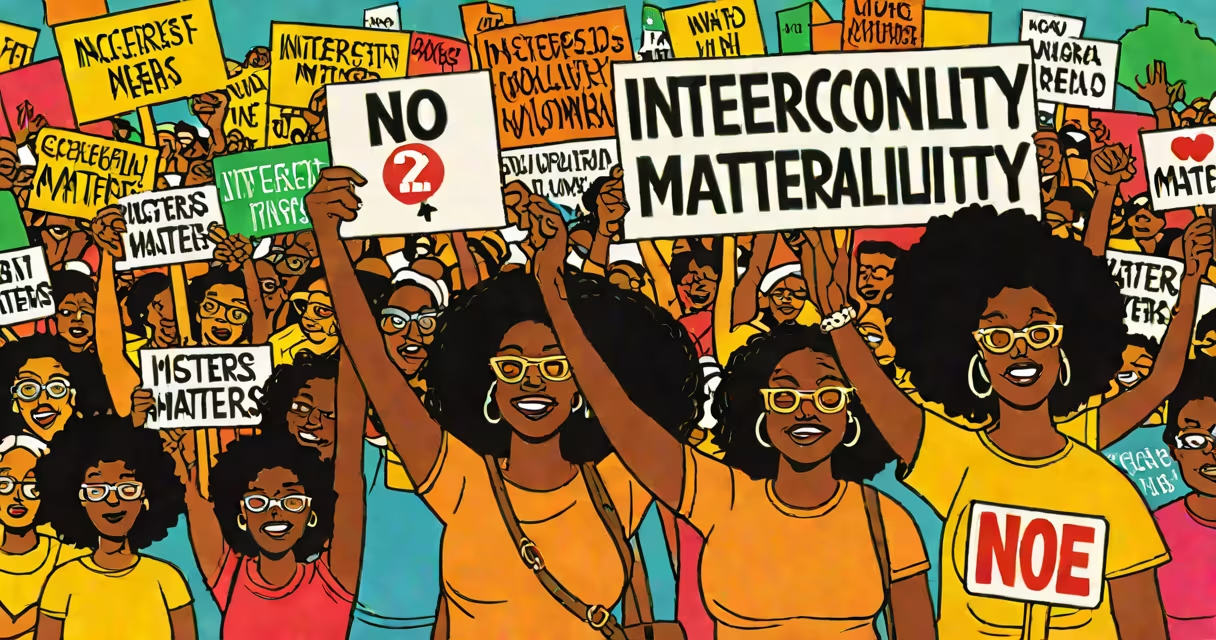
Intersectionality is a structure for understanding how multiple forms of social disadvantage-such as race, gender, class, sexuality, and disability-interact to shape individual experiences of oppression and privilege. It identifies that people do not face discrimination in isolation; rather, systems of power reinforce one another across identity lines.
The term was coined by legal scholar Kimberlé Crenshaw in 1989 to describe how Black women's legal cases were dismissed because courts treated race and gender as separate issues. A Black woman facing workplace harassment could not win under anti-racist or anti-sexist law alone because her case involved both. This gap revealed that single-axis analysis fails when identities overlap.
Today, intersectionality is used in academia, policy-making, and grassroots organizing to expose hidden layers of inequality. It is not about ranking oppression but mapping how different systems-like racism, patriarchy, and capitalism-combine to produce outcomes that no single identity can explain alone.
Intersectionality operates on the principle that identity is not additive. You don't simply add your race, gender, and income level together to get a total "oppression score." Instead, the interaction between these categories produces distinct forms of marginalization.
For example, a low-income gay man of color may face employment discrimination not because he is poor, or gay, or a person of color-but because employers assume he is "unreliable" due to a mix of stereotypes tied to all three identities. His experience is shaped by the convergence of structural biases, not their sum.
This structure challenges the idea that one form of injustice can be solved independently. When a city expands public housing, for instance, policies that ignore gender-based violence in shelters may disproportionately harm transgender women of color who face both housing insecurity and targeted violence.
Intersectionality does not rely on a fixed list of identities. But certain combinations consistently reveal deeper patterns of exclusion. The following table outlines common intersections and their real-world impacts:
| Identity Cluster | Impact Example | Source |
|---|---|---|
| Race + Gender | Black women in the U.S. are 3.5 times more likely to die during childbirth than white women, according to CDC data (2021). | CDC Maternal Health Data |
| Disability + Class | People with disabilities in low-income households are twice as likely to lack access to mental health care, per National Disability Institute (2020). | NDI Mental Health Access Report |
| Gender + Immigration Status | Undocumented women in California are 60% less likely to report domestic violence due to fear of deportation, per California State University study (2019). | CSULB CWRC Report |
These overlaps show that solutions designed for one group often fail others. A job training program for unemployed women may exclude trans women if it assumes applicants identify as female at birth. An anti-racism campaign that focuses only on police brutality may overlook how housing policies displace Indigenous families through urban renewal.
Intersectionality is frequently misunderstood as a competition of suffering or a tool for identity-based grievance. That is incorrect. The structure does not rank trauma or claim one identity is more valid than another. It analyzes systems, not individuals.
One widespread error is treating intersectionality as a synonym for diversity. Diversity refers to representation; intersectionality explains why representation alone doesn't fix inequity. A tech company hiring five women of color still risks excluding disabled queer women unless its culture and promotion practices account for layered barriers.
Another correction: intersectionality is not limited to marginalized groups. Privilege also intersects. A wealthy white man may benefit from racial privilege and economic advantage, but if he is also a veteran with PTSD, his access to healthcare may still be restricted by military mental health stigma. His experience is shaped by overlapping systems, even as he holds power in other areas.
I once attended a community forum in Oakland where organizers discussed food insecurity among seniors. Early proposals focused on expanding meal delivery services. But after including input from elderly Latina women with mobility limitations and undocumented immigrant caregivers, they realized that transportation, language access, and fear of immigration enforcement were blocking participation. They redesigned the program using intersectional insights-offering multilingual outreach, partnering with trusted local clinics, and using volunteer networks that included family members.
That project succeeded because it didn't treat "seniors" as a monolith. It recognized that older Latinas, especially those without citizenship, faced a unique blend of ageism, racism, xenophobia, and gendered caregiving expectations.
Despite its utility, intersectionality faces criticism for being difficult to operationalize. Some argue it lacks clear metrics for success. Others say it's misused to dismiss critique-"You're not being intersectional" becomes a rhetorical weapon. These concerns are valid, but they don't invalidate the structure. Rather, they call for better tools to measure and apply it.
When applied correctly, intersectionality reveals gaps in policy, research, and advocacy. It shifts focus from "Who is affected?" to "Why and how?"
For foundational reading, start with Crenshaw's original 1989 paper, "Mapping the Margins: Intersectionality, Identity Politics, and Violence Against Women," published in the Stanford Law Review. Her work remains central to contemporary applications in law, education, and public health.
Modern frameworks build on her foundation. The United Nations uses intersectionality to assess SDG progress, particularly around gender equality and inclusive development. The World Bank applies it in poverty reduction strategies to avoid one-size-fits-all interventions.
What is intersectionality mean? It means seeing the whole picture-how systems of power don't act in isolation, but through complex, overlapping connections. It is not a buzzword. It is a necessary lens for anyone committed to fairness, justice, and accurate understanding of human experience.