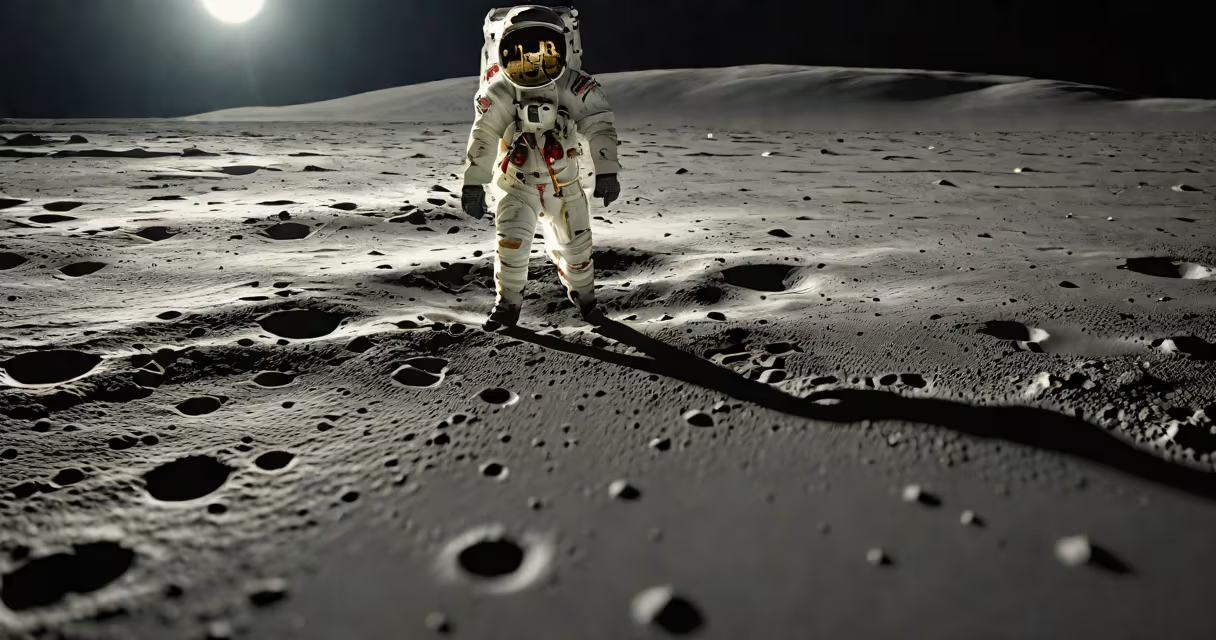
Yes, there is gravity on the moon-approximately 1.62 meters per second squared, or about 16.5% of Earth's gravity. This force results from the moon's mass attracting objects toward its center.
The moon's gravity is not zero. It's weaker than Earth's because the moon has less mass-about 1.2% of Earth's mass-and a smaller radius. This reduced gravitational pull allows astronauts to bounce while walking, explains why dust stays suspended longer after landing, and influences how spacecraft land and take off.
Gravity on the moon was measured during the Apollo missions using seismometers and tracking systems. Data from NASA's Lunar Reconnaissance Orbiter (LRO) confirms consistent gravitational fields across the surface, with slight variations due to subsurface mass concentrations called mascons.
Gravity arises from mass. The moon's mass is 7.34 × 10²² kg, roughly 1.2% of Earth's mass. Because gravity decreases with distance from the center of mass, and the moon's radius is about 1,737 km (compared to Earth's 6,371 km), the surface gravity is lower.
Newton's law of universal gravitation calculates the force between two masses: F = G(m₁m₂)/r². Using this, scientists determined that a 100 kg person weighs about 16.5 kg on the moon-equivalent to lifting a small child on Earth.
Despite being weak, lunar gravity still holds objects to the surface. A dropped hammer falls slowly, taking about 1.2 seconds to fall 1 meter-a stark contrast to Earth's 0.45 seconds. This delay is measurable and impacts astronaut mobility.
Lunar gravity produces several distinct effects, categorized by scale and mechanism:
| Effect Type | Description | Example |
|---|---|---|
| Surface Gravity | Direct pull on objects at the surface | Apollo 15 astronauts jumped 3 meters high due to low resistance |
| Tidal Influence | Gravitational interaction with Earth | Earth's gravity causes tidal bulges on the moon, locking its rotation |
| Orbital Mechanics | Gravity affecting orbiting spacecraft | LRO orbits at 50 km altitude, requiring precise thrust adjustments |
These effects are predictable and modeled using planetary science data. For example, the LRO uses gravity maps to maintain stable orbits, adjusting its path every few days to counteract gravitational anomalies.
Many assume the moon has no gravity because astronauts float. Floating occurs in microgravity environments, not zero gravity. The moon's gravity is present but insufficient to support normal Earth-like movement.
Another myth is that the moon's gravity pulls water from Earth to cause tides. While Earth's oceans respond to lunar gravity, the moon itself experiences tidal forces from Earth. These forces slowed the moon's rotation until it became tidally locked-showing one face to Earth for billions of years.
Some confuse weightlessness with absence of gravity. In orbit, objects are in freefall-constantly falling toward the moon but moving sideways fast enough to miss it. This creates apparent weightlessness, not zero gravity.
During Apollo 17, astronaut Eugene Cernan reported that jumping felt "like floating." He noted that after landing, his boots left deep impressions in the regolith-proof that gravity still acted on his mass. His suit weighed 120 lbs on Earth but only 20 lbs on the moon.
Modern missions rely on accurate gravity models. When India's Chandrayaan-3 landed in 2024, its descent thrusters fired in short bursts to compensate for the moon's weak gravity. Without precise calculations, the lander would have overshot or crashed.
Even spacewalking suits account for lunar gravity. The Apollo spacesuits were designed with extra ankle support to prevent slipping on slopes, where gravity is too weak to provide traction.
Gravity is a force. Weight is the measurement of that force on a mass. On the moon, gravity is constant, but weight changes based on mass. A 70 kg person weighs 686 N on Earth but only 114 N on the moon.
This difference matters for engineering. Landing gear must absorb impact at 1.6 m/s², not 9.8 m/s². Vehicles like the Lunar Roving Vehicle had low center of gravity and wide wheels to handle reduced friction.
One non-obvious fact: the moon's gravity field is uneven. Mascons-dense regions beneath the surface-create localized gravity spikes. These affect orbit stability and were mapped by the GRAIL mission (Gravity Recovery and Interior Laboratory), which flew twin satellites in 2012.
I once observed a video of a dropped ball during a simulated moon walk. On Earth, it fell in 0.45 seconds. On the moon, it took 1.2 seconds to drop 1 meter. The slow motion made the effect unmistakable-gravity wasn't absent, it was just weaker.
Understanding gravity on the moon is essential for planning future bases. The Artemis program relies on accurate gravity models to position habitats and launch vehicles safely. Even small errors in gravity assumptions can lead to mission failure.
For context, the moon's gravity is 1/6th of Earth's, not zero. This means objects fall slowly, people can jump higher, and dust behaves differently. It's not a vacuum of physics-it's a different physical environment governed by the same laws.
When considering whether there is gravity on the moon, the answer is clear: yes, and it shapes everything from astronaut movement to spacecraft trajectories. The presence of gravity enables exploration, while its weakness defines the challenges of living and working on another world.