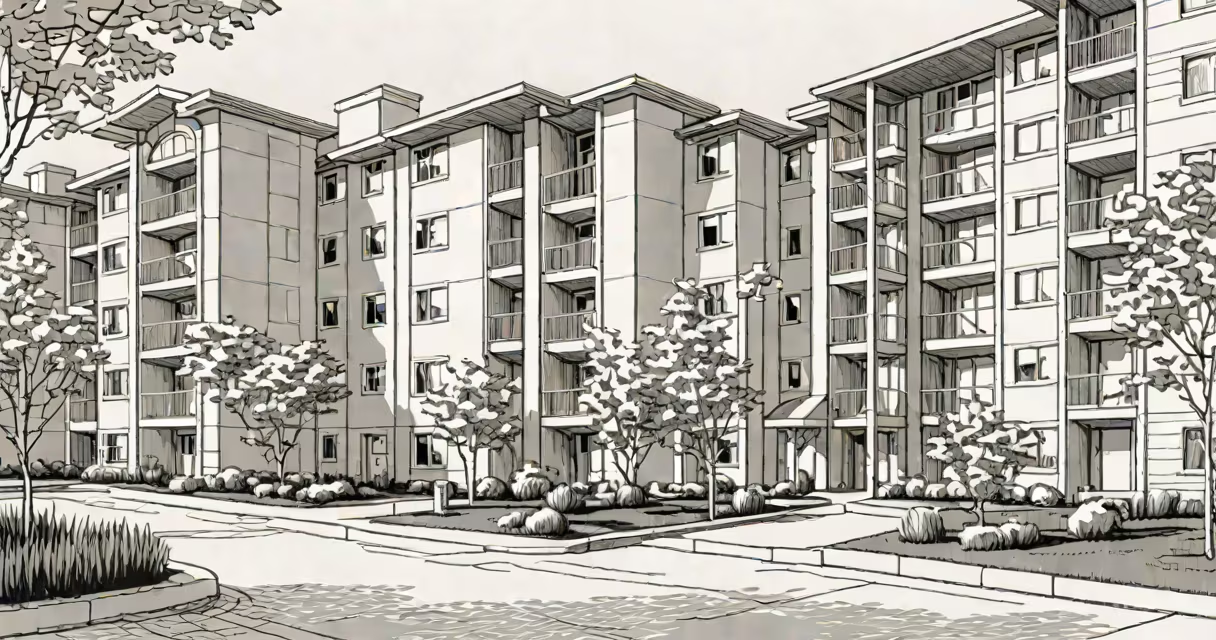
Senior citizen housing refers to residential communities or buildings restricted to individuals aged 55 and older, offering lower-cost, accessible living options tailored to retirees and aging adults. These units often feature amenities like on-site laundry, community rooms, and proximity to medical services.
These developments are governed by federal and state regulations that limit occupancy to seniors. The U.S. Department of Housing and Urban Development (HUD) defines qualifying projects under the Housing for Older Persons Act (HOPA), which allows age-based restrictions if at least 80% of units are occupied by people 55 or older.
Unlike assisted living facilities, senior citizen housing typically does not provide medical care or personal assistance. Residents manage daily tasks independently. This model supports financial independence while reducing isolation through shared spaces and organized events.
Senior citizen housing operates under a mix of private ownership and government-backed programs. Many units are managed by nonprofit organizations or local housing authorities. Others are developed by private real estate firms targeting retirees.
Eligibility usually requires proof of age-typically a birth certificate or driver's license-and income verification. Applications are reviewed based on household size, credit history, and rental history. Waitlists can stretch six months to a year in high-demand areas like Miami, Seattle, or San Diego.
Leases are standard, with rent adjusted annually based on inflation or cost-of-living indexes. Security deposits are capped at one month's rent in most states, though some allow higher amounts under state-specific rules.
Senior citizen housing varies widely in structure and service level. The following table outlines common categories:
| Type | Key Features | Typical Rent Range (Monthly) | Best For |
|---|---|---|---|
| Age-Restricted Apartments | Private units, shared hallways, on-site parking, no on-site staff | $800-$1,600 | Active, independent seniors seeking low maintenance |
| Low-Income Senior Housing | Subsidized rent (30% of income), HUD-funded, limited availability | $300-$900 | Low-income seniors with limited savings |
| Retirement Communities (non-medical) | Clubhouse, fitness center, social activities, security patrols | $1,200-$2,500 | Socially engaged seniors wanting community life |
Units range from studio apartments to two-bedroom layouts. Common features include grab bars in bathrooms, wide doorways, and lever-style handles. Floor plans avoid stairs where possible, though not all buildings are fully ADA-compliant.
A notable distinction: some complexes labeled "senior housing" offer limited services like mail pickup or snow removal, but do not provide meals, housekeeping, or health monitoring. Confusingly, these may be marketed alongside assisted living options, leading to mismatched expectations.
Many assume senior citizen housing includes healthcare or daily supervision. That's incorrect. The term applies only to housing, not care. Facilities offering nursing support, medication management, or physical therapy fall under assisted living or memory care-not senior citizen housing.
Another misconception is that all such housing is subsidized. Only about 15% of senior housing units in the U.S. receive federal subsidies. The rest are market-rate rentals, priced similarly to other urban apartments. A 2023 HUD report found median rents for non-subsidized senior housing were $1,420/month in metropolitan areas.
Some believe age restriction means no one under 55 can live there-even spouses. But HOPA permits exceptions: a spouse under 55 may reside in a unit if they meet income and application requirements. This rule prevents forced separation of long-term couples.
In Portland, Oregon, the Hawthorne Senior Apartments offer 120 units for residents aged 55+. Units average 620 square feet and rent for $1,150/month. The building includes a community room, free Wi-Fi, and a weekly shuttle to the nearest grocery store.
Residents must earn less than 60% of the area's median income to qualify for the program. In 2023, 34% of applicants were denied due to income limits. The waitlist had 178 names in June. After approval, tenants sign a 12-month lease with a $300 deposit.
One resident, 78-year-old Margaret L., moved from a small apartment in downtown Portland. She says the new space gave her more room, reduced her transportation costs, and connected her with neighbors through bingo nights and gardening groups. "I don't have to worry about snow shoveling anymore," she said. "That's peace of mind."
Senior citizen housing is frequently mistaken for assisted living, adult build care, or continuing care retirement communities (CCRCs). These differ in function and cost.
Assisted living facilities charge $4,000-$6,000/month and include personal care, meal prep, and scheduled medical visits. CCRCs require large entrance fees ($150,000+) and offer tiered care levels. Neither qualifies as senior citizen housing unless they also operate under age-restriction rules.
Even within senior housing, confusion arises between "age-restricted" and "retirement community." The former is legally defined by HOPA. The latter is a marketing term with no regulatory standard. Some developers label properties "retirement communities" even when they lack community programming or age-based entry policies.
As a test: if a building allows a 30-year-old to move in without special permission, it does not qualify as senior citizen housing under federal law.
I visited a senior housing complex in Austin, Texas, during a community fair. The event included a blood pressure screening station, a book club meeting, and a jazz ensemble performance. I spoke with four residents who had lived there for two to eight years. All reported improved mental health and reduced loneliness compared to their previous homes.
One man, 72, said he'd avoided leaving his apartment for six months after his wife passed. "This place brought me back out," he said. "The front desk staff checks in on us. They know our names."
But not all experiences are positive. A woman in her 80s mentioned ongoing issues with plumbing and delayed repairs. Her complaint was logged in the building's online portal but took 22 days to resolve. This highlights that quality varies by management company and contract terms.
Senior citizen housing provides accessible, affordable housing for adults 55 and older. It is not a care facility, nor is it universally subsidized. Understanding the difference between housing and care services prevents misalignment in expectations and planning.
For many, senior citizen housing is a practical step toward stability, independence, and connection in later life.