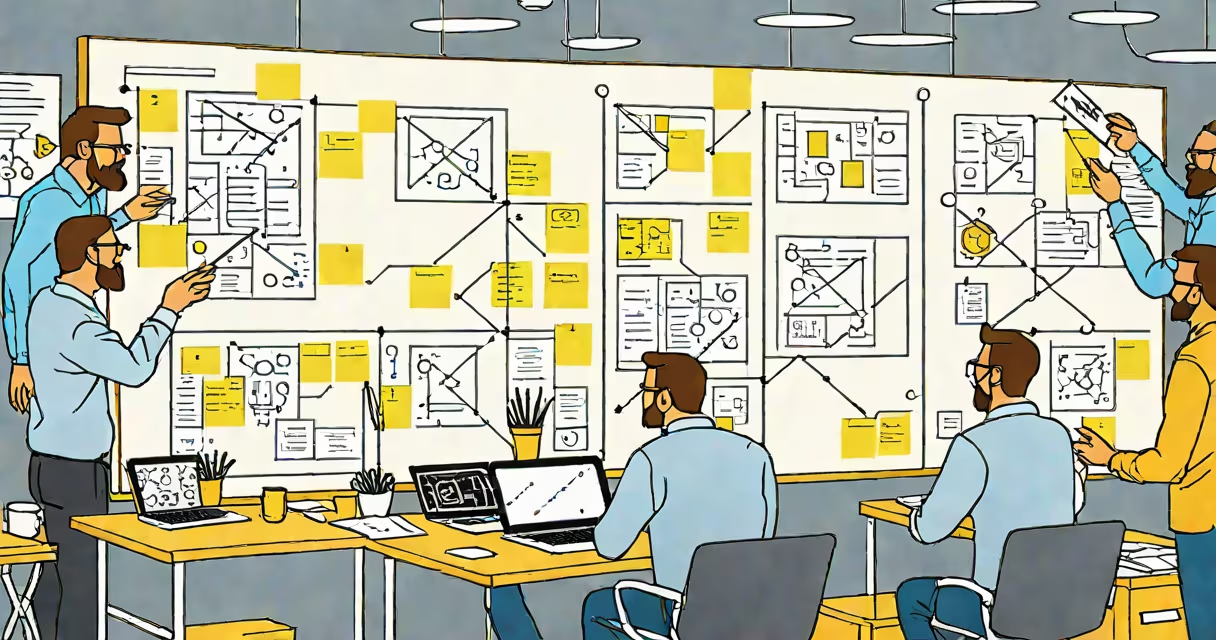
The iterative process in project management is a structured approach where work is broken into repeated cycles of planning, executing, evaluating, and refining. Each cycle produces a functional increment of the project deliverable, allowing teams to adapt based on feedback and changing requirements. This method contrasts with linear models like waterfall, where phases occur sequentially and changes are costly.
Each iteration follows a consistent pattern: define goals, execute tasks, test outputs, gather input from stakeholders, then adjust plans for the next cycle. This cycle repeats until the project meets acceptance criteria. Iterations typically last between one and four weeks, depending on team size and complexity. The core principle is delivering working components early and often, reducing the risk of major failures late in development.
For example, a software development team building a mobile app may complete an iteration focused on user login features. After coding and testing, they release a beta version to a small group of users. Feedback reveals issues with password recovery and slow load times. The team revises the design, optimizes backend queries, and includes a reset option in the next iteration. Over six iterations, the login system becomes stable, secure, and user-friendly.
Work begins with a high-level plan outlining project scope, timelines, and key milestones. Teams then break this plan into manageable chunks called iterations or sprints. During each cycle, the team selects a subset of features or tasks from the product backlog-prioritized list of required work-and commits to completing them within the timebox.
At the start of each iteration, the team holds a planning meeting to assign tasks, estimate effort, and agree on success criteria. As work progresses, daily stand-up meetings ensure alignment and flag blockers. When the cycle ends, the team demonstrates the completed work to stakeholders. A review session follows, where feedback is collected and prioritized for inclusion in the next iteration.
This closed-loop structure helps every output is validated against real-world use. Unlike traditional methods where validation happens only at project completion, iterative processes catch problems early. According to the Project Management Institute (PMI), projects using iterative approaches report 30% higher success rates due to faster issue detection and stakeholder engagement.
Several methodologies implement the iterative process. Agile is the most widely adopted, especially Scrum and Kanban. Scrum divides work into fixed-length sprints-usually two weeks-with defined roles like Product Owner, Scrum Master, and Development Team. Kanban uses a visual board to track work in progress, with no fixed iteration length, focusing instead on continuous flow.
| Structure | Iteration Length | Key Features | Best For |
|---|---|---|---|
| Scrum | 1-4 weeks | Fixed sprints, roles, ceremonies | Teams needing structure and regular feedback |
| Kanban | Flexible | Visual workflow, WIP limits | Support teams or ongoing maintenance |
| SAFe (Scaled Agile Structure) | 8-12 weeks | Aggregation of multiple teams, PI planning | Large organizations with interdependent projects |
Waterfall is not iterative. It moves through phases-requirements, design, implementation, testing, deployment-in sequence. Once a phase ends, teams rarely revisit earlier steps. This makes it unsuitable for projects with evolving needs. In contrast, the iterative process allows teams to pivot quickly when priorities shift.
Iterative process in project management is standard in software development, product design, marketing campaigns, and service delivery. It excels in environments where customer needs evolve or market conditions change rapidly. For example, a fintech startup launching a new payment feature uses biweekly iterations to validate assumptions with real users. After each cycle, they measure adoption rates, error logs, and user satisfaction scores.
According to a 2023 survey by the Project Management Journal, 76% of IT projects using iterative methods met deadlines and stayed within budget, compared to 45% in non-iterative projects. The study attributed this to better risk management and early detection of technical debt. Teams using iterative workflows reported 40% fewer critical bugs in production.
A common misconception is that iteration equals constant change. In reality, each cycle builds on the previous one with controlled adjustments. Change is guided by data-not whims. Another confusion arises between iteration and repetition. Repetition implies doing the same thing over and over. Iteration involves learning and improving with each cycle.
One frequent error is skipping the review and retrospective phase. Without analyzing what worked and what didn't, teams repeat past mistakes. A team building a healthcare dashboard skipped retrospectives during a three-month sprint cycle. By the end, they had duplicated efforts, missed accessibility standards, and delivered a tool unusable by older patients. Reintroducing retrospectives reduced rework by 55% in the next quarter.
Another mistake is treating every iteration as a mini-project. This leads to excessive documentation and approval delays. The goal is not to replicate full project governance in each cycle but to maintain enough discipline to stay aligned with objectives. A team at a logistics company initially submitted formal change requests for every minor update. After switching to lightweight check-ins, their release velocity increased by 60%.
I've observed this firsthand while leading a team developing a customer onboarding portal. Early on, we assumed clients wanted detailed forms upfront. After three iterations, user drop-off rates exceeded 70%. We pivoted to a step-by-step approach with progress indicators. Conversion improved by 52% in the fourth iteration. The lesson: feedback drives decisions, not assumptions.
When applied correctly, the iterative process in project management delivers higher quality, lower risk, and greater stakeholder trust. It's not about speed alone-it's about learning faster and adapting smarter. Tools like Jira, Trello, and Azure DevOps support iteration tracking, but the real value lies in disciplined reflection and responsiveness.