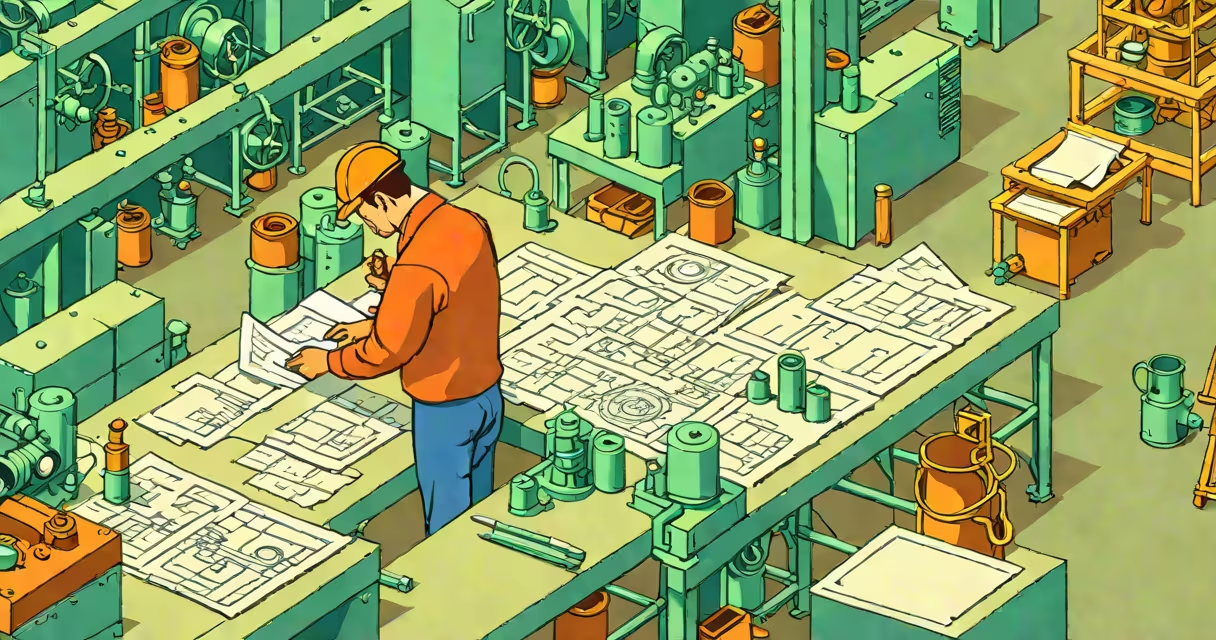
A planned economy is a system where the government controls production, distribution, and pricing of goods and services through centralized decision-making instead of market forces. In such systems, economic activity is directed by state planners who set output targets, allocate resources, and determine prices based on national goals rather than supply and demand.
Unlike market economies where prices emerge from buyer-seller interactions, a planned economy relies on five-year plans, production quotas, and administrative directives. The Soviet Union, Maoist China, and North Korea operated under this model during the 20th century. These states prioritized heavy industry, infrastructure, and military output over consumer goods, often leading to shortages and inefficiencies.
According to the World Bank, centrally planned systems in Eastern Europe collapsed between 1989 and 1991 due to persistent misallocation of capital and lack of price signals. The failure of these models led many countries to adopt market reforms, though some, like China, now blend planning with market mechanisms.
Central planning begins with a national economic plan, typically updated every five years. Government agencies collect data on labor, raw materials, energy, and existing capacity. Based on political priorities-such as building railroads or expanding steel production-they assign targets to factories and farms.
Factories receive orders specifying how much to produce, what materials to use, and by when. Workers do not choose their jobs or negotiate wages. Prices are set administratively, not by competition. If a factory exceeds its quota, it may receive bonuses. If it fails, managers face penalties. This system rewards compliance over innovation.
For example, in 1960s East Germany, the Ministry of Planning mandated that textile mills produce 1.2 million meters of cotton fabric annually. Mills were required to report weekly output. Those that met targets received additional fuel allocations. Those that fell short had their electricity cut. This rigid structure discouraged experimentation and led to outdated machinery.
Planned economies vary in structure and degree of control. The most common forms are:
| Type | Key Features | Examples |
|---|---|---|
| Command Economy | Complete state ownership of industry; all decisions made by central authority | Soviet Union (1920s-1991), North Korea |
| State-Managed Economy | Private property exists but major sectors are controlled by the state | China (1949-1978), Vietnam (pre-1986) |
| Hybrid System | Market mechanisms coexist with state planning | China (post-1978), Singapore |
China's economic transformation began with Deng Xiaoping's reforms in 1978. While the Communist Party retained control over strategic industries-like energy and telecommunications-it introduced market incentives in agriculture and manufacturing. By 2000, private enterprises accounted for over 60% of GDP, yet the state still set long-term development goals through Five-Year Plans.
North Korea maintains a strict command economy. The state controls all land, factories, and transportation. Citizens receive rations based on work points assigned by local committees. A 2019 report by the United Nations estimated that less than 1% of North Korea's population owns private property. Even small-scale trading requires approval from district officials.
Many confuse a planned economy with socialism or communism. While these ideologies often advocate for state control, they are not synonymous. Socialism can exist within a mixed economy. Communism is a political theory calling for classless society; it does not require economic planning.
Another misconception is that planned economies always fail. The Soviet Union did collapse, but early Soviet planning achieved rapid industrialization. Between 1928 and 1940, industrial output grew at an average annual rate of 10%. This growth enabled the USSR to withstand Nazi invasion during WWII. However, efficiency declined sharply after 1950 due to poor resource allocation and lack of feedback loops.
Even in modern times, elements of planning persist. The U.S. Department of Defense uses detailed procurement plans to buy weapons systems. NASA's space missions rely on multi-year budgets and engineering specifications. But these are not "planned economies" because they operate within a market-based structure where private firms compete for contracts.
In 1933, the Soviet Union launched its first Five-Year Plan. The goal was to change the country from agrarian to industrial power in ten years. The plan targeted a 250% increase in steel production, doubling of coal output, and expansion of rail networks.
To meet these goals, the state mobilized millions of workers. Factories were built in remote areas like Magnitogorsk, using imported equipment and forced labor. By 1937, steel output reached 18 million tons-up from 4 million in 1928. But the cost was high: food shortages caused famines in Ukraine and Kazakhstan, resulting in an estimated 5-7 million deaths.
The plan succeeded in industrializing the nation but failed in balancing human needs. As economist Robert Heilbroner noted in The Worldly Philosophers, "The Soviet experiment showed that central planning could build factories-but not happiness."
I once visited a former collective farm in rural Belarus. The original barn still stands, its roof caved in. Inside, rusted plows lie beside a faded poster reading "Collective Labor Builds the Future." The land is now farmed by smallholders using tractors bought on credit. The memory of central planning lingers in the silence of abandoned warehouses.
While pure planned economies are rare today, their legacy persists. Countries like China still issue national development strategies. The European Union uses coordinated economic planning through its Green Deal and Digital Agenda. Even in the U.S., federal agencies set long-term goals for clean energy deployment and broadband access.
These efforts differ from historical planned economies because they allow market flexibility and respond to feedback. They don't dictate factory output or ban private enterprise. Instead, they set targets and provide funding. This hybrid approach avoids the rigidity of old-style planning while addressing systemic challenges like climate change and inequality.
Understanding what is a planned economy clarifies how governments intervene in markets. It reveals the trade-offs between efficiency, equity, and freedom. Modern policy debates about universal healthcare, green infrastructure, and AI regulation often hinge on whether we should plan more-or trust markets more.