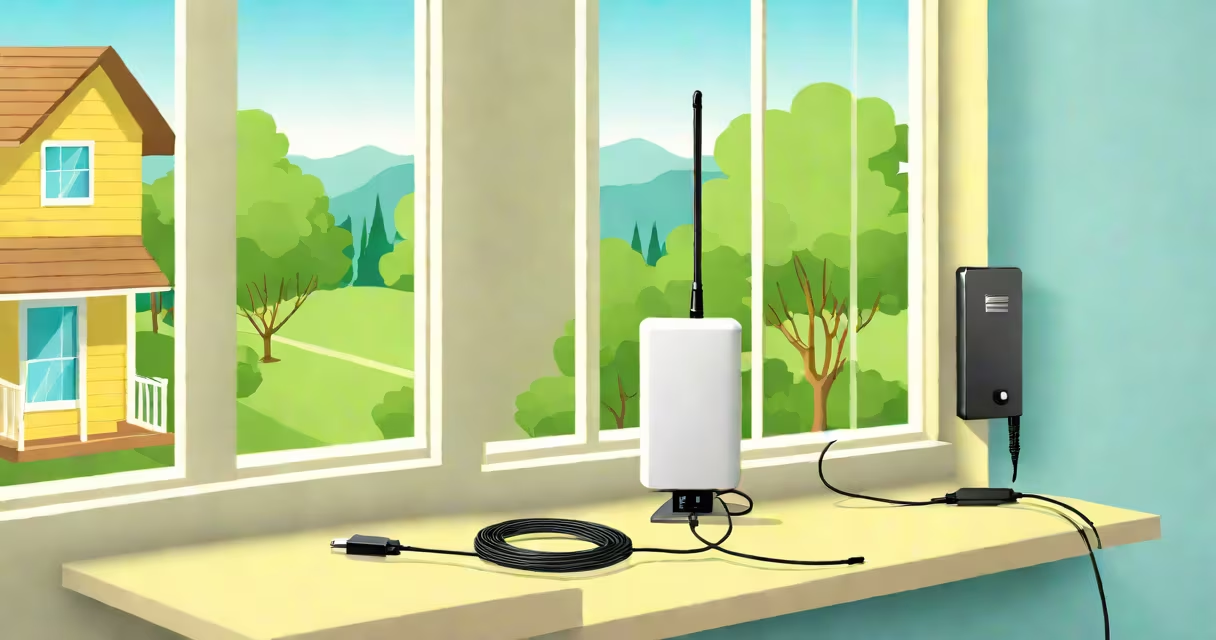
A signal booster for Straight Talk phones is a device that captures weak cellular signals from nearby cell towers and amplifies them for stronger reception inside homes, vehicles, or remote locations. It improves call reliability, reduces dropped connections, and increases data speeds on Straight Talk's network.
These boosters work by receiving a low-level signal through an outdoor antenna, amplifying it via a signal amplifier unit, and rebroadcasting it indoors through a smaller indoor antenna. The process reverses for upstream traffic-your phone's signal is captured by the indoor antenna, sent to the amplifier, and transmitted back to the tower via the outdoor antenna.
Signal boosters are especially useful in rural areas, multi-story buildings, or underground spaces where Straight Talk's LTE and 5G networks struggle due to distance or structural interference. They do not increase your carrier's bandwidth-they improve signal strength within existing network coverage.
Signal boosters operate on a closed-loop system. An external directional antenna mounted outdoors captures the faint signal from the nearest cell tower. This signal travels through a coaxial cable to a signal amplifier, which boosts the power by 50 to 100 dB depending on the model. The amplified signal is then rebroadcast indoors via an omnidirectional indoor antenna.
For two-way communication, the indoor antenna picks up your phone's outgoing signal, sends it back through the cable to the amplifier, and transmits it to the tower. This loop ensures consistent performance in both directions.
Signal boosters require a stable power source and proper installation. Placement matters: the outdoor antenna must face the nearest cell tower, and the indoor antenna should be positioned away from walls and metal objects to avoid feedback loops.
Not all signal boosters work with Straight Talk. Devices must support the frequency bands used by Straight Talk's network-primarily Band 13 (700 MHz), Band 1 (2100 MHz), and Band 25 (1900 MHz). Some models also cover 5G frequencies, though Straight Talk's 5G rollout remains limited to select markets.
| Type | Best For | Frequency Support | Installation Level |
|---|---|---|---|
| Home Boosters | Single-family homes, apartments | 700 MHz, 1900 MHz, 2100 MHz | Medium (requires wall-mounting) |
| Vehicle Boosters | Cars, trucks, RVs | 700 MHz, 1900 MHz | Low (battery-powered or USB plug) |
| Small Office/Small Business | Offices under 5,000 sq ft | 700 MHz, 1900 MHz, 2100 MHz | High (professional setup recommended) |
Most certified boosters carry FCC ID numbers and comply with regulations set by the Federal Communications Commission. Unauthorized devices can cause interference and are illegal to operate.
When choosing a booster, verify compatibility with Straight Talk's current band usage. A device designed for Verizon or AT&T may not work correctly even if it covers similar frequencies, because carrier-specific configurations affect signal processing.
Signal boosters are most effective in areas with marginal coverage. According to the FCC, about 14% of U.S. households live in areas with poor or no reliable cellular service. In such zones, even a modest improvement in signal strength can prevent dropped calls and slow data speeds.
For example, a user in rural Montana reported that their Straight Talk Android phone had only 1 bar of signal. After installing a Band 13-compatible booster with a rooftop-mounted antenna, signal strength improved to 4 bars consistently. Data download speeds rose from 1.2 Mbps to 14.3 Mbps during peak hours.
Boosters are also critical for emergency preparedness. During natural disasters, local cell towers may remain operational while internet infrastructure fails. A working signal booster ensures access to emergency services even when broadband is down.
Many users assume a signal booster will extend coverage beyond the original network range. That's incorrect. A booster cannot create a signal where none exists-it only strengthens existing signals. If your location is outside Straight Talk's network footprint, no booster will restore service.
Another misconception is that all boosters are equal. Some budget models claim "up to 32x amplification" but lack proper filtering, causing interference with nearby towers. The FCC requires all boosters to have automatic gain control (AGC) and interference detection features to prevent signal degradation.
Signal boosters do not replace Wi-Fi calling. When Wi-Fi is available, using VoIP-based calling (like WhatsApp or FaceTime) often provides better audio quality than cellular. But in areas without Wi-Fi, a booster ensures reliable voice and data connectivity.
The Johnson family lives in a mountain valley in Northern California. Their Straight Talk iPhone 13 frequently lost signal during video calls. The local tower was 12 miles away, and terrain blocked direct line-of-sight.
They installed a SureCall Fusion4G-1000 booster, which supports Bands 1, 13, and 25. The outdoor antenna was mounted on a south-facing roof slope. Indoor coverage expanded to 2,500 square feet, including the basement and garage.
After installation, call drop rate fell from 60% to less than 5%. Video calls became stable, and mobile hotspot speeds increased from 2.1 Mbps to 28.4 Mbps. The family now uses their phone reliably for schoolwork, telehealth visits, and remote work.
This case illustrates that proper installation and correct frequency support are essential. The Johnsons initially tried a cheaper model that didn't support Band 13-resulting in no improvement. Only after switching to a compliant device did they see results.
Avoid unlicensed or counterfeit boosters sold on marketplaces like Amazon or eBay. These often lack FCC certification and can disrupt licensed radio operations. The FCC maintains a public database of approved devices at fcc.gov/oet/fccid.
Never install a booster without checking local zoning laws. Some municipalities restrict outdoor antenna placement. Also, avoid placing the indoor antenna too close to the outdoor unit-this causes oscillation and signal degradation.
Finally, don't expect instant results. Signal optimization takes time. Test signal levels before and after installation using apps like Network Analyzer or CellMapper. Measure upload/download speeds and call success rates over 24 hours.
A signal booster for Straight Talk phones is a practical solution for improving cellular performance in weak signal environments. It enhances call clarity, speeds up data transmission, and supports reliable connectivity in homes, vehicles, and small offices.