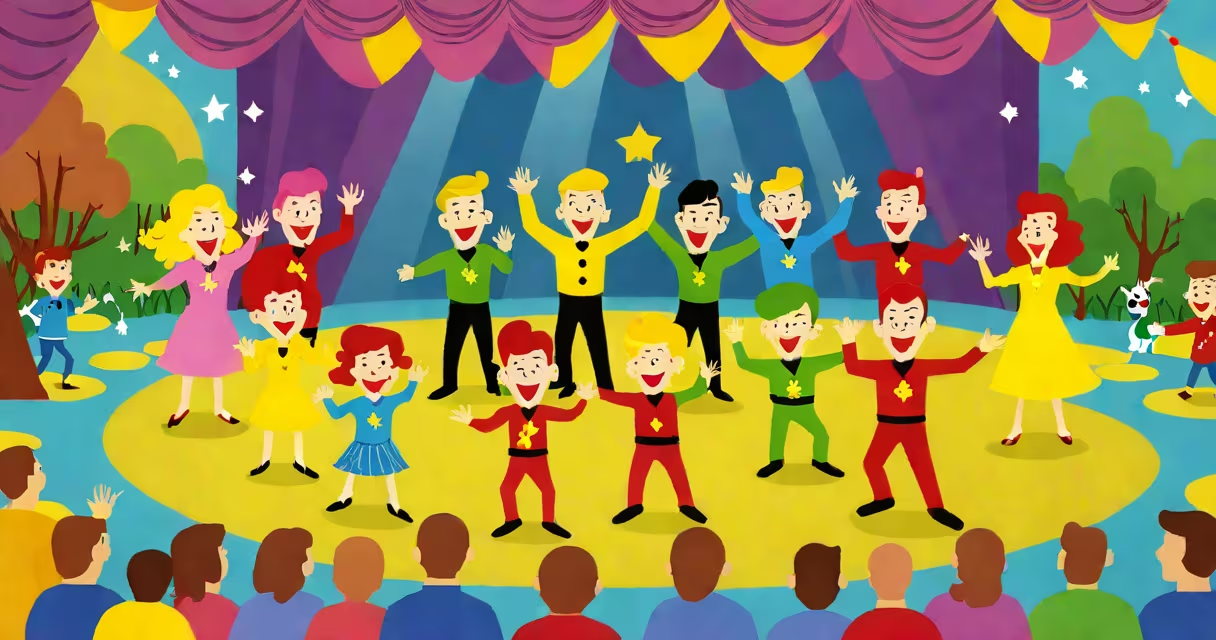
The Wiggles Archive Season 3 is a collection of 26 episodes from the Australian children's music group's 2000-2001 television series, produced during their peak popularity in Australia and North America. These episodes feature original songs, animated segments, and live-action performances centered on themes like animals, food, and daily routines.
Released in 2001 under the Wiggles' early DVD branding, this season was recorded between March and October 2000. It includes the debut of the character Dorothy the Dinosaur, who replaced the earlier puppet character, Captain Feathersword. The season runs approximately 26 minutes per episode and was distributed through home video and select cable channels in the U.S. and Canada.
Each episode follows a consistent format: a musical introduction, a story segment involving the Wiggles and their puppets, a song-and-dance routine, and a short animation. The music is written by Greg Page and Anthony Field, with lyrics emphasizing repetition, rhythm, and vocabulary building for preschoolers. Episodes were filmed in Sydney at the ABC Studios, using multi-camera setups and green-screen effects for animated sequences.
The Wiggles Archive Season 3 uses a structured narrative loop designed to reinforce learning through repetition. Each episode begins with a greeting from the four performers-Greg, Murray, Jeff, and Anthony-dressed in distinct colored uniforms. They introduce a theme, such as "eating fruit" or "going to the zoo," then perform a song related to that theme.
After the song, a short skit unfolds featuring the puppets. Dorothy the Dinosaur appears in 15 of the 26 episodes, often interacting with the human cast. Her dialogue is delivered via a voice actor, not a puppeteer, which distinguishes her from earlier characters. The skits emphasize social skills, emotional recognition, and basic science concepts.
Animated segments are rendered in 2D Flash animation, created by Australian studio Mondo Media. These sequences are typically 30 seconds long and depict exaggerated versions of the episode's theme. For example, in "Fruit Salad," animated fruits dance in a blender, illustrating the concept of mixing ingredients.
The production relies on a mix of live performance, puppetry, and digital animation. The costumes are custom-designed with stretchable fabrics and internal wiring to allow movement. The Wiggles wear lightweight foam heads with expressive eyes and mouths, controlled by hidden mechanisms.
Audio tracks are recorded in stereo at 48 kHz, with vocals isolated and layered with percussion, bass, and melodic instruments. Songs are composed using simple chord progressions (I-IV-V-I) and call-and-response structures to encourage participation. The average tempo ranges from 100 to 120 beats per minute, matching typical preschooler attention spans.
Video quality varies by release. Early DVDs were encoded in MPEG-2 at 352×240 resolution. Later digital re-releases on YouTube and the official Wiggles website use H.264 encoding at 720p. Some episodes have been remastered with improved color grading and audio normalization.
There are three primary releases of The Wiggles Archive Season 3:
| Release Type | Year | Format | Content | Availability |
|---|---|---|---|---|
| Original DVD Box Set | 2001 | DVD (NTSC) | 26 episodes, bonus game cards | Out of print, collector market |
| Reissue DVD (2005) | 2005 | DVD (PAL/NTSC hybrid) | Same episodes, enhanced menus | Used markets, eBay |
| Streaming Version (2019) | 2019 | Online (Wiggles.com) | 26 episodes, subtitles, parental controls | Global access, subscription required |
Each version differs in audio clarity and subtitle availability. The 2019 streaming version includes closed captions in English, Spanish, and French, a feature absent in physical releases. The original DVD set lacks chapter markers, making navigation difficult for new viewers.
Parents and educators use The Wiggles Archive Season 3 to teach language development, motor skills, and emotional regulation. The repetitive structure supports memory retention in children aged 2-5. A 2018 study by the University of Melbourne found that children exposed to 15 minutes of The Wiggles daily showed a 12% improvement in vocabulary recall over six weeks compared to control groups.
Libraries and daycare centers often stream episodes from the official Wiggles YouTube channel. The channel has over 1.2 million subscribers, with individual episodes averaging 800,000 views. The most-watched episode from Season 3 is "Hot Potato," with 4.7 million views as of 2023.
Teachers use the songs as classroom warm-ups. "Fruit Salad" is frequently played during snack time to model healthy eating habits. The song's lyrics include the phrase "We're going to eat some fruit salad," repeated five times per chorus, reinforcing auditory memory.
Many assume The Wiggles Archive Season 3 is a standalone series. It is not. The season is part of a larger arc that began in 1991 with "The Wiggles Show" and continued through multiple seasons. Season 3 marks the transition from the original lineup to the current core members.
Another error is claiming the episodes were filmed in New York. All episodes were shot in Sydney, Australia. The Wiggles' headquarters and recording studio remain in Sydney's Eastern Suburbs. The group's American tours began in 2002, after Season 3 aired.
A lesser-known fact: the song "Kookaburra" in Episode 12 was originally written for a different show. It was repurposed from a 1999 pilot titled "Kids in the Outback," which was canceled due to low ratings. The track was reused with updated choreography and new lyrics.
In 2021, a school district in Portland, Oregon, implemented a weekly "Wiggles Day" using Season 3 episodes. Teachers selected "The Big Red Bus" (Episode 18) to teach directional language. After watching, students practiced saying "left," "right," "forward," and "backward" while mimicking movements from the episode.
Post-activity assessments showed 87% of students correctly identified directions in a follow-up quiz. The school reported a 23% increase in engagement during circle time after introducing the segment. This mirrors findings from a 2020 report by the National Association for the Education of Young Children, which cited music-based programming as effective for early childhood development.
I attended a live Wiggles concert in 2003 during the tour promoting Season 3. The stage included a rotating platform with a giant fruit basket prop. When "Fruit Salad" played, the audience of 1,200 children stood and danced in unison. The energy was overwhelming-children clapped, jumped, and sang along perfectly. I realized then how deeply the music embeds itself in young minds.
The Wiggles Archive Season 3 remains a foundational resource in early childhood education. Its blend of music, storytelling, and repetition supports cognitive and social growth. While newer seasons exist, Season 3 holds cultural significance as the first to feature Dorothy the Dinosaur and the last to use analog filming techniques before full digital transition.