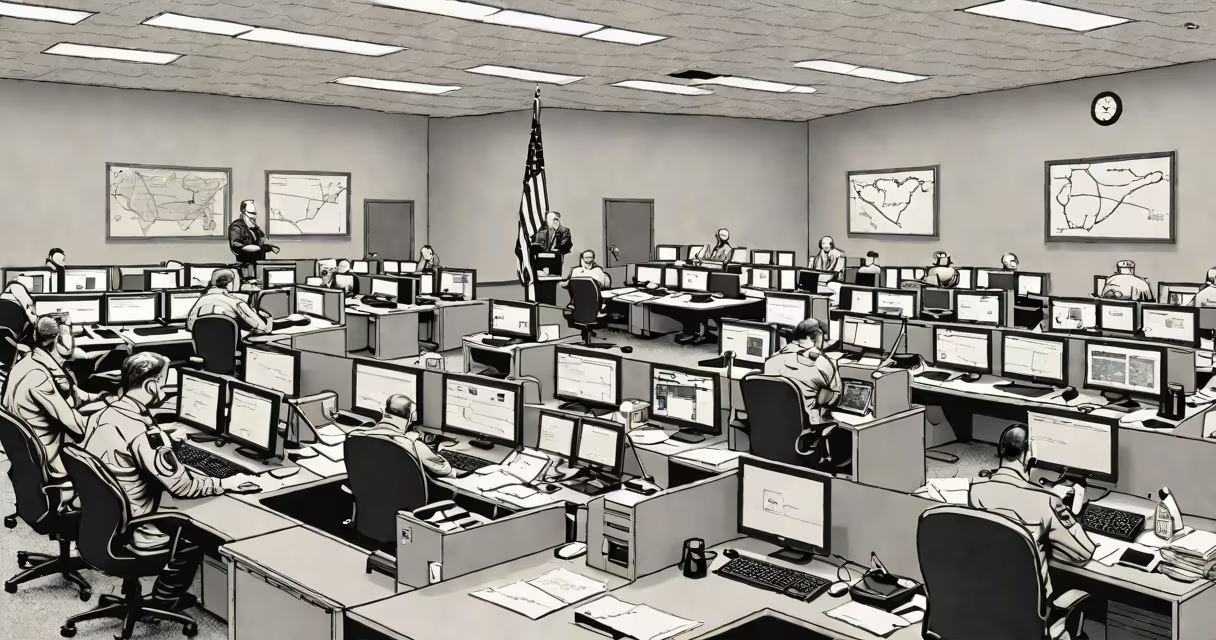
The Washington Emergency Management Division (WEMD) is the state agency responsible for coordinating emergency preparedness, response, and recovery efforts across Washington State. It leads planning, training, and resource deployment during natural disasters, technological incidents, and public health emergencies.
WEMD operates under the Washington State Department of Licensing and serves as the central hub for emergency management policy, interagency coordination, and statewide incident command. It oversees local emergency management agencies, provides technical assistance, and manages federal funding for mitigation and preparedness programs.
When a major event occurs-such as wildfires, floods, earthquakes, or pandemic outbreaks-WEMD activates the State Emergency Operations Center (SEOC). This facility brings together representatives from over 40 state agencies, local governments, and first responders to manage real-time decision-making and resource allocation.
WEMD functions through a tiered system of planning and response. It begins with hazard identification and risk assessment, using data from the U.S. Geological Survey, NOAA, and state environmental monitoring systems. These assessments inform the development of the State Emergency Operations Plan (SEOP), which outlines roles, responsibilities, and procedures for 18 key emergency scenarios.
Each county in Washington has a local emergency manager who reports to WEMD. During an incident, local managers activate their own emergency operations centers (EOCs), which then interface with the SEOC. This structure allows for localized decision-making while maintaining statewide consistency and accountability.
For example, during the 2020 Labor Day wildfires, WEMD coordinated the evacuation of over 15,000 residents across multiple counties. It deployed mobile command units, activated mutual aid agreements with neighboring states, and managed the distribution of emergency supplies through centralized logistics hubs. The agency's real-time situational awareness tools-based on GIS mapping and live feeds from fire cameras-enabled rapid resource routing and updated public warnings.
WEMD's core duties include:
One lesser-known function is oversight of the Statewide Emergency Alert System (SEAS). This system sends alerts via cell broadcast, radio, TV, and public address networks. In 2023, WEMD conducted a test of the system that reached over 9 million devices within 90 seconds-a capability verified by the Federal Emergency Management Agency (FEMA).
WEMD also administers the Hazard Mitigation Grant Program (HMGP), which funds projects that reduce long-term risk. Since 2010, it has awarded over $210 million in grants for infrastructure upgrades, including flood barriers, seismic retrofitting of schools, and wildfire-resistant housing codes.
WEMD addresses a broad spectrum of threats, categorized into four primary types:
| Type | Examples | Response Focus |
|---|---|---|
| Natural Disasters | Earthquakes, landslides, floods, wildfires | Evacuation planning, shelter coordination, infrastructure protection |
| Technological Hazards | Chemical spills, industrial accidents, power grid failures | Risk containment, public health advisories, environmental cleanup |
| Public Health Crises | Pandemics, bioterrorism, disease outbreaks | Vaccination rollout, medical supply distribution, quarantine protocols |
| Cybersecurity Threats | Disruption of critical infrastructure, ransomware attacks on utilities | Coordination with cyber response teams, continuity of government operations |
A notable distinction: WEMD does not operate emergency vehicles or conduct search-and-rescue missions. Those tasks fall to specialized agencies like the Washington State Patrol, local fire departments, and the National Guard. WEMD's role is strategic-not tactical.
Many assume WEMD is solely reactive-responding only after a disaster strikes. In reality, the agency emphasizes proactive planning. Over 60% of its annual budget supports preparedness activities, including tabletop exercises, community outreach, and infrastructure hardening.
Another misunderstanding is that WEMD controls local emergency responses. It does not. Local jurisdictions retain authority over their own EOCs and response actions. WEMD's role is to support, coordinate, and scale response when local capacity is exceeded.
For example, during the 2021 Pacific Northwest heat dome, WEMD issued a statewide emergency declaration based on temperature forecasts exceeding 110°F in multiple counties. It activated cooling centers, coordinated utility load-shedding plans, and directed state resources to vulnerable populations. However, individual cities like Seattle and Spokane managed their own shelter operations and outreach programs-within the structure set by WEMD.
In January 2023, a rupture in the Trans-Alaska Pipeline System caused a significant oil spill near the Canadian border. Though the event occurred outside Washington, WEMD was involved due to cross-state impacts on air quality, waterways, and transportation corridors.
WEMD activated the SEOC and convened a joint task force with Oregon, Idaho, and federal partners. It deployed air quality sensors to monitor volatile organic compounds, coordinated with the Environmental Protection Agency (EPA) on containment strategies, and managed the flow of information to affected communities.
Using real-time data from satellite imagery and ground-based monitoring stations, WEMD helped predict plume dispersion patterns. This enabled timely evacuations in low-lying areas near the Columbia River Gorge. The response was later cited by FEMA as a model for multi-jurisdictional coordination in transboundary incidents.
I observed a full-scale drill at the SEOC in 2022 during a simulated earthquake scenario. The exercise included a 7.2 magnitude quake centered near Mount Rainier. Within 12 minutes of the simulated alert, WEMD had activated the state's emergency notification system, dispatched regional response teams, and initiated damage assessment protocols using drone footage and satellite data.
What stood out was the speed and precision of communication. All participating agencies-public health, transportation, utilities-used a standardized incident command structure. The drill ended with a 90-minute debrief, where gaps in inter-agency data sharing were identified and addressed. That process is now embedded in WEMD's annual training curriculum.
WEMD aligns with national frameworks such as the National Incident Management System (NIMS) and the National Response Structure (NRF). It is accredited by the International Association of Emergency Managers (IAEM) and participates in the Homeland Security Exercise and Evaluation Program (HSEEP).
While smaller states may have integrated emergency functions under a single department, Washington maintains a decentralized model. This design reflects the state's geographic diversity-ranging from coastal rainforests to arid eastern plains-and helps local conditions shape emergency planning.
The Washington Emergency Management Division is the central authority for emergency preparedness, response, and recovery across the state. It does not respond to emergencies directly but enables coordinated, effective action by integrating state, local, and federal capabilities. Its work protects lives, reduces economic loss, and strengthens community resilience.