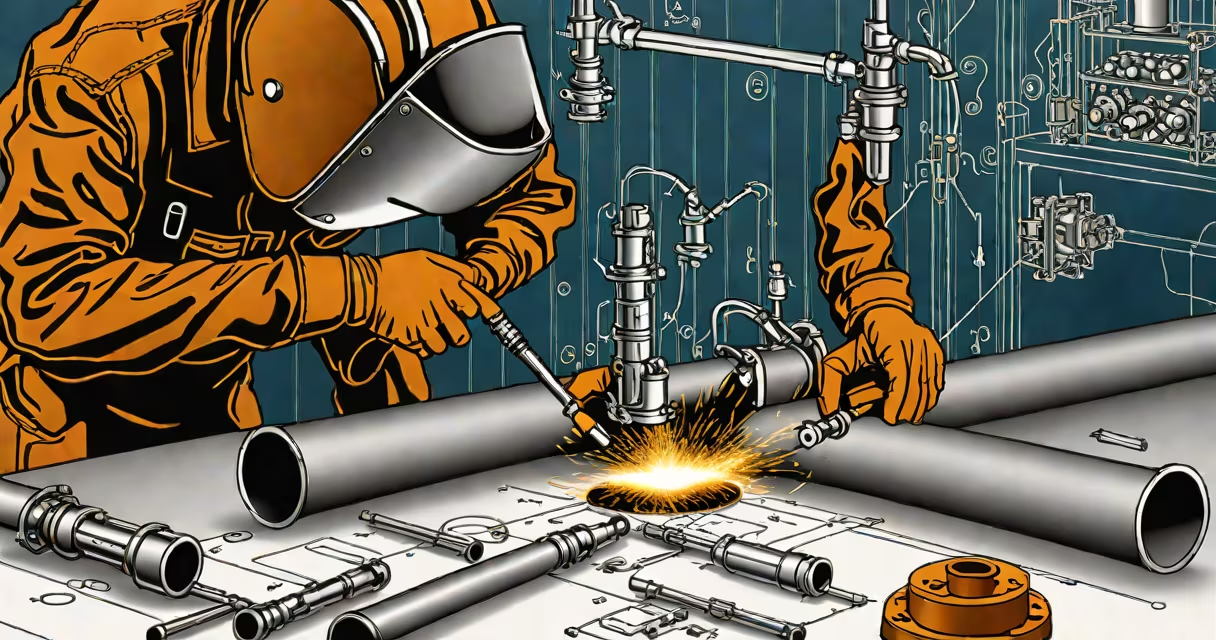
5g welding is a pipe welding position where the workpiece is fixed horizontally and the welder must deposit metal on a vertical surface while rotating the pipe. This position demands high precision and consistent technique due to gravity pulling molten metal downward.
It is part of the American Welding Society (AWS) standard for welder qualification and is among the most challenging positions in the GMAW (Gas Metal Arc Welding) process. The "5" indicates the pipe is horizontal, and the "g" stands for "groove," meaning the weld is made along a groove in the joint. This position simulates real-world conditions in pipelines, pressure vessels, and structural steel fabrication.
Welders must maintain a consistent travel speed, correct electrode angle, and proper shielding gas flow to avoid defects like undercutting, porosity, or incomplete fusion. A single mistake can compromise structural integrity, especially in high-pressure systems.
In 5g welding, the pipe is clamped in place and rotated slowly during the weld pass. The welder manually controls the torch at a 10°-15° angle from vertical, moving in a circular motion around the joint. The goal is to create a uniform bead that fuses completely through the root and fills the joint without excessive reinforcement.
The challenge lies in managing the molten pool as it moves around the circumference. Gravity pulls the metal downward, increasing the risk of sagging or burn-through on the lower side of the pipe. Skilled welders use techniques like weaving or oscillation to distribute heat evenly and prevent overheating.
For example, a 6-inch diameter carbon steel pipe with a 0.25-inch wall thickness requires a welder to complete a full 360° pass at a controlled rate of 2-3 inches per minute. Any deviation leads to inconsistent penetration or excessive spatter, both of which fail AWS inspection standards.
While 5g welding is a single position, it varies based on material type, joint design, and process used. The most common variants are:
| Material Type | Common Joint Design | Typical Shielding Gas | Application Example |
|---|---|---|---|
| Carbon steel | Butt joint, 30° V-groove | 75% argon / 25% CO₂ | Pipeline construction (e.g., natural gas lines) |
| Stainless steel | Double V-groove, root pass required | 100% argon | Chemical processing equipment |
| Aluminum alloy | Single V-groove, 15° included angle | 100% argon | Aerospace and marine structures |
Each material requires different amperage settings and wire feed speeds. For instance, aluminum demands higher voltage and faster wire feed rates due to its high thermal conductivity. Using the wrong parameters results in poor fusion and increased porosity.
Industrial sectors such as oil and gas, power generation, and heavy machinery rely heavily on 5g welding. Pipeline projects like the Keystone XL and Trans Mountain Expansion required thousands of qualified 5g welders to meet safety and compliance standards.
Many assume 5g welding is simply "welding a pipe." That's incorrect. The position is not about the orientation of the pipe alone-it's about the combination of rotation, gravity, and access constraints. Unlike flat or horizontal welding, 5g requires constant adjustment as the weld progresses around the circle.
A common misconception is that automation can easily replace manual 5g welding. While robotic systems exist, they require precise programming and fixturing. Most field environments lack the space and infrastructure for robotics. Manual welders remain essential for repairs, tight spaces, and complex joints.
Another error is confusing 5g with 2g (horizontal fillet). Both involve horizontal pipes, but 2g uses a fillet weld on a corner, while 5g is a full-penetration butt weld. The AWS D1.1 Structural Welding Code explicitly separates these positions in qualification testing.
In 2021, a pipeline rupture occurred near Prudhoe Bay, Alaska. Emergency crews had to repair a 12-inch diameter steel pipe under sub-zero temperatures. The repair team used 5g welding to rejoin the fractured section.
They selected a 75% argon/25% CO₂ shielding gas mix to reduce spatter and improve arc stability in cold conditions. The welders completed the job using a 0.045-inch ER70S-6 wire at 280 amps and 22 volts. Each welder had to perform a 360° pass in less than 15 minutes to minimize heat input and prevent distortion.
Post-weld radiographic testing confirmed full penetration and no cracks. The repair held under 1,200 psi pressure, meeting API 1104 standards. This case shows that 5g welding isn't theoretical-it's critical infrastructure.
I spent six weeks training for my AWS Certified Welder test. My instructor emphasized that 5g wasn't about speed-it was about consistency. I failed my first attempt because I rushed the lower half of the pipe, causing a crater crack. On the second try, I slowed down, focused on maintaining a steady arc length, and used a slight figure-eight weave pattern.
After three hours of practice, I finally passed. The key insight: your hand doesn't move the torch-you're guiding the arc. The difference between a pass and a failure is often just 1/16 inch of travel speed variation.
Some believe 5g welding only applies to large-diameter pipes. In reality, it's used on pipes as small as 1 inch in diameter, especially in HVAC and instrumentation systems. The AWS B2.1 Standard specifies minimum pipe diameters for qualification, including 1.5 inches for certain materials.
Another myth is that 5g welds don't need post-weld heat treatment (PWHT). This is false. For carbon steel above 1 inch thickness, PWHT is mandatory to relieve residual stress and prevent hydrogen-induced cracking. Skipping PWHT risks failure under cyclic loading.
Finally, many think 5g welding is interchangeable with 6g. They are not. 6g involves a pipe at a 45° angle, making it even harder due to variable gravity effects. 5g is simpler because the pipe rotates uniformly, allowing predictable heat distribution.