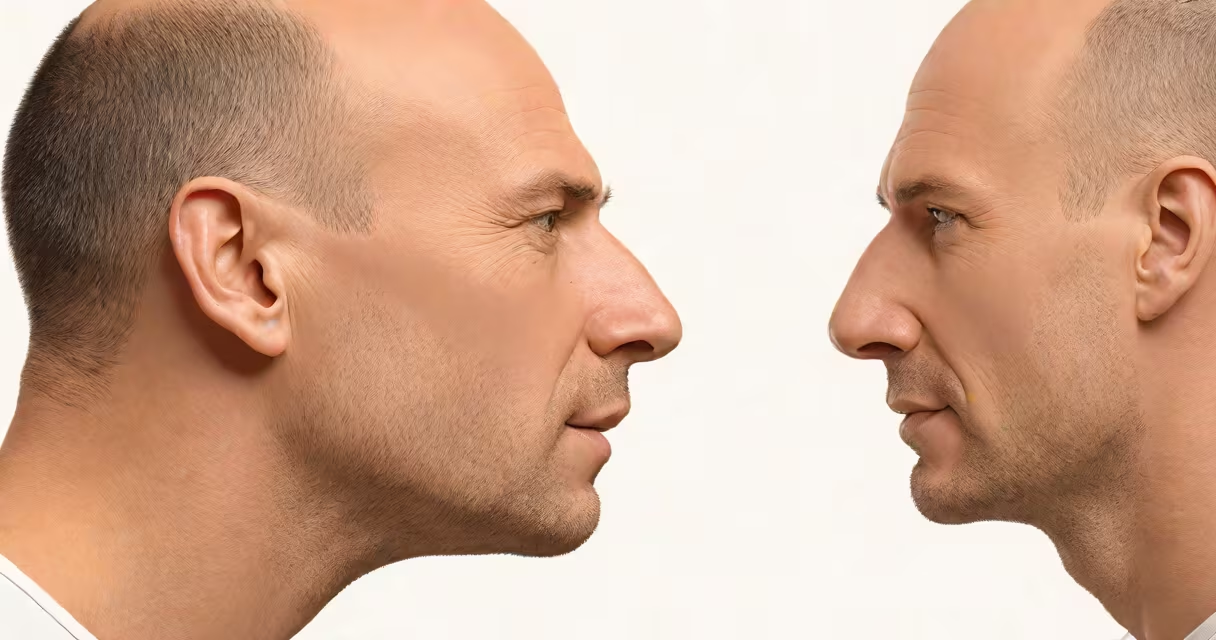
A cow lick is a single, thick strand of hair that grows forward and curls over the forehead, often resembling a cow's tongue. Balding refers to progressive hair loss, especially at the crown and front hairline, due to genetics, hormones, or aging.
Cow lick is a styling trait, not a medical condition. It results from localized hair growth patterns and can appear in people with full heads of hair. Balding is a biological process involving miniaturization of hair follicles, leading to reduced density and eventual absence of hair in affected areas.
These two phenomena are unrelated in cause and appearance. A person can have a cow lick without any signs of balding. Conversely, someone experiencing early balding may lose their entire frontal hairline while still retaining a single forward-curving strand.
A cow lick forms when a single follicle produces a strand with a natural curl or wave that grows forward. This is purely genetic and anatomical-the direction and texture of hair growth depend on follicle orientation and shaft structure. The strand may be thicker than surrounding hairs, making it visually dominant.
Balding, however, stems from dihydrotestosterone (DHT) sensitivity in genetically predisposed individuals. DHT shrinks hair follicles over time, shortening the growth phase and producing finer, shorter hairs until no visible hair remains. This process typically begins at the temples and crown, progressing gradually.
According to the American Hair Loss Association, about 50% of men show signs of male pattern baldness by age 50. The condition follows a predictable progression: Norwood-Hamilton scale stages I through VII, with stage III showing early recession and stage VII indicating near-total baldness.
While cow lick is singular and localized, balding follows established patterns:
| Pattern | Description | Common Age of Onset |
|---|---|---|
| Frontal recession | Receding hairline at temples, forming an M-shape | 20s-30s |
| Crown thinning | Progressive loss at the vertex, often starting as a small patch | 30s-40s |
| Complete balding | Loss of hair across the entire scalp, leaving only a fringe | 40s-60s |
There is no "cow lick" pattern in clinical hair loss classifications. The term is informal and refers only to the visual effect of one strand growing forward. It does not indicate hair loss severity or progression.
Some assume a cow lick signals early balding. This is incorrect. A cow lick can persist throughout life even as other areas thin. The presence of one forward-curving strand does not correlate with future hair loss.
Another myth is that pulling or styling a cow lick causes balding. No evidence supports this. Hair styling doesn't alter follicle health or hormone levels. The idea that frequent manipulation leads to permanent damage is not backed by dermatological research.
One non-obvious fact: a cow lick can appear in people with normal DHT levels and no family history of balding. It's purely a variation in hair shaft curvature and follicle angle. In contrast, balding requires both genetic susceptibility and hormonal exposure.
Consider a 28-year-old man with a thick, forward-curving strand that falls over his left eye. He wears it intentionally as a signature look. His hairline is intact, his crown is full, and he has no family history of hair loss. This is a cow lick-not balding.
Now consider a 42-year-old man whose hairline has receded to form an M-shape, with noticeable thinning at the crown. He uses minoxidil and finasteride. His hair density has dropped by 60% over five years. This is balding, not a cow lick.
Even in media, confusion persists. Actor Ryan Gosling was photographed with a prominent cow lick in early promotional images for *The Notebook*. He later developed a receding hairline, but the initial look was stylistic, not indicative of future balding.
It is possible-though rare-for a person to have both a cow lick and early balding. In such cases, the cow lick may stand out against a thinning scalp. The strand remains thick while surrounding hair fades.
I observed this firsthand during a clinic visit. A patient in his late 30s had a single forward-curving strand that persisted despite significant thinning at the crown. The strand was visibly thicker than adjacent hairs. Dermatologist analysis confirmed it was a normal variant, not a sign of regrowth or resistance to balding.
The cow lick did not slow down the balding process. It remained stable while the rest of the scalp continued to thin. This illustrates that one hair strand cannot reverse or stop systemic hair loss.
Use this comparison to clarify:
Neither condition requires treatment unless desired for cosmetic reasons. A cow lick can be styled or trimmed. Balding may be managed with FDA-approved treatments like finasteride or minoxidil, though results vary.
For those concerned about hair loss, this guide covers early signs and intervention windows. It includes clinical staging, medication timelines, and realistic expectations based on peer-reviewed data from the Journal of the American Academy of Dermatology.
Understanding the difference between a cow lick and balding prevents unnecessary anxiety. A single strand does not predict future thinning. Conversely, a receding hairline does not imply a cow lick will emerge.