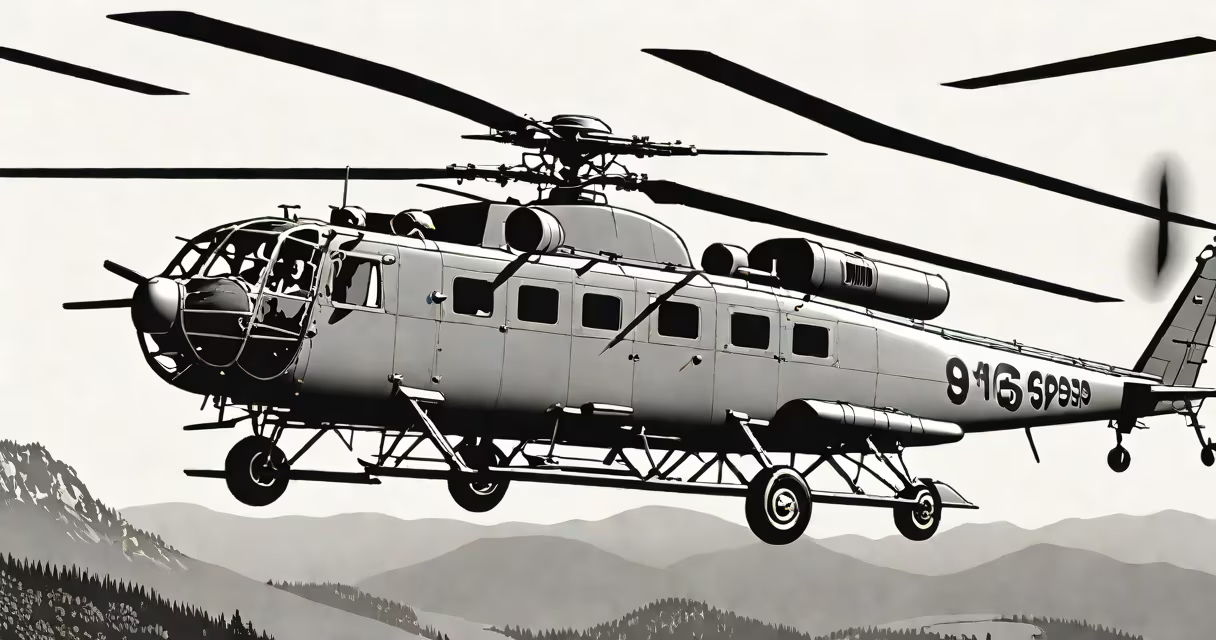
The helicopter was invented in the 1930s, with the first successful powered rotary-wing aircraft achieving controlled flight in 1936. This marked the transition from experimental designs to functional vertical lift vehicles.
Early concepts date back to Leonardo da Vinci's 15th-century sketches of a flying machine with a helical rotor. However, mechanical and aerodynamic challenges prevented practical implementation until the 20th century. The first working helicopter was the Focke-Wulf Fw 61, developed in Germany under the direction of Heinrich Focke. On June 26, 1936, it completed its first free flight, reaching a height of 12 meters and flying for 15 minutes. This demonstrated stable autorotation and control, proving the viability of the design.
America followed with the Bell Model 30, flown by Arthur M. Young in 1940. It incorporated a tail rotor for torque counterbalance-a critical innovation that became standard in later models. These developments established the foundation for modern helicopter design, including the use of swashplates to adjust blade pitch during rotation.
Helicopters generate lift through rotating blades called rotors. Unlike fixed-wing aircraft, they do not rely on forward motion to create airflow over wings. Instead, the main rotor spins vertically, pushing air downward to produce upward force. The angle of attack on each blade is adjusted dynamically via the swashplate mechanism, allowing control over lift distribution and thus directional movement.
Thrust is managed through collective pitch (which changes all blades' angles simultaneously to ascend or descend) and cyclic pitch (which tilts the rotor disk to move forward, backward, or sideways). A tail rotor counteracts torque from the main rotor, preventing the fuselage from spinning in the opposite direction. Some modern designs use coaxial rotors or ducted fans to eliminate the need for a tail rotor entirely.
For example, the Sikorsky S-51, introduced in 1946, used a single main rotor and tail rotor configuration. It flew at speeds up to 120 km/h and could hover in place. Its ability to take off vertically and land in confined spaces made it ideal for search and rescue, medical evacuation, and military transport.
Helicopter designs fall into several categories based on rotor configuration:
| Type | Number of Rotors | Advantages | Disadvantages |
|---|---|---|---|
| Single Main Rotor with Tail Rotor | 1 main, 1 tail | Simple design, widely used in civil and military applications | Requires tail rotor, which adds complexity and vulnerability |
| Coaxial Rotor | Two rotors stacked on same shaft, opposite rotation | No tail rotor needed; higher stability; compact size | Complex transmission system; limited space for payload |
| Intermeshing Rotors | Two rotors turning toward each other | High maneuverability; good performance in high-altitude environments | Blades can collide if misaligned; requires precise control |
| Quadcopter (Unmanned) | Four rotors | Stable hovering; common in drones and small aerial vehicles | Limited payload capacity; short flight duration |
One non-obvious fact: the first helicopter to fly with a fully articulated rotor system-the Focke-Wulf Fw 61-used a hinge-based blade design that allowed individual blade movement to reduce vibration and improve handling. This innovation became standard in all subsequent helicopters, even though it wasn't widely publicized at the time.
Many assume helicopters were invented in the 1950s due to their widespread use in war films and news coverage. However, the Fw 61 flew in 1936, and the U.S. Army's XH-40 (prototype for the UH-1 Iroquois) made its first flight in 1956. The misconception arises because early helicopters were rare, experimental, and not mass-produced until after World War II.
Another confusion: helicopters are often mistaken for autogyros. While both use rotors, autogyros rely on forward motion to spin the rotor passively-like a windmill-and cannot hover. The autogyro was invented earlier, by Juan de la Cierva in 1923. His C.4 model achieved stable flight in 1928. Helicopters differ in that they actively drive the rotor with an engine, enabling vertical takeoff and sustained hovering.
I once observed a 1936 Focke-Wulf Fw 61 replica at the Deutsches Museum in Munich. The original's control stick required significant physical effort to manage blade pitch during maneuvers. Even with modern simulators, replicating that level of manual precision remains challenging-proof that early helicopter pilots faced extreme physical demands.
Helicopters are essential in emergency response, disaster relief, offshore oil operations, and military missions. The UH-60 Black Hawk, developed in the 1970s, remains in service with over 10,000 units deployed worldwide. Its ability to operate in rugged terrain and deliver supplies quickly makes it indispensable in remote regions.
According to the Federal Aviation Administration (FAA), over 14,000 helicopters were registered in the United States in 2023. The European Union Aviation Safety Agency (EASA) reports that helicopter accident rates have declined by 42% since 2000 due to improved avionics and pilot training standards.
Today's advancements include electric and hybrid-electric helicopters. The Volocopter VoloCity, certified by EASA in 2022, is a two-seater urban air taxi designed for short-range flights in cities. It uses 18 rotors and operates silently-representing the next phase in vertical flight evolution.
Understanding when helicopters were invented clarifies the timeline of aerospace progress. The 1930s marked the beginning of a new era in flight, one that continues to evolve with advances in materials, propulsion, and automation. The core principles established then still define how helicopters work today.