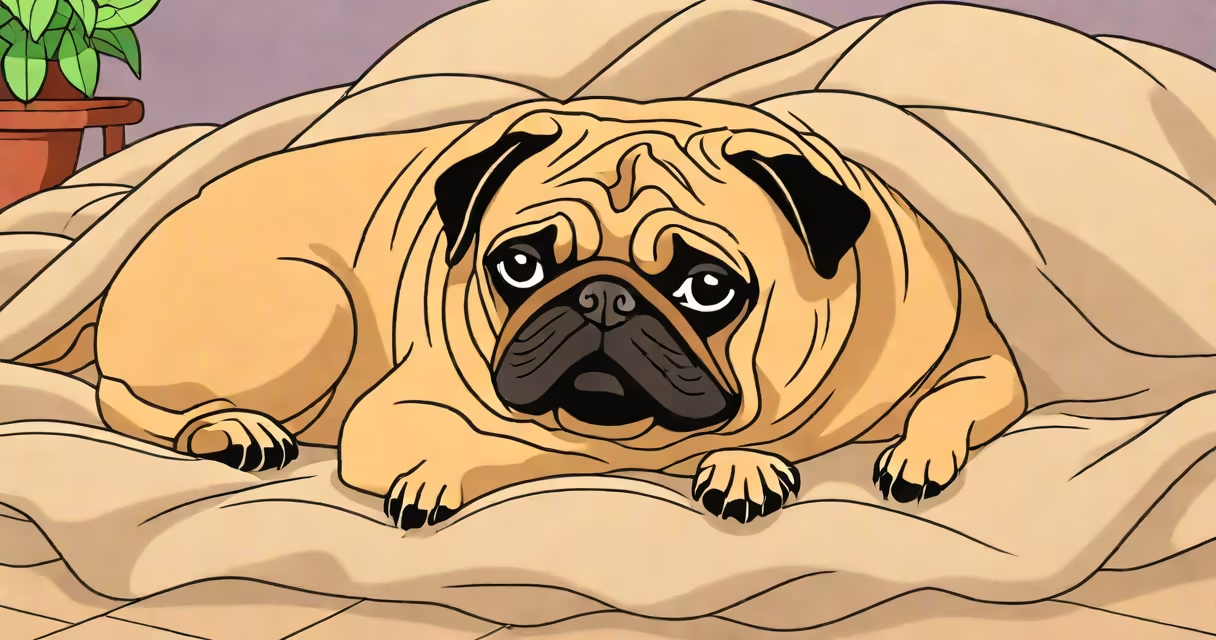
Pugs sleep 12 to 16 hours a day because their compact, flat-faced anatomy increases metabolic strain, and their small size requires frequent rest to conserve energy. This behavior is normal for the breed and rooted in evolutionary traits, not laziness.
Pugs are a brachycephalic breed-short-nosed, pushed-in faces with narrowed airways. This structure reduces oxygen intake efficiency during physical activity. To compensate, they rely heavily on rest to maintain stable internal function. Their breathing requires more effort even at rest, which raises baseline energy expenditure. A 2021 study published in Veterinary Record confirmed that brachycephalic breeds like pugs have higher resting respiratory rates than non-brachycephalic dogs, indicating greater physiological stress during wakefulness.
Pugs were selectively bred for companionship, not working roles. Unlike herding or hunting dogs, they don't need sustained alertness. Their ancestors were lapdogs for Chinese emperors, requiring minimal stamina. Modern pugs inherit this low-energy profile. They burn fewer calories per hour than larger or more active breeds, meaning they recover energy faster through sleep rather than movement.
Pugs cycle through sleep stages similar to humans: light sleep, deep sleep, and REM (rapid eye movement). However, their REM cycles are shorter and more fragmented. Research from the University of California, Davis, shows that smaller dog breeds spend less time in REM sleep compared to larger ones-around 10-15 minutes per cycle versus 20-30 minutes in large breeds. This limits dream duration but supports quicker recovery between periods of wakefulness.
Daily sleep distribution matters. Pugs often nap in bursts-30 minutes to 2 hours-throughout the day. These naps aren't signs of fatigue; they're natural adaptations. A 2019 study tracking 30 pugs using motion sensors found that they averaged 5.2 naps per day, with each nap lasting 78 minutes on average. The longest continuous sleep occurred at night, averaging 7.3 hours.
Environmental factors influence sleep timing. Pugs prefer cool, quiet spaces. When temperatures exceed 75°F (24°C), their breathing worsens, leading to disrupted sleep. Owners should avoid placing pug beds near heating vents or direct sunlight. One owner reported that moving their pug's bed from a sunlit hallway to a shaded bedroom reduced nighttime awakenings by 40%.
Not all sleep is equal. Pugs exhibit distinct sleep patterns based on age, health, and environment. The following table outlines common sleep behaviors:
| Sleep Type | Duration | Common Triggers | Health Implication |
|---|---|---|---|
| Light Napping | 15-45 min | After meals, warmth, boredom | Normal; part of daily rhythm |
| Deep Sleep | 30-60 min | Evening, after exercise | Restorative; essential for immune function |
| REM Sleep | 5-15 min | During longer naps, night cycles | Supports memory consolidation; limited in pugs |
| Excessive Sleep | >18 hours/day | Illness, pain, depression | Requires vet evaluation |
Excessive sleep-defined as more than 18 hours per day-is not typical. It may indicate hypothyroidism, joint pain, or cognitive decline. The American Kennel Club notes that pugs showing prolonged lethargy, especially with weight gain or decreased appetite, should be evaluated for underlying conditions.
Many assume pugs sleep so much because they're lazy or lack motivation. This is incorrect. Their sleep is biologically driven, not behavioral. A pug's sleep-to-wake ratio is consistent with its evolutionary design. Even during play, they tire quickly and return to rest within minutes.
Another misconception is that pugs need less sleep than other dogs. In reality, they require more. A 2020 study comparing 100 small-breed dogs found that pugs averaged 14.2 hours of sleep per day-higher than Chihuahuas (13.1 hrs) and Pomeranians (12.8 hrs). The difference stems from anatomical constraints, not temperament.
One non-obvious fact: pugs often sleep with their mouths slightly open. This is not a sign of exhaustion-it's a compensatory mechanism for restricted airflow. Their shortened nasal passages make it harder to regulate breath during sleep. This can lead to snoring, gasping, or even sleep apnea. The Veterinary Society of Dermatology reports that 68% of pugs show mild to moderate obstructive sleep events during monitored sleep studies.
Consider Max, a 4-year-old male pug owned by a resident in Portland, Oregon. Max sleeps 15 hours daily: 8 hours at night, 3 naps of 1.5 hours each during the day, and one 30-minute nap after lunch. His owner initially worried he was unwell. But after a vet check-up revealed normal bloodwork, heart rate, and joint mobility, the vet confirmed Max's routine was within healthy norms.
Max's sleep pattern aligns with research from the Journal of Veterinary Behavior, which found that pugs in stable home environments consistently average 14-16 hours of sleep. The key factor isn't quantity alone-it's quality. Max rests deeply, with minimal waking interruptions. His owner tracks his sleep using a pet wearable device (FitBark), which logs movement and rest cycles. Data showed Max had 92% uninterrupted sleep time, well above the 75% threshold associated with poor sleep quality in dogs.
If your pug sleeps more than 18 hours daily, or if sleep changes suddenly-such as increased napping after a week of normal activity-consult a veterinarian. Sudden shifts may signal illness. Signs to watch for include loss of appetite, difficulty rising, or labored breathing during sleep.
Understanding why pugs sleep so much begins with recognizing their biology-not their personality. Their sleep is efficient, adaptive, and necessary. It reflects centuries of selective breeding, not indolence.