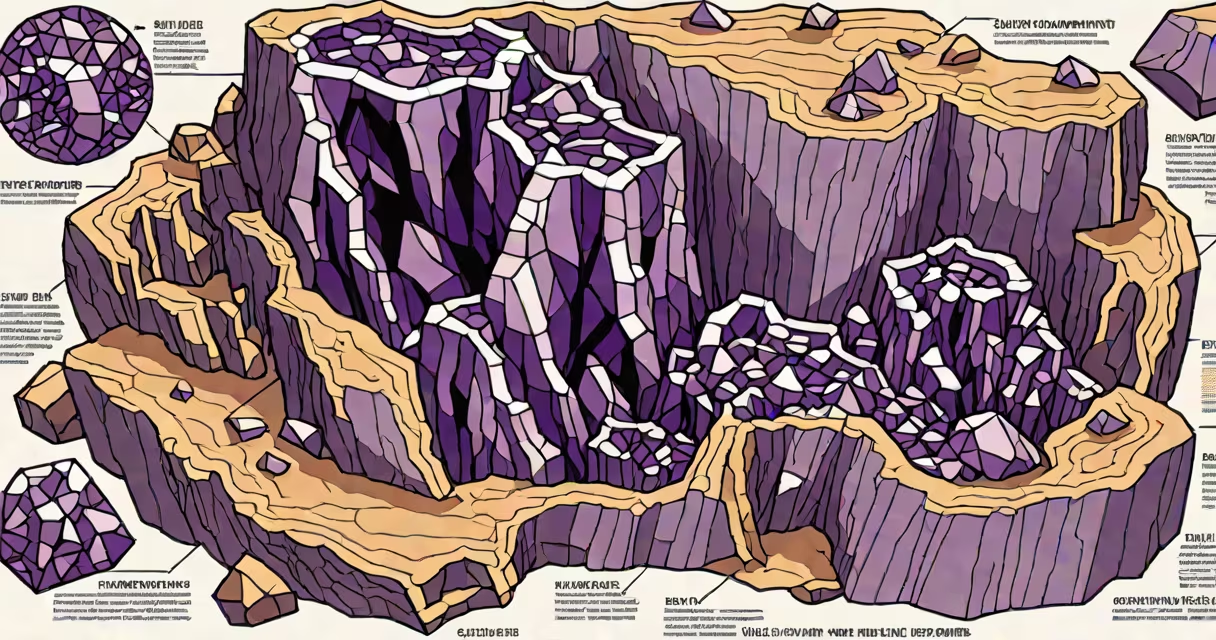
Amethyst forms when silica-rich hydrothermal fluids infiltrate cavities in volcanic rock and slowly crystallize into purple quartz under heat and pressure over thousands to millions of years. The purple color arises from iron impurities and radiation exposure during crystal growth.
Amethyst is different quartz (SiO₂) with a distinctive violet hue. Its formation begins deep underground, where magma cools and creates porous or fractured rock. Water rich in dissolved silica seeps into these spaces, often driven by tectonic activity or residual heat from cooling igneous bodies. As the fluid cools gradually, silica precipitates out and builds crystal lattices layer by layer.
The key factor that turns clear quartz into amethyst is trace amounts of iron (Fe³⁺) within the crystal structure. When exposed to natural radiation-such as gamma rays from nearby radioactive minerals-these iron ions absorb energy and alter the way light passes through the crystal. This interaction causes the absorption of certain wavelengths, resulting in the visible purple color. Without iron and radiation, the stone remains clear quartz.
Amethyst development occurs in stages, each requiring specific conditions. The process starts with the creation of a void-typically a gas pocket in cooling lava or a crack in solidified basalt. These openings provide space for mineral-laden fluids to enter and deposit material over time.
Hydrothermal fluids carry dissolved silica, water, and trace elements like iron, aluminum, and titanium. As temperature drops-from around 100°C to 20°C-the solubility of silica decreases. This triggers precipitation, where atoms align into ordered crystal structures. Growth rates average 0.1 to 1 millimeter per year, depending on fluid flow and chemistry.
Color development happens during or shortly after crystal formation. Iron ions substitute for silicon in the crystal lattice. Subsequent exposure to natural radiation-common in continental crusts with uranium or thorium-excites electrons in the iron, leading to the characteristic purple absorption spectrum. The intensity of color correlates with iron concentration and duration of radiation exposure.
Amethyst occurs in several distinct geological settings, each producing variations in crystal size, clarity, and color saturation. The most common types are based on location and formation environment.
| Type | Formation Environment | Typical Color Range | Notable Locations |
|---|---|---|---|
| Geode amethyst | Cavities in basaltic lava flows | Pale to deep violet | Uruguay, Brazil, South Dakota |
| Druse amethyst | Fractures in granite or rhyolite | Light lavender to grayish-purple | Madagascar, India |
| Crystal clusters | Hydrothermal veins in metamorphic rock | Deep purple to reddish-violet | Ural Mountains, Russia |
Geodes-cavity-lined rocks filled with crystals-are among the most iconic sources. In Uruguay, large geodes form in ancient lava flows where gases escaped during cooling. Over time, groundwater enriched with silica and iron seeped in, depositing layers of quartz. After millions of years, these deposits formed massive amethyst clusters, some reaching over 1 meter in diameter.
A lesser-known fact: not all purple quartz is amethyst. Some stones labeled "amethyst" in retail markets are artificially heated to mimic the color. Natural amethyst requires both iron and radiation-conditions absent in lab-grown or treated stones. True amethyst cannot be created in a lab without simulating geological timescales and natural radiation sources.
Many assume amethyst forms directly from molten lava. This is incorrect. Lava cools too quickly for slow crystal growth. Instead, amethyst develops in post-magmatic environments-after the rock has solidified and cooled. The fluid phase is essential; without it, silica cannot move and deposit in structured patterns.
Another myth is that amethyst only forms in high-pressure zones. While pressure influences crystal quality, amethyst commonly forms at shallow depths (1-5 km) under moderate pressure. The critical factors are temperature stability, fluid composition, and time-not extreme pressure.
I once examined a sample from a mine in Siberia where amethyst grew in a network of fractures within rhyolite. The crystals were aligned along stress planes, indicating slow, directional growth. The core showed faint zoning-alternating bands of pale and dark purple-proving the fluid chemistry changed over time. This visual evidence confirmed that amethyst formation is not instantaneous but a gradual process spanning centuries.
According to the United States Geological Survey (USGS), amethyst deposits are primarily associated with hydrothermal systems linked to volcanic activity. Their 2021 report on gemstone formation notes that "iron-doped quartz crystals develop purple hues only when subjected to prolonged exposure to ionizing radiation in natural geological settings."
The Mineralogical Society of America confirms that the color centers responsible for amethyst's hue are due to Fe³⁺ ions in tetrahedral coordination with oxygen. Their 2019 study on crystal defects shows that radiation-induced electron traps in the quartz lattice absorb blue and green light, leaving the red and violet components visible to the human eye.
These findings validate that amethyst is not simply colored quartz-it is a structurally complex mineral whose color results from atomic-scale interactions over long periods.
Understanding how amethyst forms reveals more than geology-it illustrates how Earth's hidden processes create beauty. From molten rock to purple crystal, the process takes millions of years and relies on precise chemical and physical conditions. The result is a stone valued for its color, clarity, and history.