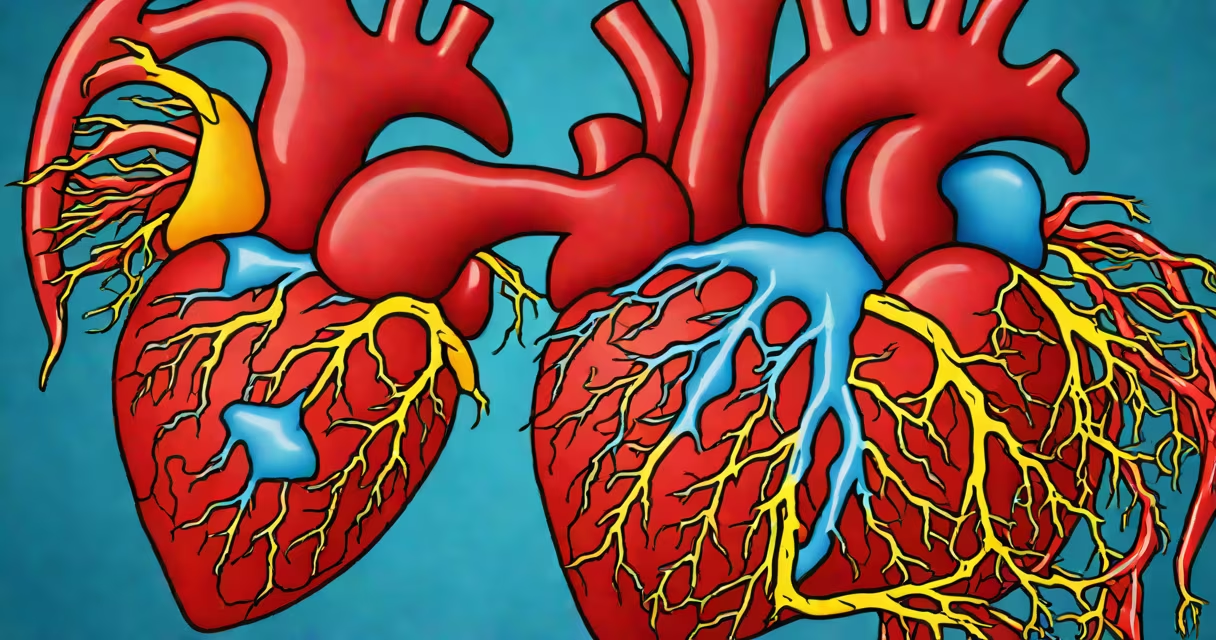
Acute coronary syndromes (ACS) are emergencies caused by abrupt reduction or complete blockage of blood flow to the heart muscle, leading to tissue damage or death. They result from rupture of atherosclerotic plaques in coronary arteries, triggering clot formation and impaired oxygen delivery.
ACS encompasses three main clinical presentations: ST-elevation myocardial infarction (STEMI), non-ST-elevation myocardial infarction (NSTEMI), and unstable angina. All stem from acute myocardial ischemia-oxygen deprivation in heart tissue-but differ in severity and diagnostic markers. STEMI involves complete arterial occlusion visible on electrocardiogram (ECG) as ST-segment elevation. NSTEMI shows no ST changes but elevated cardiac biomarkers like troponin. Unstable angina presents with chest pain at rest, no biomarker rise, and no ECG changes.
Coronary artery disease (CAD) underlies most ACS cases. Plaque buildup narrows arteries over time. When a plaque ruptures, platelets aggregate rapidly, forming a thrombus. This process typically occurs within minutes, leading to irreversible myocardial injury if blood flow isn't restored. The American Heart Association reports that approximately 785,000 Americans experience a new or recurrent ACS event annually, with 200,000 resulting in death before hospital arrival.
ACS begins with endothelial injury in a coronary artery, often due to hypertension, smoking, diabetes, or high cholesterol. This triggers inflammation and lipid deposition, forming atherosclerotic plaques. Over time, these plaques grow and may become vulnerable-thin-cap fibroatheromas with large lipid cores and thin fibrous caps.
Plaque rupture exposes collagen and tissue factor to circulating blood. Platelets adhere instantly, activating coagulation cascades. Fibrin strands form a mesh around aggregated platelets, creating a thrombus. Within 30 minutes, this clot can obstruct the vessel lumen completely. Myocardial cells begin dying after about 20 minutes without oxygen, with necrosis becoming irreversible after 60-90 minutes.
A 2021 study published in Circulation found that patients who received reperfusion therapy (e.g., angioplasty or thrombolytics) within 90 minutes of symptom onset had a 40% lower mortality rate compared to those treated after two hours. Early intervention remains the single most critical determinant of survival.
The classification of ACS relies on ECG findings and cardiac biomarker levels. A clear differentiation between STEMI and NSTEMI is essential for treatment selection.
| Type | ECG Changes | Troponin Levels | Treatment Approach |
|---|---|---|---|
| STEMI | ST-segment elevation in contiguous leads | Elevated | Immediate reperfusion: primary PCI or fibrinolytic therapy |
| NSTEMI | No ST elevation; may show T-wave inversion or ST depression | Elevated | Invasive strategy within 24-72 hours; antiplatelet and anticoagulant therapy |
| Unstable Angina | No ST elevation or depression; may have changing changes | Normal or borderline | Risk stratification; early invasive evaluation if high-risk features present |
One common misconception is that all chest pain requiring hospitalization is a heart attack. In reality, unstable angina lacks detectable myocardial necrosis. Patients with unstable angina have normal troponin levels but exhibit high-risk symptoms such as new-onset or worsening exertional chest pain, lasting longer than 10 minutes, or occurring at rest. Misdiagnosis can delay necessary interventions.
Another key distinction: not all ACS events involve plaque rupture. In rare cases, spontaneous coronary artery dissection (SCAD) causes ACS, particularly in young women without traditional risk factors. SCAD accounts for less than 1% of ACS cases but is responsible for up to 10% of heart attacks in women under 50, according to the National Institutes of Health.
Many patients present with atypical symptoms. Women, older adults, and people with diabetes are more likely to report fatigue, nausea, shortness of breath, or back/jaw pain rather than crushing chest pressure. A 2020 analysis in JAMA Internal Medicine showed that women were 30% less likely than men to receive timely reperfusion therapy despite similar symptom profiles.
Some assume that a normal ECG rules out ACS. This is false. Up to 10% of STEMI cases initially show no ST elevation. Changing ECG changes-such as evolving T-wave inversions or new left bundle branch block-can precede definitive ST changes. Delaying treatment based solely on a single normal ECG increases risk of complications.
I once observed a 67-year-old man arrive at the emergency department with severe epigastric pain and diaphoresis. His initial ECG was unremarkable. Troponin rose from 12 ng/L to 480 ng/L over four hours. A coronary angiogram revealed a 95% occlusion in the proximal left anterior descending artery. He was diagnosed with NSTEMI and underwent successful percutaneous coronary intervention (PCI) within six hours. This case highlights how subtle presentations can mask significant pathology.
Time is myocardium. For STEMI, door-to-balloon time-the interval from hospital arrival to balloon inflation during PCI-should not exceed 90 minutes. The European Society of Cardiology recommends achieving this target in at least 90% of cases. Delays beyond two hours increase infarct size and long-term morbidity.
After revascularization, patients enter secondary prevention phases. Antiplatelet agents like aspirin and clopidogrel reduce recurrence risk by 30%. Statins lower LDL cholesterol below 70 mg/dL, slowing plaque progression. Lifestyle modifications-smoking cessation, dietary sodium restriction, regular aerobic exercise-reduce rehospitalization rates by nearly half over five years.
Long-term outcomes depend heavily on adherence. A 2022 cohort study in The Lancet Cardiovascular Medicine found that only 58% of ACS survivors took prescribed medications consistently after discharge. Non-adherence correlated with a 2.3-fold higher risk of recurrent events.