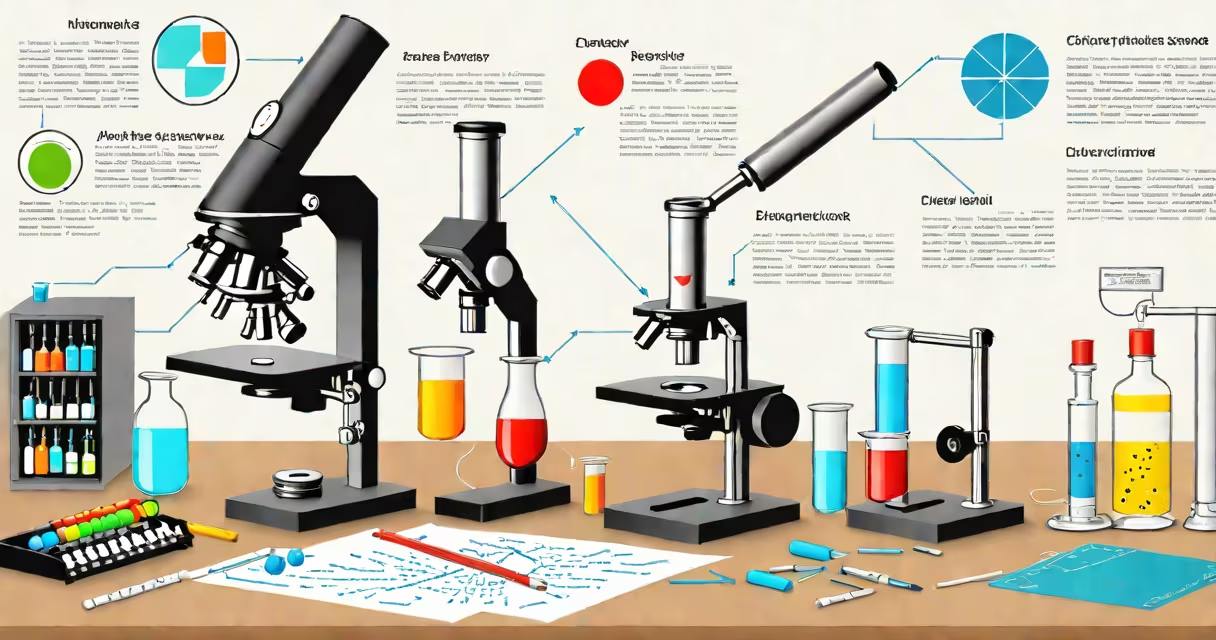
A biology major studies the structure, function, growth, origin, evolution, and distribution of living organisms. The curriculum integrates laboratory work, field research, and theoretical study across scales-from molecular interactions to system dynamics. Students explore life at multiple levels, using evidence-based methods to understand biological phenomena.
Biology majors take foundational courses in chemistry, physics, and mathematics to support their study of life processes. These courses provide the quantitative and analytical tools needed to interpret experimental data and model biological systems. The core curriculum includes genetics, biochemistry, ecology, and evolutionary biology, forming a complete understanding of life's mechanisms.
By the end of their undergraduate program, students complete advanced coursework tailored to their interests. Many pursue concentrations in areas such as microbiology, neuroscience, or conservation biology. Research experience is often required, preparing students for careers in medicine, biotechnology, or environmental science.
Biology programs follow a structured progression. First-year students typically enroll in introductory biology, general chemistry, and calculus. These courses establish the scientific foundation necessary for later specialization. For example, a student studying enzyme kinetics in biochemistry must first understand thermodynamics and reaction rates from prior chemistry training.
Second- and third-year courses build on this base. Students take classes in cell biology, genetics, and physiology. Laboratory components are essential-students perform experiments like PCR amplification, gel electrophoresis, and microbial culturing. These hands-on experiences develop technical skills and reinforce conceptual learning.
Fourth-year students often complete a capstone project or senior thesis. One student at the University of California, Davis, investigated the impact of microplastics on zebrafish development using controlled exposure trials and histological analysis. This project combined genetic screening, behavioral observation, and tissue staining-skills learned across multiple semesters of course work.
The standard biology major covers five central domains:
Many schools offer formal specializations. A student interested in disease mechanisms may choose a medical biology track, which includes courses in immunology, pathology, and pharmacology. Others may focus on cellular biology, diving deeper into organelle function, signal transduction, and cell cycle control.
| Specialization Track | Key Courses | Common Career Paths |
|---|---|---|
| Medical Biology | Human anatomy, infectious diseases, clinical diagnostics | Medical school, pharmaceutical research, public health |
| Cellular Biology | Advanced cell signaling, stem cell biology, microscopy techniques | Biotech labs, academic research, drug development |
| Environmental Biology | Conservation biology, climate change modeling, soil science | Nature reserves, government agencies, sustainability consulting |
These tracks are not rigid. A student in the medical biology path might take elective courses in evolutionary developmental biology, linking ancient genetic patterns to modern disease susceptibility.
Biology majors train professionals who contribute to healthcare, agriculture, environmental protection, and biotechnology. In healthcare, biology graduates enter medical school or work in diagnostic labs. According to the U.S. Bureau of Labor Statistics, employment in biomedical science roles is projected to grow 6% from 2022 to 2032-faster than average for all occupations.
In agriculture, biology-trained scientists develop pest-resistant crops and sustainable farming practices. For example, researchers at Iowa State University engineered corn varieties with enhanced drought tolerance through gene expression manipulation-a direct application of molecular biology principles.
Environmental biologists monitor biodiversity loss and assess pollution impacts. A team from Stanford University used DNA barcoding to identify fish species in river systems, revealing declines in native populations due to dam construction. This method relies on genetic markers taught in upper-level genetics courses.
Biology is not solely about memorizing facts. While foundational knowledge is required, the discipline emphasizes hypothesis testing, data interpretation, and critical thinking. A student may recall that mitochondria produce ATP, but they must also explain how oxidative phosphorylation couples electron transport to proton gradient formation.
Another misconception is that biology majors only prepare students for medical careers. While many do go on to become physicians, others work in policy, education, or tech. A graduate from the University of Michigan developed a mobile app that uses machine learning to identify plant diseases from smartphone images-combining botany, computer science, and field observation.
Some assume that all biology research involves animals. While vertebrate studies are common, much modern research uses model organisms like fruit flies (Drosophila melanogaster), nematodes (C. elegans), or yeast (Saccharomyces cerevisiae). These species allow controlled experiments with shorter lifespans and simpler genomes, enabling faster discovery cycles.
One non-obvious fact: biology majors often spend more time in labs than in lecture halls. At the Massachusetts Institute of Technology, students in the biology department complete over 600 hours of lab work during their four years-equivalent to nearly 15 weeks of full-time research. This experiential component builds technical proficiency and prepares students for graduate-level work.
I once assisted in a summer research program at a university in Colorado, analyzing bacterial resistance patterns in stream water samples. We collected samples from five sites along a mountain watershed, filtered them through 0.22-micron membranes, and cultured colonies on agar plates containing antibiotics. After identifying resistant strains via biochemical tests, we mapped their distribution across elevation gradients.
This project revealed that antibiotic resistance genes were more prevalent downstream of a small town's wastewater outflow. The results contributed to a local report on water quality and informed municipal planning. It demonstrated how classroom concepts-like selective pressure and horizontal gene transfer-apply directly to environmental monitoring.
Understanding what a biology major studies reveals a changing, interdisciplinary field grounded in observation, experimentation, and evidence. The knowledge gained supports innovation across sectors-from personalized medicine to system restoration.