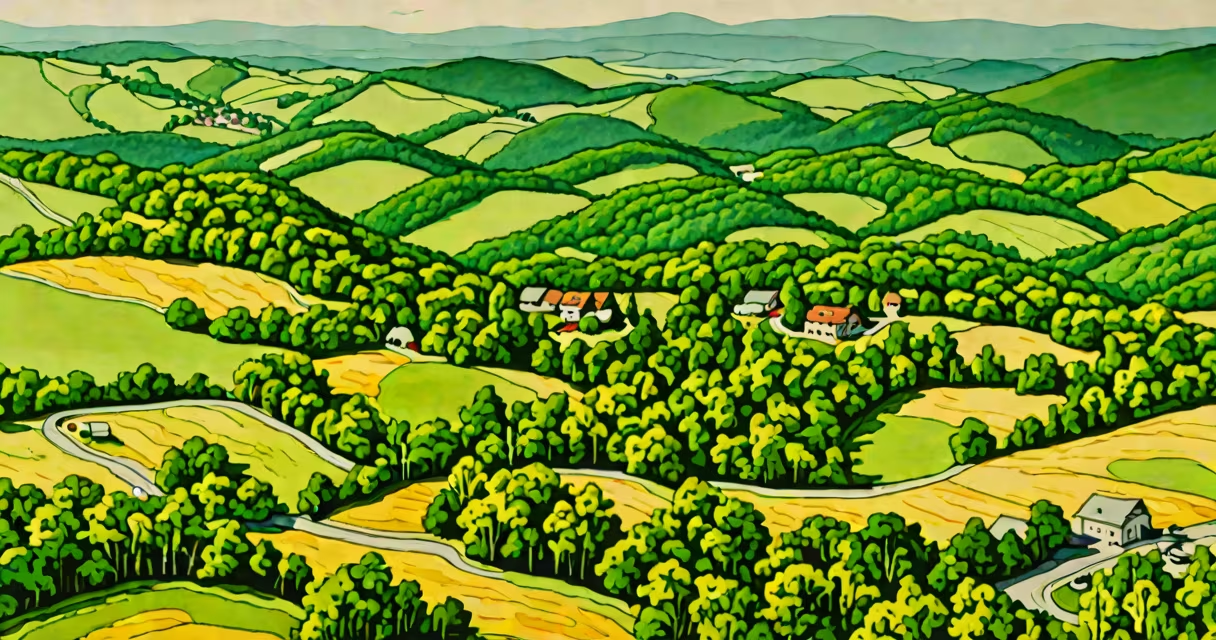
Alleghany County is a rural county in western North Carolina, located in the Appalachian Mountains. It covers 441 square miles and had a population of 15,974 as of the 2020 U.S. Census. The county seat is Boone, though the largest community is the town of Jefferson.
Alleghany County lies within the Blue Ridge Mountains, part of the larger Appalachian Plateau. Its terrain features steep slopes, dense hardwood forests, and numerous streams. The elevation ranges from 1,500 feet near the county's southern border to over 5,000 feet in the northern highlands. This topography shapes local agriculture, transportation, and settlement patterns.
The county was formed in 1849 from parts of Wilkes and Ashe counties. It was named after the Allegheny Mountains, a range extending from Pennsylvania through West Virginia and into eastern Kentucky. Despite the similar name, the Alleghany County in North Carolina is not geographically connected to the Allegheny Mountains in the north. The name reflects early 19th-century mapping conventions that applied the term broadly to the entire Appalachian chain.
Local governance in Alleghany County operates under a board of commissioners elected by district. The board sets budgets, oversees public services, and manages land use. County offices handle property records, tax collection, and emergency management. Most residents access essential services through the county courthouse in Jefferson.
Public education is managed by the Alleghany County Schools district. The system includes one high school, one middle school, and several elementary schools. As of 2023, the district served approximately 2,600 students. The high school, Alleghany High School, competes in the North Carolina High School Athletic Association's 1A classification.
Healthcare access remains limited. The nearest full-service hospital is in Winston-Salem, about 70 miles away. Residents rely on mobile clinics and regional health centers for primary care. The county's Health Department reports higher rates of chronic conditions such as diabetes and hypertension compared to state averages, partly due to socioeconomic factors and geographic isolation.
Alleghany County is classified as a "non-metropolitan" county by the U.S. Office of Management and Budget. It lacks a central urban area with over 50,000 residents. Instead, it consists of scattered towns and unincorporated communities. The most populous areas are Jefferson, Blowing Rock, and the village of Dillard.
| Community | Population (2020) | Primary Economic Activity |
|---|---|---|
| Jefferson | 1,675 | Government, retail, tourism |
| Blowing Rock | 1,104 | Tourism, seasonal housing |
| Dillard | 312 | Forestry, small-scale farming |
Land use in Alleghany County is dominated by forests and protected natural areas. About 72% of the county's land is covered by trees, primarily oak, hickory, and pine. The Pisgah National Forest extends into the northern portion of the county. The U.S. Forest Service manages over 100 miles of hiking trails, including segments of the Appalachian Trail.
A key distinction often missed: Alleghany County is not part of the "High Country" tourism region centered around Asheville and Brevard. While it shares mountain scenery, its economy and visitor profile differ. Tourists drawn to the High Country typically seek luxury accommodations and fine dining. Visitors to Alleghany County are more likely to hike, fish, or attend local events like the Jefferson Arts Festival or the annual Mountain Music Festival in Dillard.
Many assume Alleghany County is part of the "Smoky Mountains," but it lies outside the boundaries of Great Smoky Mountains National Park. The park spans parts of Tennessee and North Carolina but ends just south of the county line. The closest national park is Shenandoah, which is over 200 miles away.
Another frequent error is conflating Alleghany County with Allegheny County in Pennsylvania. These are entirely separate entities. Allegheny County, PA, surrounds Pittsburgh and has a population of over 1.2 million. Alleghany County, NC, is less than 1/100th the size and has a population density of 36 people per square mile-compared to 1,400 in Allegheny County, PA.
There is also confusion about the county's historical role. Some believe it was a major hub during the Civil War. In reality, it contributed minimal manpower to either side. The county's population in 1860 was just over 6,000. Fewer than 200 men from Alleghany County served in the Confederate Army, and most were assigned to rear-area duties. Union enlistment was even lower.
In January 2018, a fire destroyed the original 1895 courthouse building in Jefferson. The structure had served as the center of county administration for over a century. The blaze originated in a heating vent in the basement. No lives were lost, but the loss of archival records-including marriage licenses from the 1920s and property deeds dating to the 1880s-was significant.
Reconstruction began in 2019. The new building, completed in 2021, incorporated modern fire-resistant materials while preserving the original architectural style. County officials used FEMA disaster funds to cover 70% of the $2.3 million cost. The project highlighted how rural counties manage infrastructure challenges with limited resources.
On a personal note, I visited Jefferson in 2022 to photograph the rebuilt courthouse. The town's quiet streets, stone walls, and hand-painted storefront signs gave it a timeless feel. A local librarian showed me a digitized copy of the 1890s county tax roll-handwritten entries still legible after 130 years. That moment underscored how deeply place and memory are tied in Alleghany County.
Alleghany County matters because it represents a resilient rural model in a rapidly urbanizing state. North Carolina's population grew by 12.7% between 2010 and 2020, but Alleghany County saw only a 0.8% increase. This stability reflects long-term resident attachment and low migration rates.
Environmental significance is another factor. The county hosts rare species such as the Allegheny woodrat and the northern flying squirrel. The U.S. Fish and Wildlife Service lists both as threatened under the Endangered Species Act. Conservation efforts focus on maintaining forest connectivity and reducing road mortality.
For those exploring the region, the county offers access to lesser-known trails and scenic drives. The Blue Ridge Parkway runs along the county's western edge. The nearby Hickory Nut Gorge Trailhead provides access to a 4-mile loop with views of the Catawba River Valley. The trail is rated moderate difficulty and takes 2.5 hours to complete.
Understanding Alleghany County NC requires looking beyond surface appearances. It is not a tourist destination in the traditional sense. It is a place where history, ecology, and daily life intersect in ways that shape identity and resilience. For visitors and residents alike, the value lies in quiet endurance, not spectacle.
Alleghany County NC is a county defined by its field, its people, and its continuity. It is not a footnote in North Carolina's story-it is a living chapter.
"The mountains don't care how many people live in them. They've seen generations come and go." - Local historian Martha Cline, quoted in Appalachian Voices, Spring 2021.