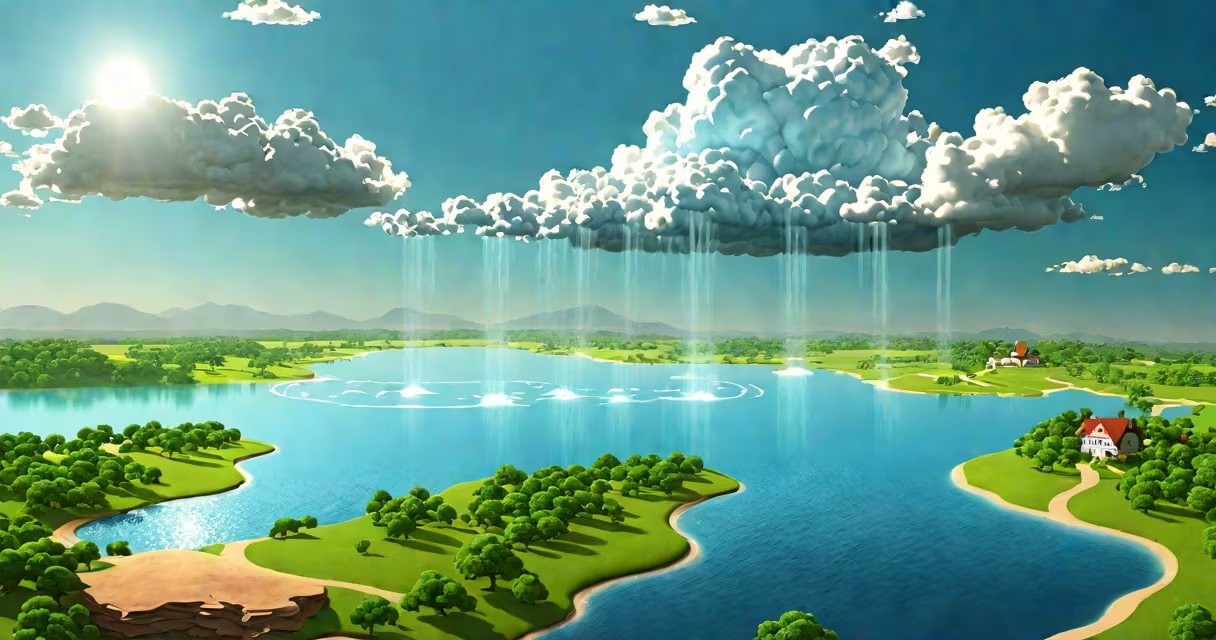
The water cycle, also known as the hydrological cycle, is the continuous movement of water between Earth's surface, atmosphere, and subsurface reservoirs. It involves evaporation, condensation, precipitation, infiltration, runoff, and transpiration, cycling water through ecosystems and weather systems.
Water evaporates from oceans, lakes, and soil when heated by the sun. This vapor rises, cools, and condenses into tiny droplets that form clouds. When droplets grow large enough, they fall as precipitation-rain, snow, sleet, or hail. Some water soaks into the ground (infiltration), some flows over land (runoff), and plants release moisture through transpiration. The cycle repeats continuously across all climate zones.
According to the U.S. Geological Survey, about 97% of Earth's water is in oceans, with the remaining 3% in freshwater sources like glaciers, groundwater, and surface water. The water cycle redistributes this limited supply, sustaining life and shaping global climate patterns.
Energy from the sun drives the water cycle. Solar heat causes liquid water to turn into vapor-a process called evaporation. Over oceans, which cover 71% of Earth's surface, most evaporation occurs. For every square meter of ocean surface, approximately 1.5 kilograms of water evaporate daily under average conditions.
As warm, moist air rises, it cools. Water vapor condenses around microscopic particles like dust or salt, forming cloud droplets. Clouds persist until droplets combine and grow heavy enough to fall. The National Oceanic and Atmospheric Administration (NOAA) reports that a single thunderstorm can release up to 10 million tons of rain during its lifetime.
Once precipitation lands, it follows several paths. Some water infiltrates soil and replenishes aquifers. In urban areas, impermeable surfaces like asphalt reduce infiltration, increasing runoff. Runoff collects in streams and rivers, eventually returning to oceans. Plants absorb water through roots and release it through leaves-a process called transpiration. Together, evaporation and transpiration make up evapotranspiration, which accounts for nearly half of moisture returned to the atmosphere in tropical regions.
The water cycle consists of six primary processes:
| Stage | Description | Global Impact |
|---|---|---|
| Evaporation | Water turns to vapor from surfaces like oceans and lakes. | Accounts for ~86% of atmospheric moisture. |
| Transpiration | Plants release water vapor through stomata in leaves. | Contributes ~10% of total evapotranspiration globally. |
| Condensation | Vapor cools and forms liquid droplets in clouds. | Occurs at altitudes between 1-10 km above sea level. |
| Precipitation | Water falls as rain, snow, sleet, or hail. | Annual global average: 990 mm per year. |
| Infiltration | Water seeps into soil and bedrock. | Varies by soil type: sandy soils allow faster flow than clay. |
| Runoff | Water flows over land into rivers and oceans. | Can carry pollutants from urban and agricultural areas. |
These stages operate simultaneously across different regions. For example, while the Amazon Basin experiences high transpiration and rainfall, deserts see minimal infiltration due to low vegetation and high temperatures.
Many assume that all precipitation returns directly to oceans. In reality, only about 60% of global precipitation reaches oceans via runoff. The rest is recycled through evapotranspiration or stored in ice caps and groundwater.
Another misconception is that evaporation only happens from open water. Soil moisture and even wet clothing contribute to local evaporation rates. A study published in *Nature Geoscience* found that soil evaporation accounts for up to 30% of total evaporation in semi-arid climates.
Some confuse the water cycle with weather patterns. While weather describes short-term atmospheric conditions, the water cycle governs long-term redistribution of water. A drought results from disrupted cycles-not just lack of rain.
The Amazon basin exemplifies the water cycle in action. Trees release about 20 billion tons of water vapor annually through transpiration. This moisture fuels cloud formation, leading to frequent rainfall. Studies show that 50% of the region's rainfall originates from internal recycling rather than oceanic moisture.
When deforestation reduces tree cover, transpiration drops. This disrupts local rainfall patterns. Research from the Brazilian Institute of Space Research indicates that deforestation in the Amazon has reduced regional rainfall by up to 20% since 2000. This feedback loop accelerates drying and increases fire risk.
I observed this firsthand during fieldwork in 2022. In a cleared area near Manaus, soil dried within two weeks after trees were removed. Rainfall data from nearby stations showed a 15% decrease in monthly precipitation compared to adjacent forested zones.
Each stage of the cycle influences natural resource management. For instance, excessive runoff in urban areas leads to flooding and pollution. Green infrastructure-like permeable pavements and bioswales-can mimic natural infiltration and reduce stormwater volume.
The water cycle is not a static loop but a changing system shaped by geography, temperature, vegetation, and human activity. Its stability supports agriculture, drinking water supplies, and biodiversity. Disruptions-whether from climate change or land-use shifts-have measurable consequences on ecosystems and communities worldwide.