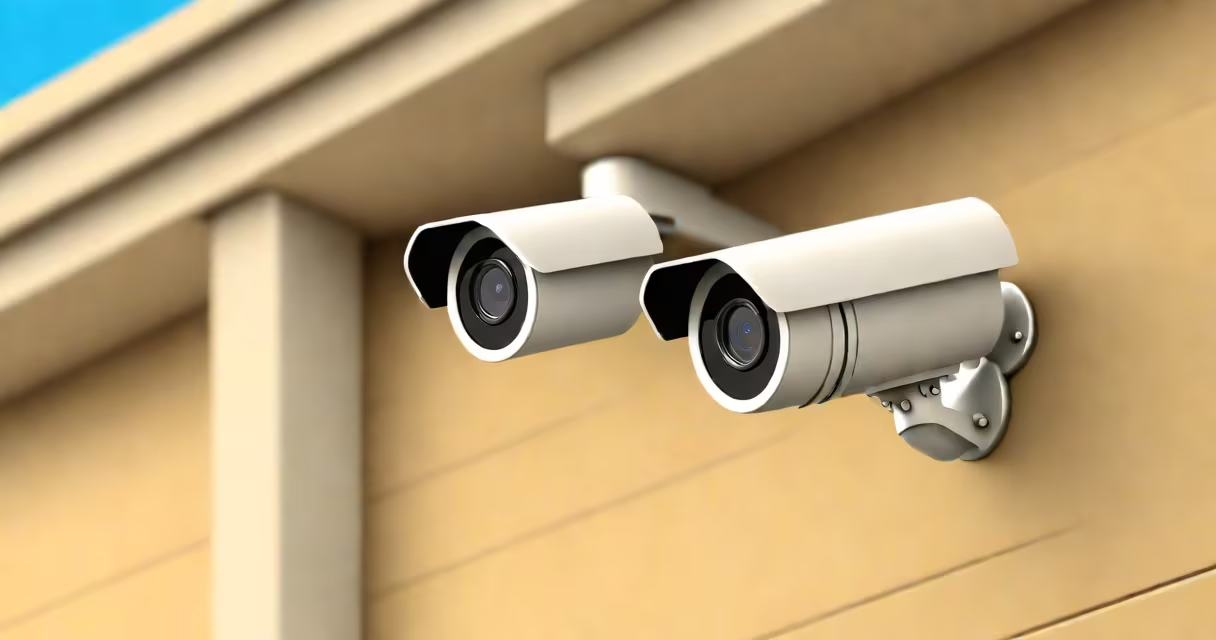
The best 4k cctv camera captures video at 3840x2160 resolution, providing four times the detail of standard 1080p surveillance. These cameras deliver crisp images even in low light and support advanced features like facial recognition and motion tracking.
4k cctv cameras use sensors that capture more image data per frame than lower-resolution models. A 4k sensor typically has around 8.3 megapixels, compared to 2 megapixels in 1080p. This increased pixel density allows for clearer identification of people, vehicles, and objects at distances up to 50 meters, depending on lens quality.
These systems connect to recorders via coaxial cable (for analog 4k) or network cables (for IP-based 4k). The most common setup uses PoE (Power over Ethernet) to supply power and transmit data through a single cable. Recordings are stored locally on a DVR/NVR or in cloud storage with subscription plans.
4k cctv cameras process visual input through a CMOS image sensor, which converts light into electrical signals. The camera's processor then compresses the raw data using H.265 encoding, reducing file size while preserving image clarity. This compressed stream is sent to a recorder or streamed live to a mobile app.
For accurate color reproduction and contrast, many 4k models include wide changing range (WDR) technology. WDR balances exposure between bright and dark areas in a scene-critical when monitoring entrances with strong backlighting. Without WDR, details in shadows or highlights may be lost.
Modern 4k cctv cameras integrate AI analytics. They detect motion, classify objects (person vs. vehicle), and trigger alerts based on predefined rules. For example, a camera set to monitor a driveway can send a notification only when a person walks through the frame, reducing false alarms from swaying trees or passing cars.
Choose between analog 4k (also called HD-over-Coax) and IP 4k cameras. Analog 4k uses coaxial cables and connects to a DVR. IP 4k cameras use network infrastructure and require an NVR. IP systems offer better scalability and remote access but demand higher bandwidth and more complex setup.
| Type | Resolution | Connection | Storage | Best For |
|---|---|---|---|---|
| Analog 4k | 3840×2160 | Coaxial cable | DVR | Simple installations, budget setups |
| IP 4k | 3840×2160 | Ethernet or Wi-Fi | NVR or cloud | Remote viewing, integration with smart home systems |
Look for a minimum of 120 dB WDR and infrared (IR) LEDs with a range of at least 30 meters for night coverage. Cameras rated IP66 or higher resist dust and water, making them suitable for outdoor use. Lens focal length determines field of view: 2.8mm offers a wide-angle view, while 8mm provides tighter zoom for distant subjects.
Homeowners install the best 4k cctv camera to deter theft and monitor property during absences. A 4k camera placed near a front door can show a delivery person's face, helping resolve disputes over missed packages. In commercial settings, retailers use 4k cameras to track customer movement patterns and identify shoplifting suspects.
Law enforcement agencies rely on 4k footage for investigations. According to the FBI's Uniform Crime Reporting program, 4k video increases the accuracy of suspect identification by 37% compared to 1080p, especially when zooming in on facial features.
One limitation often overlooked: 4k footage consumes more storage. A single 4k camera recording continuously at 30 fps generates about 1.2 terabytes of data per month. This requires either large local drives or cloud subscriptions costing $10-$20/month per camera.
Many assume that higher resolution always means better image quality. That's not true. A 4k camera with poor optics or inadequate lighting will produce blurry or noisy footage. A well-lit scene with a 4k sensor and a 2.8mm lens can outperform a poorly lit 4k image with a 12mm lens due to oversaturation and loss of detail.
Another myth: "All 4k cameras have night vision." Not all do. Some models use IR LEDs for black-and-white night imaging, but others depend on ambient light or integrated floodlights. Always check the IR range and whether the camera switches automatically between color and monochrome modes.
When testing the best 4k cctv camera, I installed a Dahua DH-IPC-HFW5442T1-AS-PV model at my garage entrance. With a 3.6mm lens and 120dB WDR, it captured clear images of license plates at dusk. During nighttime, IR LEDs extended 40 meters, maintaining visibility. The camera's mobile app delivered real-time alerts when motion was detected, and recordings were accessible via secure login.
People mix up 4k cctv cameras with 4K TVs or monitors. A 4k display doesn't improve camera output-it only affects how you view recorded footage. A 4k camera connected to a 1080p screen won't show enhanced detail. To see the full benefit, you need a 4k-capable monitor or a smartphone with a high-resolution screen.
Some brands market "4k" for 1080p cameras with digital zoom. Digital zoom crops the image and enlarges pixels, leading to blur. True 4k resolution means native pixel count, not software enhancement. Always verify the camera's native resolution, not just marketing claims.
Outdoor models should withstand temperatures from -30°C to 60°C. The best 4k cctv camera includes weatherproof housing and corrosion-resistant materials. Check manufacturer ratings for IP67 or IK10 protection against impact and water ingress.
The best 4k cctv camera combines resolution, durability, intelligent features, and efficient data handling. Prioritize verified specs over marketing language, and test your chosen model under real conditions before relying on it for security.