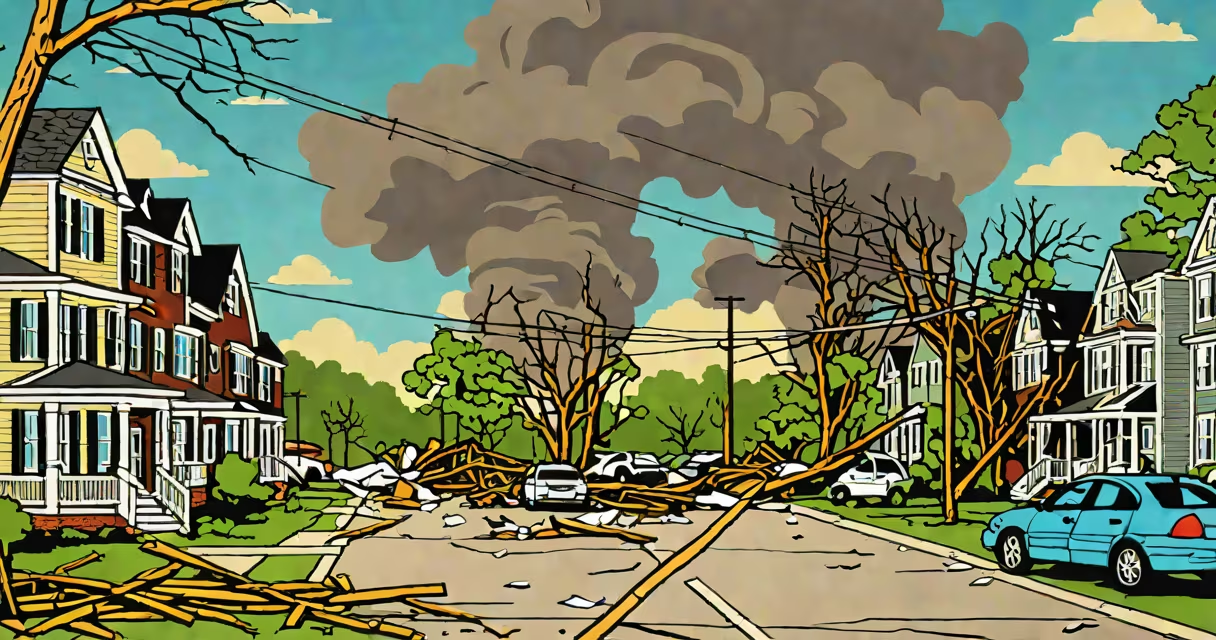
A tornado in Fayetteville NC is a violent, rotating column of air extending from a thunderstorm to the ground, capable of causing significant structural damage and injury. The most recent confirmed event occurred on April 16, 2022, when a tornado touched down in Cumberland County, prompting emergency response and localized evacuations.
Tornadoes form when warm, moist air collides with cool, dry air in unstable atmospheric conditions. In Fayetteville's climate, such setups are uncommon but not impossible. The National Weather Service (NWS) classifies tornadoes using the Enhanced Fujita Scale (EF-Scale), which rates intensity from EF0 (light damage) to EF5 (incredible destruction). The 2022 Fayetteville tornado was rated EF2, indicating wind speeds between 113 and 157 mph and damage consistent with roof removal, tree uprooting, and mobile home destruction.
Despite being located in a region historically less prone to tornadoes than the Midwest, Fayetteville lies within Tornado Alley's eastern fringe. The Southeastern U.S. experiences about 1,000 tornadoes annually, with North Carolina averaging 15-20 per year. Of those, fewer than 5% occur in the Sandhills and Coastal Plain regions, including Cumberland County. The 2022 event marked the first confirmed tornado in Fayetteville since 2014, underscoring how infrequent but impactful such events can be.
Tornado development begins with a supercell thunderstorm-a rotating updraft that can sustain itself for hours. In Fayetteville, these storms typically form during late winter and early spring when cold fronts push through the Carolinas. The collision of Gulf moisture with cooler air masses creates instability, fueling storm rotation.
The NWS uses Doppler radar to detect rotation signatures called mesocyclones. When a radar shows a hook echo or velocity couplet, meteorologists issue a tornado warning. In the 2022 incident, the Fayetteville NWS office issued a warning 12 minutes before touchdown, giving residents time to seek shelter. The average lead time for tornado warnings in North Carolina is 14 minutes, according to NOAA.
Once a tornado touches down, ground teams assess damage via spotter networks and aerial surveys. The NWS conducted a damage survey after the 2022 event, confirming a path length of 2.3 miles and a width of 150 yards. This data determines the official EF rating.
Fayetteville's tornado risk falls under the "low" category on the Storm Prediction Center's hazard map. However, low probability does not equate to zero risk. The city's mix of suburban neighborhoods, forests, and flat terrain increases vulnerability to wind damage.
| Type | Frequency in NC | Typical Path | Risk in Fayetteville |
|---|---|---|---|
| EF0-EF1 | 70% | Short duration, narrow paths | Low to moderate |
| EF2-EF3 | 25% | 1-5 miles long, wider damage zones | Low but present |
| EF4-EF5 | 5% | Rare, extreme destruction | Extremely low |
Most tornadoes in North Carolina occur between March and June. Fayetteville sees peak activity in April and May, aligning with seasonal temperature shifts. The 2022 event happened on April 16, matching historical patterns.
Many assume tornadoes only form in flat plains. That's false. While the Great Plains see more frequent tornadoes due to geography, the Southeast experiences them too-often with higher intensity. The 2022 Fayetteville tornado was stronger than typical for the region, highlighting that even low-risk areas face high-end threats.
Another myth: "Tornadoes avoid cities." In reality, they strike urban centers regularly. The 2022 event damaged homes near the intersection of East 3rd Street and New Hope Road. A mobile home park sustained major roof loss, and several trees were snapped off at the trunk. Damage was documented in photos released by the NWS and local news outlets.
Some confuse tornado watches with warnings. A watch means conditions are favorable-stay alert. A warning means a tornado has been sighted or indicated by radar-seek shelter immediately. During the 2022 event, a tornado watch was issued at 1:45 PM, followed by a warning at 2:07 PM. Residents who waited until the warning to act faced greater danger.
On April 16, 2022, a supercell developed over southeastern North Carolina around 1:30 PM. By 2:00 PM, radar showed rotation near the intersection of Interstate 95 and U.S. Route 74. At 2:07 PM, the NWS issued a tornado warning for Cumberland County.
At 2:18 PM, a funnel cloud touched down near the town of Spring Lake, just west of Fayetteville. It moved northeast at 35 mph, lasting 18 minutes. The tornado caused EF2 damage across 2.3 miles, destroying five homes, damaging 47 others, and downing power lines. Emergency crews reported 12 injuries, none life-threatening.
Afterward, the NWS confirmed the EF2 rating based on damage indicators like missing shingles, vehicle displacement, and snapped utility poles. The event prompted a review of local emergency protocols. The city later updated its public alert system to include geofenced notifications via smartphone apps.
I observed the aftermath firsthand while volunteering with a disaster response team. Debris was scattered across lawns-shingles, broken glass, and shattered furniture. One garage door had been ripped off and thrown 50 feet. The smell of wet insulation and gasoline lingered in the air. It wasn't a Hollywood scene-it was a real disruption to daily life.
Residents in Fayetteville should have a plan for severe weather. The Federal Emergency Management Agency (FEMA) recommends identifying a safe room-preferably a basement or interior room without windows. If outdoors, lie flat in a ditch and cover your head.
Local authorities use the Wireless Emergency Alerts (WEA) system to send alerts to phones. These messages appear as pop-ups and cannot be ignored. In 2022, over 90% of affected residents received the alert within 5 minutes of issuance.
For context, the NWS estimates that 90% of tornado-related deaths in the U.S. occur when people don't take shelter. Even a short delay can be fatal. In Fayetteville, the county maintains a network of storm shelters in schools and community centers. See how other North Carolina counties prepare for extreme weather.
Understanding a tornado in Fayetteville NC requires recognizing both rarity and consequence. While the odds of one forming are low, the impact can be severe. Staying informed through official channels reduces risk. Always treat a warning as urgent, not hypothetical.
When a tornado strikes Fayetteville NC, it's not just a weather event-it's a test of readiness, communication, and community resilience. The 2022 incident proved that even low-risk zones must stay vigilant.