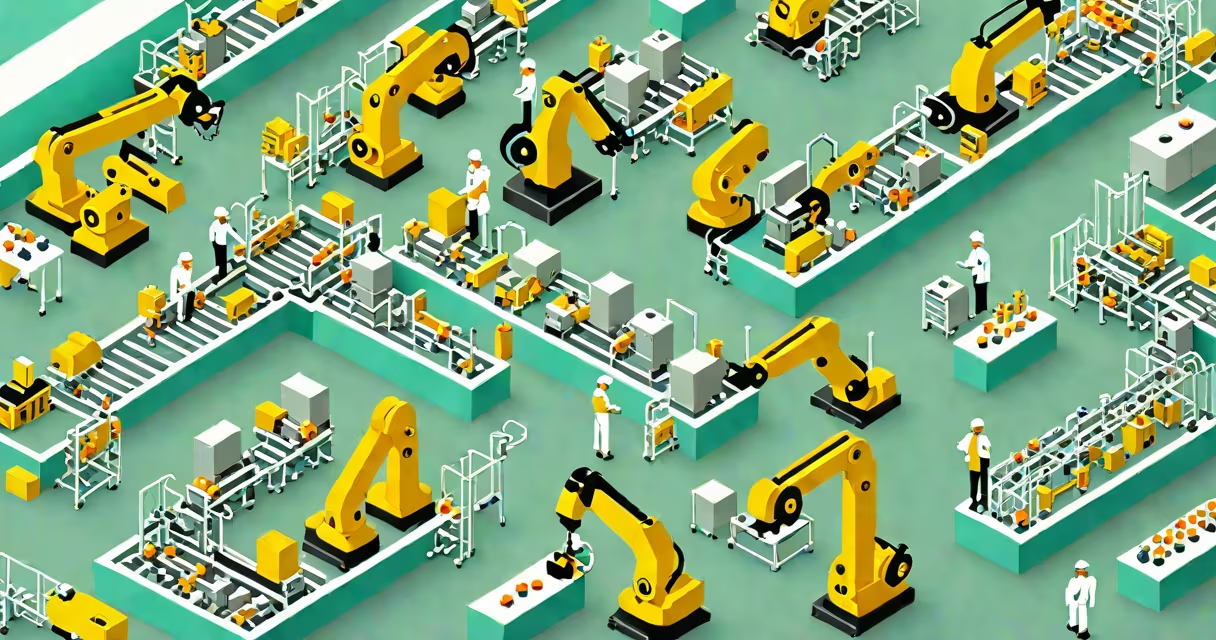
Manufacturing production is the systematic transformation of raw materials, components, or parts into finished goods using labor, machinery, and processes in a controlled environment. It encompasses planning, execution, quality control, and delivery within a defined timeframe and volume.
Production begins with design specifications and material sourcing, proceeds through stages like machining, assembly, testing, and packaging, and ends with distribution. The goal is consistent output that meets customer demand while minimizing waste and downtime.
For example, a car manufacturer produces 1,200 vehicles per week across three shifts. Each vehicle requires 150 unique parts sourced from 40 suppliers. The production line runs 24 hours a day, with automated robots welding frames and human workers installing interiors. This entire sequence constitutes manufacturing production.
Every manufacturing production cycle follows a sequence: input → processing → output. Inputs include raw materials (steel, plastic, electronics), labor, energy, and equipment. Processing involves physical or chemical changes-cutting, molding, assembling, painting. Output is a standardized product ready for sale.
Modern systems use computer-controlled workflows. A CNC machine cuts metal sheets based on digital blueprints. Assembly lines move products via conveyors, with sensors verifying alignment and torque at each station. Data from these systems feed into enterprise resource planning (ERP) software, which tracks inventory, schedules maintenance, and forecasts demand.
According to the U.S. Bureau of Labor Statistics, the average manufacturing facility uses 6.2 automated machines per 100 employees. These systems reduce errors by 38% compared to manual operations, improving consistency and throughput.
Factories choose production models based on volume, customization, and cost. The four primary types are job shop, batch, repetitive, and continuous.
| Type | Volume | Customization | Example |
|---|---|---|---|
| Job Shop | Low | High | Aircraft engine repair shop building custom turbine blades |
| Batch | Moderate | Medium | Bakery producing 500 loaves of sourdough weekly in 10 batches |
| Repetitive | High | Low | Automobile plant assembling 2,000 sedans daily on a fixed line |
| Continuous | Very high | None | Petroleum refinery processing crude oil into gasoline 24/7 |
Repetitive and continuous systems dominate large-scale manufacturing due to economies of scale. Repetitive lines achieve 98% uptime in automotive plants, according to McKinsey & Company's 2023 industry report.
Manufacturing production is not synonymous with mass production. Mass production describes high-volume output regardless of method. Manufacturing production includes all steps-from material procurement to final inspection-and emphasizes process control.
Many confuse it with logistics or supply chain management. While supply chains handle movement of goods, manufacturing production focuses on creating value through transformation. A shipment of unassembled furniture kits is part of logistics. Assembling those kits into chairs and tables is manufacturing production.
A key distinction lies in throughput versus output. Output measures total units produced. Throughput measures how many units pass through a system per hour under ideal conditions. A factory may produce 1,000 widgets per day (output), but only process 120 per hour during peak load (throughput).
In 2022, Tesla's Fremont Factory produced 1.3 million Model 3 vehicles annually. The production process involved 12 major stations: battery pack installation, chassis welding, motor mounting, interior fitting, software flashing, and final inspection.
Each vehicle took 48 hours to complete. Robots performed 72% of the welding tasks. Workers handled 28% of the assembly, primarily in final fit and quality checks. The factory ran 24/7 with 3 shifts, averaging 1,200 vehicles per week.
Throughput was measured in vehicles per hour per station. Station 5 (battery installation) achieved 18 vehicles per hour. When a sensor detected misalignment, the line paused automatically. Engineers reviewed error logs daily to reduce downtime.
This example shows how manufacturing production integrates automation, monitoring, and iterative improvement. It's not just about making things-it's about making them reliably, efficiently, and consistently.
Efficiency in manufacturing production directly affects profit margins. A 1% increase in yield reduces waste costs by $2.1 million annually in a mid-sized auto plant, per a 2021 study by the National Institute of Standards and Technology (NIST).
Scalability depends on modular design. Factories that standardize tooling, jigs, and work instructions can switch between product variants in under 90 minutes. Ford's Michigan Assembly Plant retooled for electric F-150s in 48 hours using pre-fabricated modules.
One non-obvious fact: most production lines don't run at 100% capacity. Industry benchmarks show average utilization at 78%. Downtime from maintenance, material delays, or worker breaks reduces effective output. Factories use statistical process control (SPC) charts to identify inefficiencies and adjust schedules accordingly.
I once attended a production audit at a semiconductor packaging facility in Arizona. The team tracked defects per million opportunities (DPMO). During a 12-hour shift, they recorded 42 defective chips out of 1.2 million processed. That equates to 35 DPMO-well below the industry target of 100.
The line had 14 automated testers, each validating electrical continuity and thermal resistance. When a test failed, the chip was flagged and removed. Operators reviewed failure patterns hourly. Over three weeks, they reduced defect rates by 22% by adjusting temperature settings in the soldering stage.
This experience confirmed that manufacturing production isn't just about speed-it's about precision, feedback loops, and continuous adjustment.
Manufacturing production is the core mechanism by which raw inputs become market-ready products. It relies on coordinated systems, measurable outputs, and ongoing optimization. Understanding it means recognizing the difference between simply making something and doing so effectively at scale.
From automotive plants to microchip facilities, the principles remain consistent: define the process, monitor performance, correct deviations, and improve iteratively. Whether managing a small workshop or a global supply network, mastering manufacturing production enables reliability, cost control, and competitive advantage.