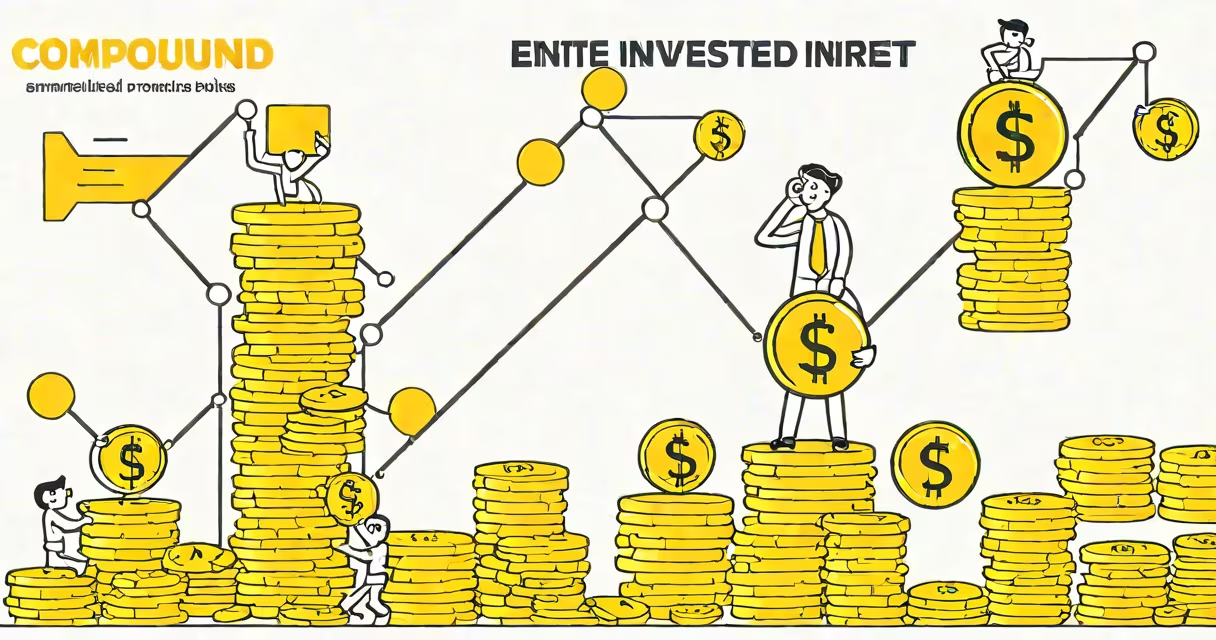
The compound interest formula solved problems involves calculating how money grows over time when interest is added to the principal and then earns interest itself. The standard equation is A = P(1 + r/n)^(nt), where A is the final amount, P is the initial principal, r is the annual interest rate, n is the number of compounding periods per year, and t is time in years. This formula applies to savings accounts, loans, and investments where returns accumulate on prior earnings.
Compound interest differs from simple interest because it includes reinvestment of earned interest. With simple interest, only the original principal earns interest. With compound interest, both the principal and all previously accumulated interest grow together. For example, a $1,000 deposit at 5% annual interest compounded annually grows to $1,628.89 after 10 years, while simple interest yields only $1,500. The difference increases with longer time spans and higher compounding frequency.
Financial institutions use daily, monthly, quarterly, or annual compounding. More frequent compounding leads to faster growth. A 6% annual rate compounded monthly results in a higher final balance than the same rate compounded annually. The formula adjusts for this via the variable n-the number of times interest is applied per period. When n = 1, interest compounds once per year. When n = 12, it compounds monthly. When n = 365, it compounds daily.
The core idea behind the compound interest formula is exponential growth. Each compounding period multiplies the current balance by (1 + r/n). Over multiple periods, this multiplication repeats, leading to rapid expansion. The exponent nt represents the total number of compounding intervals over the entire time span.
To illustrate, suppose you invest $5,000 at 4% annual interest compounded quarterly (n = 4) for 5 years. Plug values into the formula: A = 5000 × (1 + 0.04/4)^(4×5). Simplify inside the parentheses: 1 + 0.01 = 1.01. Raise 1.01 to the power of 20 (4 × 5): 1.01^20 ≈ 1.22019. Multiply by 5000: 5000 × 1.22019 = $6,100.95. After five years, your investment grows to $6,100.95.
Interest earned in this case totals $1,100.95. Without compounding, the same rate would yield only $1,000 in interest ($5,000 × 0.04 × 5). The extra $100.95 comes from interest earning interest during each quarter. This effect becomes more pronounced over longer durations. After 20 years, the same investment reaches $11,040.20-over double the simple interest result.
Problems involving the compound interest formula fall into three categories: future value calculations, time-to-reach goals, and required initial deposits. Solving each requires rearranging the formula based on known variables.
| Problem Type | Known Variables | Unknown Variable | Formula Adjustment |
|---|---|---|---|
| Future Value | P, r, n, t | A | A = P(1 + r/n)^(nt) |
| Time to Reach Goal | A, P, r, n | t | t = log(A/P) / [n × log(1 + r/n)] |
| Required Principal | A, r, n, t | P | P = A / (1 + r/n)^(nt) |
A common error is misidentifying the compounding frequency. Using n = 1 for monthly compounding leads to underestimating growth by nearly 1%. Another mistake is confusing nominal and effective annual rates. The nominal rate is stated; the effective rate accounts for compounding. For example, 6% nominal compounded monthly gives an effective rate of 6.168%, not 6%.
When solving for time, logarithms are necessary. For instance, determining how long it takes $10,000 to grow to $20,000 at 5% compounded annually: 20,000 = 10,000 × (1 + 0.05)^t. Divide both sides by 10,000: 2 = 1.05^t. Take log base 10 of both sides: log(2) = t × log(1.05). Solve: t = log(2)/log(1.05) ≈ 14.2 years. The rule of 72 estimates this as 72 ÷ 5 = 14.4 years-very close.
Compound interest powers retirement accounts, student loans, and credit card debt. A $100 monthly contribution to a retirement fund growing at 7% annually compounds to $181,000 after 30 years-far more than the $36,000 paid in. Conversely, unpaid credit card balances at 20% APR compound rapidly. A $5,000 balance grows to $6,000 in just 13 months with monthly compounding.
Many people assume compound interest only benefits savers. In reality, it amplifies debt. Credit cards often charge daily compounding interest. A $1,000 balance at 24% APR compounded daily (n = 365) grows to $1,249.34 in one year. The effective annual rate is 26.8%, not 24%. This gap between nominal and effective rates catches borrowers off guard.
Another misconception is that doubling time is constant. While the rule of 72 provides a quick estimate, it assumes a fixed rate. If the rate changes, so does doubling time. A 3% rate doubles in about 24 years; a 10% rate doubles in 7.3 years. The formula shows that doubling time decreases nonlinearly as rates increase.
I once helped a client plan for college funding. Their goal was $50,000 in 10 years with a 4.5% annual return compounded monthly. Using the formula P = A / (1 + r/n)^(nt), we calculated the needed deposit: P = 50,000 / (1 + 0.045/12)^(12×10). That's 50,000 / (1.00375)^120 ≈ 50,000 / 1.566 ≈ $31,920. They needed to start with $31,920. Without compounding, they'd have needed $35,714-over $3,000 more.
Compound interest is not the same as continuous compounding. Continuous compounding uses the mathematical constant e and the formula A = Pe^(rt). It assumes interest is added constantly, not at discrete intervals. For example, $1,000 at 5% annual interest compounded continuously grows to $1,648.72 in 10 years-slightly more than the $1,628.89 from annual compounding.
Many textbooks simplify problems by assuming annual compounding. But real-world applications often use monthly or daily compounding. The difference may seem small, but over decades, it adds up. A $100,000 investment at 6% compounded annually grows to $181,940 in 10 years. The same rate compounded monthly yields $181,940 vs. $182,070-$130 more. Over 30 years, the gap widens to $10,000.
Finally, compound interest doesn't require money. It applies to population growth, inflation, and even viral spread. A disease spreading at 10% daily growth doubles in about 7 days. The same pattern appears in social media shares and software adoption curves. The underlying math remains the same-exponential growth from repeated multiplication.