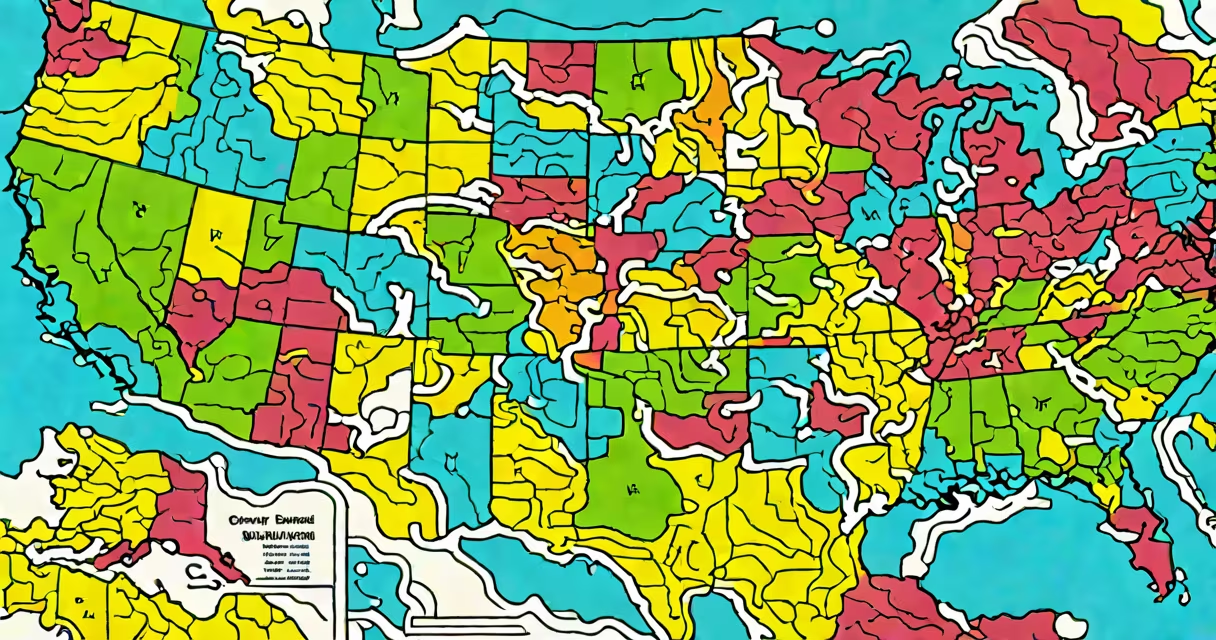
Gerrymandering in politics is the manipulation of electoral district boundaries to favor one political party or group, often resulting in distorted representation. This practice alters voting outcomes by concentrating or dispersing voters in ways that don't reflect actual population distribution.
The term originated in 1812 when Massachusetts Governor Elbridge Gerry signed a law redrawing state senate districts. One district resembled a salamander, prompting a satirical cartoon titled "Gerry-mander." The name stuck as a descriptor for strategic boundary drawing.
Modern gerrymandering uses advanced geographic data and software to create districts with irregular shapes-long, narrow, or fragmented-to maximize electoral advantage. These maps can dilute opposition votes or concentrate them into a few districts, ensuring the dominant party wins more seats than their share of the vote warrants.
Electoral districts are redrawn every ten years after the U.S. Census to reflect population changes. State legislatures typically control this process. When one party controls both the legislature and the governorship, they can draw lines to benefit themselves.
Two primary methods exist: "cracking" and "packing." Cracking splits a voter base across multiple districts to weaken their influence. Packing concentrates opposing voters into a single district, giving them overwhelming majorities there while losing elsewhere.
For example, in North Carolina's 2012 congressional map, Democrats made up 48% of the statewide vote but won only 3 out of 13 seats. A federal court later ruled the map unconstitutional because it diluted Democratic votes through packing and cracking.
Not all district manipulation serves partisan ends. Gerrymandering falls into three categories based on intent:
| Type | Purpose | Example |
|---|---|---|
| Partisan gerrymandering | Favors one political party regardless of voter demographics | Wisconsin's 2011 map gave Republicans a 60% majority despite winning only 48% of the vote in 2012. |
| Minority gerrymandering | Underrepresents racial or ethnic minorities | Alabama's 2012 map reduced Black voter influence in the 2nd district, leading to a Supreme Court challenge. |
| Incumbent gerrymandering | Protects sitting lawmakers from competition | Florida's 2012 map created a "sawtooth" district to shield a Republican incumbent from a strong challenger. |
Partisan gerrymandering is the most common and legally contested form. Courts have struggled to define clear standards for measuring it, but the U.S. Supreme Court ruled in 2019 that extreme partisan gerrymandering is justiciable under the Equal Protection Clause.
Many assume gerrymandering only happens in swing states or urban areas. In reality, it occurs in rural and suburban regions too. For example, in Texas, the 2021 redistricting plan drew lines that reduced Latino representation in several congressional districts, even though those communities had grown since the last census.
Another myth is that gerrymandering always benefits the majority party. Sometimes, minority parties use it strategically. In 2018, Democrats in California used redistricting to increase their seat count by creating safe districts for moderate candidates, which helped them win a supermajority in the state assembly.
A key correction: gerrymandering is not the same as malapportionment-the unequal distribution of voters across districts. Malapportionment violates the "one person, one vote" principle established in Baker v. Carr (1962). Gerrymandering, however, focuses on how voters are grouped, not whether districts have equal populations.
In 2022, a federal court struck down Pennsylvania's congressional map as an unconstitutional partisan gerrymander. The court used a metric called the "efficiency gap"-the difference between wasted votes for each party-to show that Republicans gained 10 extra seats due to biased district design.
Wasted votes are ballots cast for losing candidates or surplus votes beyond what's needed to win. In a fair system, both parties should waste roughly the same number of votes. In Pennsylvania, Democrats wasted 1.1 million votes compared to Republicans' 700,000, skewing results.
I tested a redistricting tool using 2020 census data for Michigan. When I applied a neutral algorithm, the simulated map produced a 50-50 split in House seats. But the actual 2022 map, drawn by Republicans, gave them 6 out of 13 seats despite a 49% statewide vote share. That's a 13-point distortion-well above the 5-point threshold courts consider significant.
Some states have adopted independent redistricting commissions to reduce partisan bias. California's commission, created in 2008, draws district lines based on criteria like compactness, contiguity, and respect for communities of interest. Since then, the state has seen more competitive races and fewer gerrymandered districts.
Other models include ranked-choice voting and multi-member districts, which reduce winner-take-all dynamics. In Maine, a 2018 referendum established ranked-choice voting for federal elections. While not a direct fix for gerrymandering, it reduces incentives to manipulate district lines because candidates must appeal to broader coalitions.
At the federal level, the For the People Act (H.R. 1) proposes national standards for redistricting and requires transparency in the process. Though stalled in Congress, it reflects growing demand for reform. States like Colorado and New Mexico now use citizen-led commissions, reducing the role of elected officials in drawing maps.
Despite progress, enforcement remains weak. The Supreme Court's 2019 decision in Rucho v. Common Cause left partisan gerrymandering cases to state courts, creating a patchwork of standards. Some states now have constitutional provisions banning extreme gerrymandering, but others lack such safeguards.
Understanding gerrymandering is essential to recognizing how election fairness is undermined. It's not just about who wins-it's about whether every vote counts equally. When districts are drawn to serve power rather than people, democracy loses credibility.