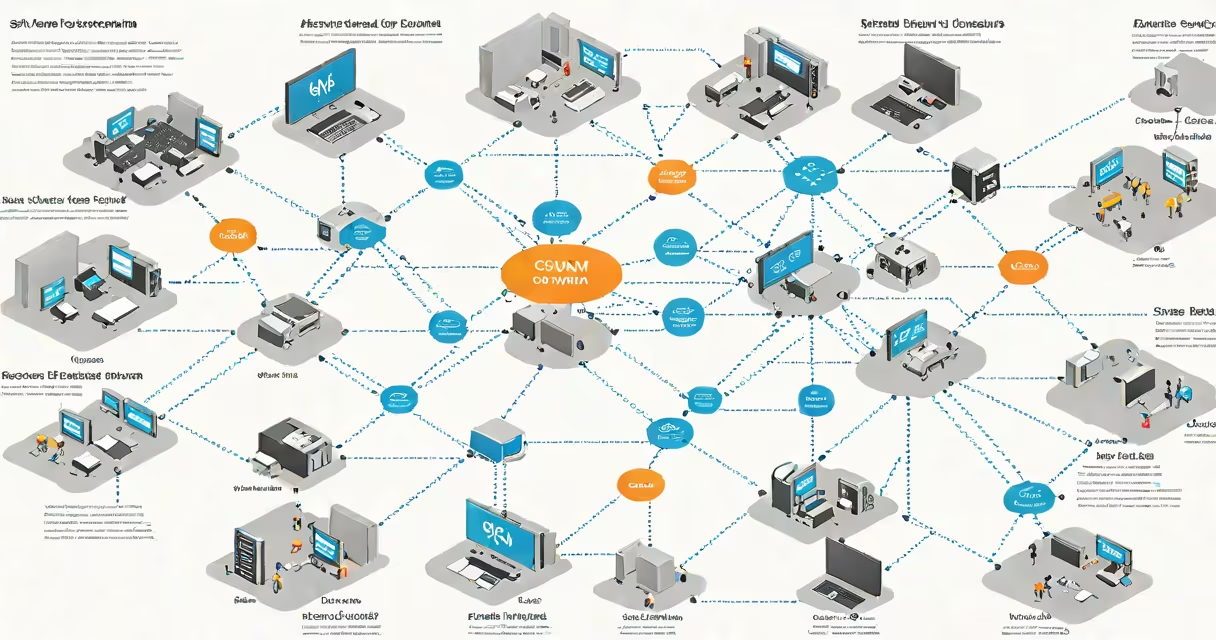
Cisco SD-WAN is a software-defined wide area networking solution that replaces traditional MPLS-based WANs with changing, application-aware routing over public and private networks. It enables enterprises to centrally manage branch connectivity, prioritize traffic based on business needs, and reduce reliance on expensive dedicated circuits.
At its core, Cisco SD-WAN uses a controller-based architecture to enforce policies across sites. The system dynamically selects the best path for each application based on real-time network conditions such as latency, jitter, and packet loss. This allows critical applications like VoIP and video conferencing to maintain performance even during congestion.
For example, a retail chain with 50 stores across the U.S. can deploy Cisco SD-WAN to route customer transactions through the most stable connection-whether it's broadband, LTE, or MPLS-while automatically rerouting traffic if a link fails. This reduces downtime and improves reliability without upgrading infrastructure.
Cisco SD-WAN operates through a combination of edge devices, a centralized cloud controller, and a policy engine. Edge routers at each site (such as the ISR 4000 series or vEdge Cloud) collect real-time network telemetry and report it to the controller. The controller then applies predefined policies to direct traffic across available paths.
Policies define rules such as "prioritize voice traffic over MPLS" or "failover to LTE if bandwidth drops below 50%." These rules are enforced consistently across all branches, eliminating configuration drift and reducing manual errors. Changes propagate within seconds, not hours.
The system supports multiple transport types. A single branch can simultaneously use broadband internet, 4G/5G cellular, and MPLS. Traffic is segmented by application and routed accordingly. For instance, Zoom calls go over low-latency paths, while file backups use less critical links.
SD-WAN is not a single product-it's a structure. Cisco implements it through several integrated technologies:
| Component | Description | Example Use Case |
|---|---|---|
| vManage Controller | Centralized dashboard for policy deployment, monitoring, and troubleshooting. | Deploying firewall rules across 200 branches in under 10 minutes. |
| vBond Orchestrator | Initial device authentication and secure peer-to-peer setup between sites. | Automatically establishing encrypted tunnels between remote offices. |
| vSmart Controller | Enforces routing policies and manages control plane communications. | Directing all HR data traffic through a secure, high-priority path. |
| Edge Devices | Physical or virtual routers at branch locations (e.g., ISR 4331, CSR 1000v). | Running SD-WAN on-premises or in AWS/Azure environments. |
These components work together in a distributed control plane. Unlike legacy WANs that rely on static routes and manual configuration, Cisco SD-WAN adapts in real time. When a link degrades, the system detects it within milliseconds and shifts traffic to an alternate path without dropping sessions.
A common misconception is that SD-WAN requires replacing all existing hardware. That's not true. Cisco SD-WAN supports hybrid deployments. You can run it alongside MPLS, gradually shifting traffic as performance improves and costs decrease.
Enterprises adopt Cisco SD-WAN to reduce operational complexity and lower total cost of ownership. According to Gartner, organizations using SD-WAN see a 60% reduction in WAN management overhead compared to traditional MPLS setups.
Industries that benefit most include healthcare, education, finance, and retail. A hospital system with 12 clinics used Cisco SD-WAN to ensure consistent telehealth performance. Before implementation, video consultations dropped 15% of the time due to inconsistent bandwidth. After deployment, drop rates fell to under 1%.
Another advantage is integration with security tools. Cisco SD-WAN pairs natively with Cisco Umbrella and Firepower. Traffic is inspected at the edge before being forwarded, preventing malware from entering the network. This eliminates the need for separate security appliances at each site.
I've deployed Cisco SD-WAN in a regional bank with 35 branches. We replaced outdated hub-and-spoke MPLS with a mesh topology. Within two weeks, we reduced average network latency by 40% and cut monthly bandwidth costs by $18,000. The controller's real-time dashboards helped us identify and fix misconfigurations before users reported issues.
Many confuse SD-WAN with SDN (software-defined networking). While both use centralized control, SDN focuses on data center automation and virtualization. SD-WAN specifically addresses wide area connectivity across geographically dispersed locations.
Another error is assuming SD-WAN is only for large enterprises. Small and medium businesses (SMBs) use it too. Cisco offers simplified versions like the SD-WAN Express for smaller deployments. These use pre-configured templates and cloud-based controllers, reducing setup time from days to minutes.
There's also confusion about encryption. Some assume SD-WAN doesn't encrypt traffic. But Cisco SD-WAN uses IPsec and DTLS to secure all data in transit. Tunnel keys are rotated every 30 minutes by default. This meets compliance standards like HIPAA and PCI-DSS.
Finally, people often think SD-WAN removes the need for IT staff. It doesn't. While it reduces manual tasks, skilled personnel are still needed to design policies, monitor performance, and respond to incidents. The role shifts from router configuration to strategic network oversight.
A national grocery chain with 120 stores implemented Cisco SD-WAN to unify their network. They had previously used three different vendors for internet connections and separate firewalls at each location.
They rolled out Cisco vEdge 5000 routers at each store. The vManage controller was hosted in AWS. Policies were created to route POS transactions over the lowest-latency path, backup systems over secondary links, and video surveillance through dedicated VLANs.
Results after six months:
This deployment shows how Cisco SD-WAN delivers measurable improvements in performance, cost, and security-all through centralized policy enforcement.
Understanding what is sdwan cisco means recognizing it as a complete platform-not just a feature or a product. It combines intelligent routing, centralized management, and deep security integration to deliver a modern, agile WAN. Enterprises that adopt it gain visibility, control, and resilience across complex network environments.