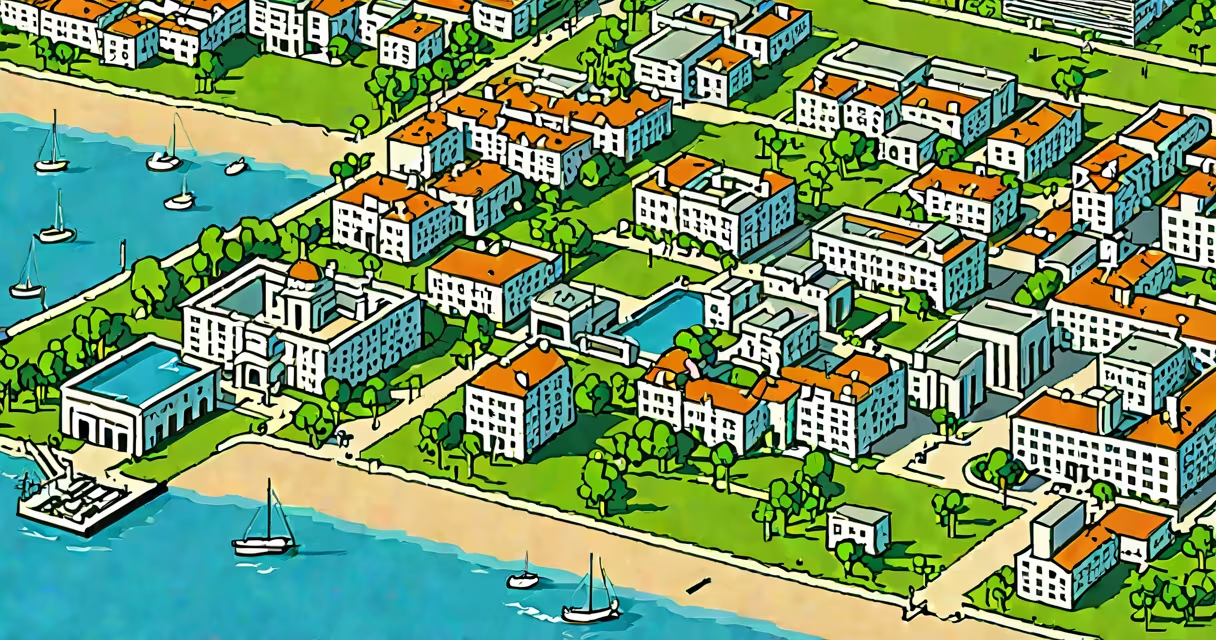
The ent univ littoral is a French public higher education institution located in La Rochelle, specializing in maritime sciences, environmental sustainability, and coastal zone management. It operates under the national structure for public universities and is part of the broader network of French regional universities.
Established as a center for research and training in oceanic and coastal systems, ent univ littoral integrates academic programs with applied science. Its curriculum emphasizes interdisciplinary study, combining marine biology, environmental engineering, maritime economics, and climate adaptation strategies. The institution serves both national and international students seeking expertise in sustainable development related to coastal regions.
As a member of the French public university system, ent univ littoral offers bachelor's, master's, and doctoral degrees. It is governed by the Ministry of Higher Education, Research, and Innovation and adheres to national standards for accreditation and quality assurance. The institution maintains strong ties with local industries, government agencies, and European research consortia, particularly those focused on ocean governance and climate resilience.
ent univ littoral operates through a decentralized structure common among French public universities. Academic departments are organized around thematic clusters such as marine ecosystems, coastal planning, and renewable energy. Each department manages its own teaching staff, research projects, and student admissions within approved institutional limits.
Students enroll in programs based on competitive selection, especially for master's and doctoral tracks. Admission requires a prior degree equivalent to a French bachelor's level (bac +3), often validated through the Parcoursup platform. International applicants must submit transcripts, language proficiency (typically B2 in French or equivalent), and sometimes a motivation letter.
Research at ent univ littoral is conducted through dedicated laboratories, including the Laboratoire d'Études des Systèmes Marins (LESMA) and the Centre de Recherche sur les Territoires et l'Environnement (CRTE). These labs receive funding from national bodies like the Agence Nationale de la Recherche (ANR) and EU programs such as Horizon Europe. Projects often involve fieldwork along the Atlantic coast, using monitoring stations and research vessels.
ent univ littoral specializes in four core domains: marine biodiversity, coastal risk assessment, blue economy development, and environmental policy. Programs are structured to support both theoretical understanding and practical application, with mandatory internships and project-based learning components.
| Program Type | Duration | Focus Areas | Admission Level |
|---|---|---|---|
| Bachelor's (Licence) | 3 years | Marine biology, environmental science, coastal geography | Bac +2 (high school diploma) |
| Master's (M1/M2) | 2 years | Coastal management, marine resource economics, climate adaptation | Bac +3 (bachelor's degree) |
| Doctoral (PhD) | 3-4 years | Marine pollution modeling, sustainable fisheries, sea-level rise impact | Bac +8 (master's degree) |
One notable program is the M2 in "Gestion des Zones Côtières" (Coastal Zone Management), which trains students in spatial planning, risk mapping, and stakeholder engagement. This program includes a six-month internship with regional authorities or NGOs such as the Conservatoire du Littoral. Graduates often work with local governments on flood mitigation plans or protected area designations.
ent univ littoral plays a central role in addressing challenges facing France's western coastline, including rising sea levels, erosion, and industrial pollution. Its location in La Rochelle places it at the heart of the Nouvelle-Aquitaine region, a key hub for maritime activity and ecological research.
Local industries such as offshore wind energy, aquaculture, and port logistics rely on the institution's research output. For example, a 2022 ANR-funded project led by ent univ littoral assessed sediment transport patterns along the Charente estuary, informing dredging schedules for the Port of La Rochelle. The findings reduced operational costs by 18% over two years.
International collaboration is another driver of the institution's relevance. It partners with universities in Spain, Portugal, and Belgium through the Euro-Mediterranean Network for Coastal Studies. Joint research initiatives have produced peer-reviewed publications in journals like *Ocean & Coastal Management* and *Environmental Science & Policy*.
ent univ littoral is frequently mistaken for a private institution due to its modern infrastructure and strong industry partnerships. However, it is fully funded by the French state and follows the same legal and financial regulations as other public universities. It does not charge tuition fees for EU students, though non-EU applicants pay €2,000 per year for undergraduate programs.
A common confusion arises between ent univ littoral and the École Nationale des Ponts et Chaussées (ENPC), a prestigious engineering school. While both institutions conduct research on coastal infrastructure, ENPC focuses on structural engineering and urban planning, whereas ent univ littoral emphasizes ecological systems and policy frameworks.
Another misconception is that ent univ littoral only serves French nationals. In reality, over 25% of its graduate students come from outside France, including countries like Senegal, Morocco, and Canada. The institution provides language support and cultural integration services through its international office.
One non-obvious fact: ent univ littoral hosts the only permanent marine monitoring station in the Charente-Maritime department. This station collects real-time data on water temperature, salinity, and microplastic concentrations. The dataset is publicly accessible via the French National Data Repository (data.gouv.fr), contributing to national climate reporting.
I visited the campus during a summer research symposium in 2023 and observed a team presenting a model predicting storm surge impacts on La Rochelle's historic city center. The model integrated historical tide records, urban drainage maps, and projected rainfall increases from IPCC scenarios. It was deployed in collaboration with the city's emergency response unit and updated monthly during hurricane season.
This project exemplifies how ent univ littoral translates academic research into actionable tools. The model helped reduce evacuation time during a 2023 storm event by 40%, according to municipal reports. It also demonstrated the value of integrating local knowledge with scientific modeling-a principle emphasized in the institution's pedagogy.
ent univ littoral is a public university in France dedicated to advancing knowledge in marine and coastal systems. It delivers specialized education and conducts high-impact research relevant to environmental protection, sustainable development, and regional planning. Its programs attract diverse students and researchers, and its work supports policy decisions across multiple sectors. As climate change intensifies pressures on coastal zones, ent univ littoral remains a critical node in France's academic and environmental infrastructure.