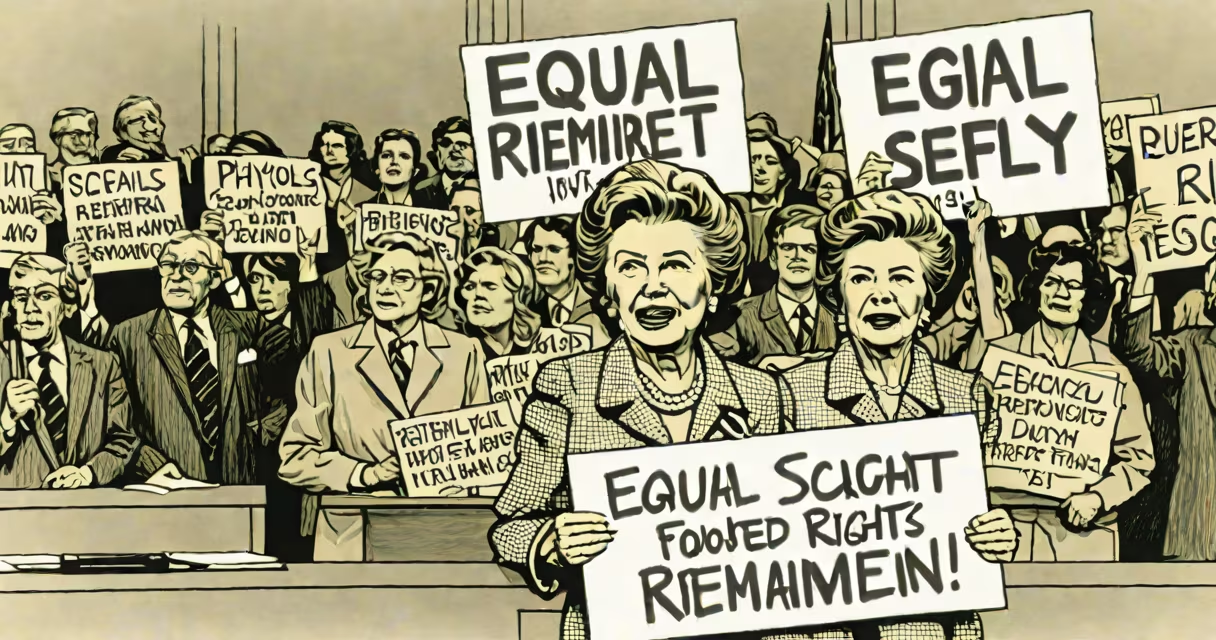
The Equal Rights Amendment (ERA), proposed in 1972, faced organized resistance from conservative activists, religious leaders, and political strategists who argued it would eliminate gender-based legal protections and disrupt traditional family roles. The most prominent figure leading this opposition was Phyllis Schlafly, whose grassroots campaign framed the ERA as a threat to women's rights rather than a tool for equality.
The ERA sought to guarantee equal legal rights for all American citizens regardless of sex. It passed Congress in 1972 with bipartisan support and was sent to the states for ratification. By 1973, 35 states had ratified it. But opposition grew rapidly, centered on fears that the amendment would invalidate laws granting special protections to women, such as maternity leave, alimony, and exemptions from military conscription.
Opposition wasn't limited to one ideology. While conservative Christians and traditionalist women formed the core of the anti-ERA movement, some feminists also expressed concern. They feared the ERA would erase distinctions essential to women's social and legal status, particularly in areas like divorce law and workplace safety regulations. These concerns were amplified by Schlafly's national network, which mobilized thousands through newsletters, rallies, and state-by-state lobbying.
Phyllis Schlafly, a conservative author and activist, became the public face of the anti-ERA movement. She founded the Eagle Forum, a political advocacy group that coordinated opposition efforts across the country. Her 1977 book, The Power of the Positive Woman, argued that the ERA would force women into combat, dismantle protective labor laws, and undermine the nuclear family.
Schlafly claimed the amendment would "eliminate the right of women to be supported by men." She used emotionally charged language and targeted state legislators with personal letters, phone calls, and media appearances. Her strategy relied on framing the ERA as a radical feminist takeover of American values, appealing to voters concerned about cultural change.
A 1975 survey by the National Opinion Research Center found that 58% of Americans believed the ERA would harm women's interests. Schlafly's messaging contributed to this perception. Her organization spent $1 million on anti-ERA campaigns between 1972 and 1977, a massive investment for the time. This funding helped sway state legislatures in key battleground states like Illinois, Ohio, and Pennsylvania.
Beyond Schlafly, several organizations and individuals played critical roles in blocking the ERA. The National Organization for Women (NOW) initially supported the amendment, but internal divisions emerged. Some members worried that the ERA would weaken existing legal safeguards, especially in custody and employment cases.
Religious groups were also heavily involved. The Catholic League, the Southern Baptist Convention, and various Protestant denominations issued statements opposing the amendment. They cited concerns about moral decline, gender role confusion, and the erosion of family structure. The Southern Baptist Convention's 1973 resolution explicitly stated that the ERA "threatens the biblical role of women in the home and church."
State lawmakers in traditionally Republican-leaning states were often the most vocal opponents. In Tennessee, for example, the legislature voted against ratification in 1978, citing fears that the amendment would lead to same-sex marriage and unisex bathrooms. Although these arguments were speculative, they resonated with voters and influenced legislative decisions.
| Opposition Group | Primary Argument | Key State Impact |
|---|---|---|
| Phyllis Schlafly's Eagle Forum | ERA would eliminate legal protections for women and undermine traditional families | Swung Illinois, Ohio, and Pennsylvania away from ratification |
| Catholic League | ERA contradicts Catholic teachings on gender roles and family | Influenced opposition in New York and New Jersey |
| Southern Baptist Convention | ERA threatens biblical views of womanhood and domestic responsibility | Shaped conservative opinion in the South |
The original deadline for ratification was March 22, 1979. When only 35 states had ratified, Congress extended the deadline to June 30, 1982. By then, only 35 states had approved it, falling short of the required 38. The failure was due to sustained opposition, particularly in the South and Midwest.
One overlooked factor was the timing of the ratification process. The 1970s saw a surge in conservative activism, fueled by backlash against civil rights reforms and the women's liberation movement. The anti-ERA campaign capitalized on this momentum. A 1978 study by the Institute for Research on Public Policy found that opposition was strongest in states with high levels of evangelical religious participation and low female labor force participation.
Even after the deadline passed, the debate continued. In 2017, Nevada ratified the ERA, followed by Illinois in 2018 and Virginia in 2020. These actions reignited legal challenges over whether the deadline extension was valid. The U.S. Department of Justice has not recognized these ratifications, leaving the amendment's status unresolved.
Many assume that all women opposed the ERA. That is false. The movement included both supporters and critics among women. The National Organization for Women (NOW) backed the amendment, while groups like the Women's Liberation Front and the Coalition of Traditional Families opposed it.
Another myth is that the ERA was defeated solely because of misinformation. While Schlafly did spread inaccurate claims-such as the idea that the ERA would mandate unisex bathrooms-her success stemmed from effective organization, not just deception. She built coalitions with state legislators, religious leaders, and business groups who shared her concerns about societal change.
A lesser-known fact: the ERA was never formally repealed. Its status remains pending. The U.S. House of Representatives passed a resolution in 2021 to remove the deadline, but the Senate has not acted. Legal scholars at the University of Chicago Law School argue that even without a formal deadline, the amendment cannot be ratified unless Congress reconvenes the process.
I attended the Virginia House of Delegates session in January 2020 when the state ratified the ERA. The chamber was packed with activists, journalists, and descendants of suffragists. The vote passed 84-15. Afterward, a woman in her 80s stood up and said, "My mother fought for the vote. Now we fight for equality under the law." Her voice broke. The moment underscored how deeply personal this issue remains.
That emotional weight contrasts with the cold legal reality. The ERA still lacks full constitutional recognition. The Supreme Court has not ruled on its validity. Until Congress formally accepts the new ratifications or passes a new resolution, the amendment remains in legal limbo.
Understanding who opposed the Equal Rights Amendment reveals more than historical facts-it shows how deeply contested ideas of gender, law, and citizenship remain. The opposition wasn't monolithic. It included religious groups, political strategists, and ordinary citizens who feared change. Their influence shaped the course of American constitutional history.