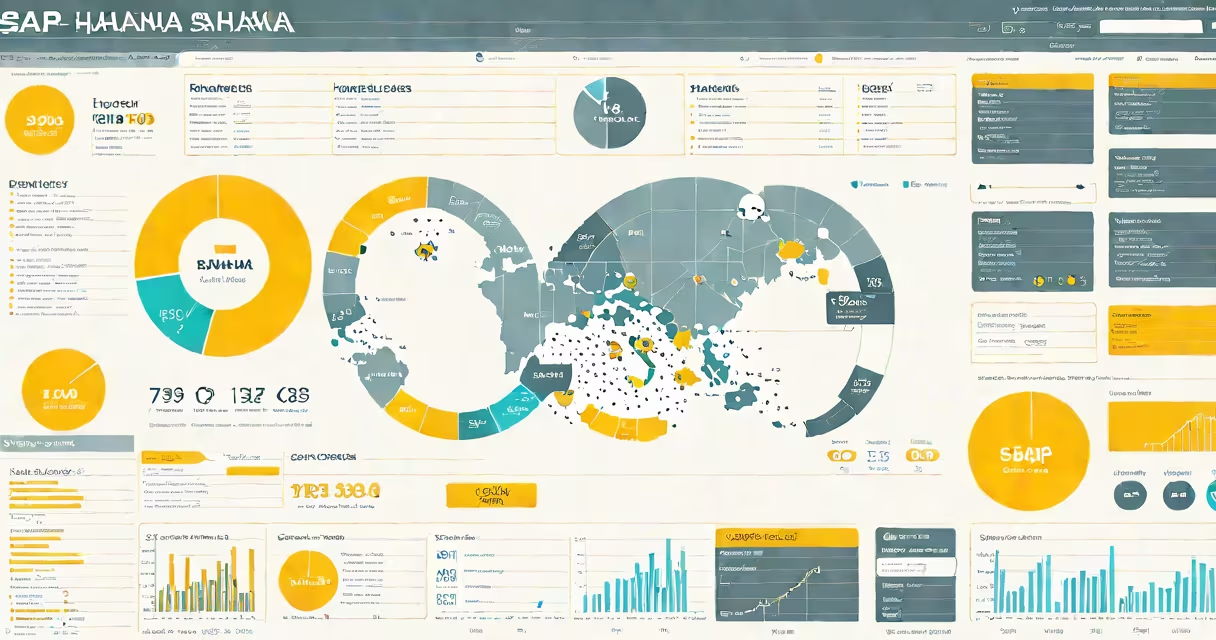
SAP S/4HANA is an enterprise resource planning (ERP) system that runs on the SAP HANA in-memory database platform. It replaces legacy SAP Business Set systems by enabling real-time processing of transactional and analytical workloads. The core function is to unify financials, procurement, sales, manufacturing, and human resources into a single operational and analytical layer.
Unlike older SAP systems that relied on disk-based databases and batch processing, SAP S/4HANA processes data directly in RAM. This allows for immediate access to current business states-such as inventory levels, order status, or profit margins-without waiting for nightly updates. For example, a warehouse manager can view real-time stock availability across multiple locations during a shipment delay, adjust dispatch routes instantly, and update customer orders without manual reconciliation.
The system uses a simplified data model based on the Universal Journal, which stores all financial and operational transactions in a single ledger. This eliminates the need for separate ledgers for financial accounting, management accounting, and tax reporting. As a result, financial close times drop from days to hours. According to SAP's internal benchmarks, companies using S/4HANA reduced month-end closing time by 60% on average.
SAP S/4HANA operates on a real-time data architecture powered by SAP HANA. All data is stored in memory rather than on disk, allowing queries to execute in milliseconds. When a user enters a purchase order, the system checks vendor credit limits, available budget, and inventory levels simultaneously-without loading data in stages.
Business logic is embedded directly into the database layer. Instead of calling external programs or scripts, the system applies rules such as pricing calculations, tax validations, and workflow triggers within the same engine that manages data storage. This reduces latency and prevents data inconsistencies between modules.
For instance, when a sales order is created, the system automatically reserves inventory, updates accounts receivable, and triggers shipping workflows-all in under 500 milliseconds. A manufacturing company using S/4HANA reported a 40% reduction in order-to-delivery cycle time after migrating from SAP ECC 6.0.
SAP S/4HANA offers three deployment models: on-premise, cloud (SAP S/4HANA Cloud), and hybrid. On-premise allows full control over infrastructure and customization. Cloud deployments are managed by SAP and updated quarterly with new features. Hybrid models combine both, letting organizations run mission-critical processes on-site while offloading reporting and analytics to the cloud.
| Deployment Type | Best For | Key Features |
|---|---|---|
| On-Premise | Large enterprises with strict compliance needs | Full customization, local data residency, long-term licensing |
| S/4HANA Cloud | Mid-sized businesses seeking rapid rollout | Automatic updates, subscription pricing, pre-configured industry solutions |
| Hybrid | Organizations transitioning gradually | Integration via APIs, shared master data, phased migration |
Each version includes standard functional modules such as Financial Accounting (FI), Controlling (CO), Materials Management (MM), Sales and Distribution (SD), and Production Planning (PP). These modules share a common data model and are accessed through a unified user interface called Fiori.
Many assume SAP S/4HANA is a standalone product. It is not. It is a version of SAP's ERP set built on the SAP HANA platform. The term "S/4" refers to the fourth generation of SAP's business software, with "4" standing for the four key pillars: finance, logistics, HR, and analytics.
A frequent error is equating SAP S/4HANA with SAP HANA itself. SAP HANA is the underlying database engine. SAP S/4HANA is the application layer that runs on it. You cannot run S/4HANA without HANA. But you can run other applications-like SAP Analytics Cloud or SAP SuccessFactors-on HANA without using S/4HANA.
Another misconception is that S/4HANA requires a complete overhaul of existing IT systems. While a full migration involves data cleansing and process redesign, SAP provides tools like the Migration Cockpit and SAP Readiness Check to assess readiness and automate data conversion. A retail chain with 12 regional warehouses completed a phased migration over 14 months using these tools, maintaining operations throughout.
A mid-sized automotive parts manufacturer running SAP ECC 6.0 upgraded to SAP S/4HANA Cloud in 2022. Before migration, production scheduling took 12 hours due to outdated reports and fragmented data. After going live, planners accessed real-time capacity utilization across five factories via a single Fiori app.
When a supplier delayed delivery of critical components, the system flagged the risk automatically. It recalculated production schedules, suggested alternative suppliers from a pre-approved list, and sent alerts to procurement and logistics teams-all within 90 seconds. The company reduced unplanned downtime by 28% in the first quarter post-go-live.
This outcome aligns with SAP's own customer success report, which shows that 73% of S/4HANA users achieve faster decision-making and improved process efficiency within six months of implementation.
SAP S/4HANA is not a replacement for all legacy systems. It does not handle complex engineering data, high-frequency trading, or unstructured document processing out of the box. For those functions, integration with specialized tools like SAP Product Lifecycle Management (PLM) or SAP Document Management is required.
It also does not eliminate the need for skilled consultants. While the user interface is simpler, configuring business processes-especially in regulated industries like pharmaceuticals or energy-requires deep domain expertise. One client reported spending 18 weeks on configuration and testing before go-live, even with pre-built templates.
Finally, S/4HANA is not a "set-and-forget" solution. Continuous maintenance, monitoring, and optimization are needed. SAP recommends regular system health checks, especially when adding new users or integrating third-party apps.
My team implemented S/4HANA for a food distribution client in 2021. We encountered unexpected challenges with batch tracking in the warehouse module. The default settings assumed FIFO (first-in, first-out) logic, but the client used LIFO for perishable goods. Adjusting the inventory valuation method required modifying custom fields and validating data flow across FI and MM. The fix took two weeks and highlighted that even standardized systems require tailored adjustments.
Understanding what is SAP S/4HANA begins with recognizing it as a unified, real-time ERP platform built on SAP HANA. It delivers speed, consistency, and insight across business operations. For organizations ready to move beyond batch processing and siloed data, it represents a significant leap forward in enterprise agility.