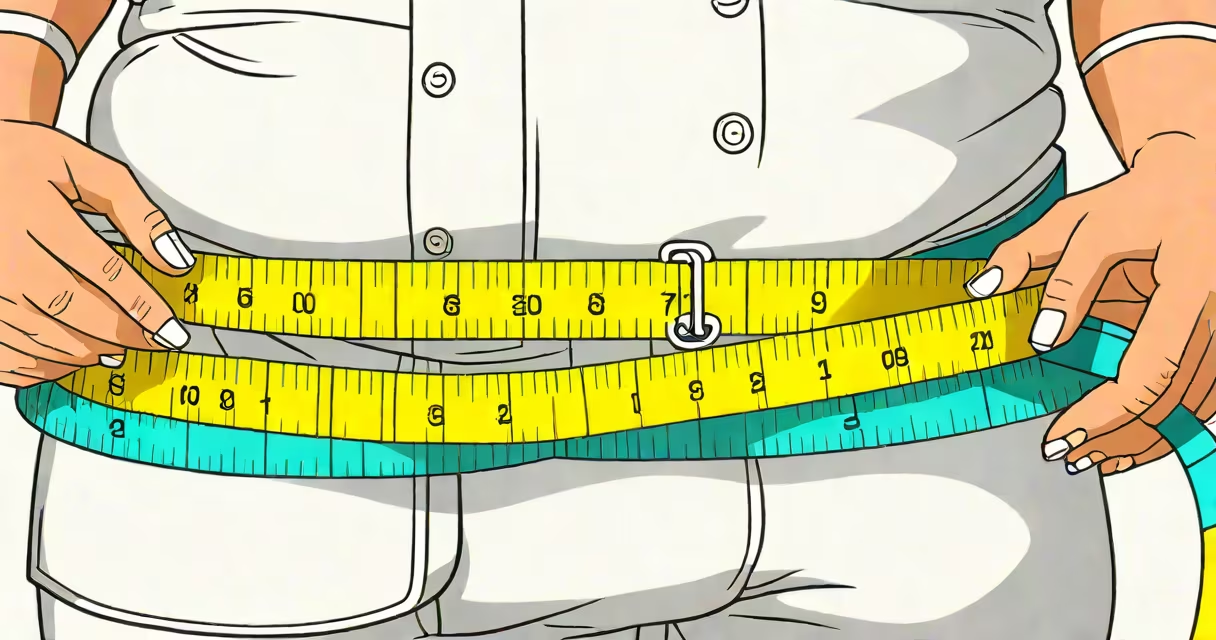
Girth is the distance around a body part or object measured at a single point, typically using a flexible tape measure. It's a linear measurement taken in a complete loop around the circumference of a limb, torso, or other cylindrical structure. This method applies to human anatomy, clothing sizing, athletic equipment, and industrial parts.
Measuring girth requires a flexible, non-stretchable tape measure. The tape must lie flat against the surface being measured, neither too tight nor too loose. For body measurements, the tape should follow natural contours-like the waistline or biceps-without compressing tissue. Accuracy depends on consistent placement and proper tension.
Standard units are inches or centimeters. A common mistake is measuring at the wrong anatomical landmark. For example, waist girth should be taken at the narrowest point between the ribcage and hips, not at the navel. Misplacement leads to incorrect values, especially in health tracking or garment fitting.
The process begins by identifying the correct anatomical site. For waist girth, locate the natural indentation above the hip bone-this is the anatomical waist. Stand upright with feet together and arms relaxed. Wrap the tape horizontally around the body at this level, ensuring it's parallel to the floor.
Take the measurement at the end of a normal exhalation. Breathing in or out alters the abdominal diameter. The tape should rest lightly-no compression-and remain parallel to the ground. If the tape sags or lifts, the reading is invalid.
For limbs, such as biceps or calves, measure at the midpoint of the muscle. Place the tape around the widest part, keeping it snug but not tight. Use a mirror or ask someone to assist for accuracy. Always record both sides if comparing symmetry.
Different body regions require distinct techniques. Below are common applications:
| Body Part | Measurement Site | Use Case | Typical Units |
|---|---|---|---|
| Waist | Narrowest point between ribcage and hips | Health risk assessment, clothing fit | cm or in |
| Hips | Widest point below the waist, over the buttocks | Clothing size, body fat distribution | cm or in |
| Biceps | Midpoint of upper arm, relaxed | Fitness progress, muscle mass tracking | cm or in |
| Thigh | Center of thigh, standing | Exercise monitoring, prosthetic fitting | cm or in |
Medical guidelines from the National Institutes of Health recommend waist girth over BMI for assessing metabolic risk. A waist girth above 40 inches (102 cm) in men and 35 inches (88 cm) in women indicates increased risk for heart disease and type 2 diabetes.
In fashion, girth measurements determine size charts. A size medium shirt may have a chest girth of 40 inches, while a size large is 44 inches. These standards vary slightly between brands, so always check the specific brand's size guide.
People often confuse girth with height or weight. Girth measures circumference, not vertical length or mass. It's not the same as volume or surface area. Confusing these leads to misinterpretation in fitness logs or medical records.
A frequent error is using a rigid ruler instead of a flexible tape. Rigid tools cannot conform to curves. Even a slight gap between the tool and skin causes underreporting. A steel tape measure, for example, cannot bend around a calf without gaps.
Another issue is inconsistent timing. Measuring at different times of day affects results due to hydration, food intake, and posture. For reliable tracking, take measurements at the same time daily-preferably in the morning after waking and before eating.
I measured my waist girth weekly during a 12-week strength training program. Using a standard 6-foot flexible tape, I placed it at the natural waistline, level with the belly button, and ensured it was horizontal. I recorded the value at the end of a relaxed breath.
Initial measurement: 36 inches (91.4 cm). After 12 weeks: 33 inches (83.8 cm). This 3-inch reduction indicated fat loss and improved core engagement. The change wasn't visible on the scale-weight dropped only 2 pounds-but girth showed meaningful progress.
This example shows why girth matters more than weight alone. Muscle is denser than fat, so weight stays stable while girth decreases. Without girth tracking, progress could be missed entirely.
Many assume girth can be estimated visually. This is unreliable. Studies show even trained professionals overestimate or underestimate girth by 2-5 inches when estimating without a tape. Visual estimation introduces bias and limits accuracy.
Another misconception is that girth changes only with weight gain or loss. But shifts occur due to posture, bloating, or muscle development. A man who gains muscle in his arms may see biceps girth increase despite stable weight.
Girth is not a proxy for health. While waist girth correlates with visceral fat, it doesn't capture blood pressure, cholesterol, or insulin sensitivity. Use girth alongside other metrics for a full picture.
Accurate girth measurement is essential in medicine, fitness, and design. It provides objective data that reflects real changes in the body or object. When done correctly, it reveals patterns invisible to the naked eye.