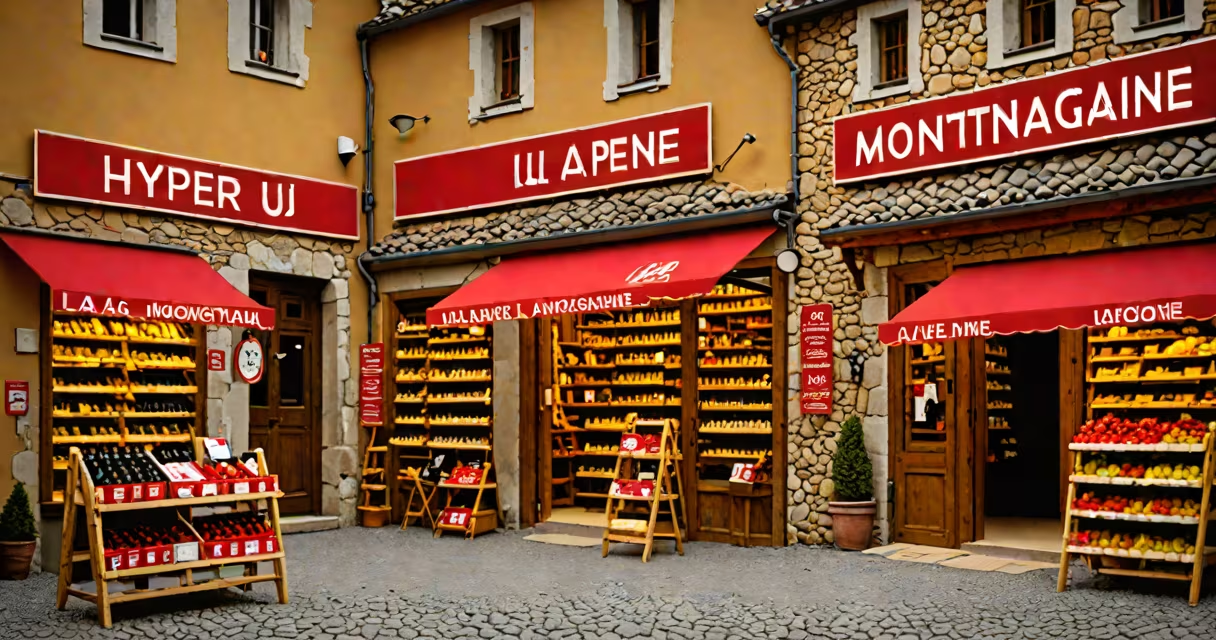
Hyper U La Montagne is a regional supermarket brand operated by the French retail group Groupe Casino, primarily serving rural and mountainous communities in eastern France. It functions as a localized variant of the national Hyper U chain, emphasizing affordability, proximity, and community ties over standardized formats.
The name "La Montagne" reflects geographic identity rather than a product line. It denotes stores located in or near mountainous regions such as the Jura, Alps, or Massif Central. These locations often face logistical challenges, including limited transport access and seasonal population shifts. Hyper U La Montagne responds by adjusting inventory, staffing, and pricing to match local demand patterns.
Unlike national Hyper U outlets, which follow uniform layouts and branding, Hyper U La Montagne stores vary in size and layout. Some occupy converted farm buildings or former railway stations. Others operate out of repurposed town halls. This adaptability allows them to serve remote populations where large-format supermarkets cannot sustain operations.
Hyper U La Montagne operates under a decentralized model. Local managers have autonomy over stock selection, promotional calendars, and staffing decisions. This enables rapid adaptation to seasonal changes-such as increased demand for winter supplies in alpine towns or fresh produce during summer tourism peaks.
For example, in the village of Saint-Béat in the Ariège department, a Hyper U La Montagne store stocks 68% locally sourced dairy products during winter months. This includes cheese from nearby farms and milk delivered daily from a cooperative in Foix. The store's weekly flyer features a rotating list of regional farmers' markets, reinforcing its role as a community hub.
Inventory is managed through a hybrid system combining central distribution and local procurement. While basic staples like bread, sugar, and bottled water come from national warehouses, perishables such as eggs, vegetables, and meats are sourced within a 50-kilometer radius. This reduces spoilage and supports local economies.
Hyper U La Montagne is not a single corporate format. Instead, it represents a category of localized Hyper U units. The following table outlines key differences between standard Hyper U and Hyper U La Montagne:
| Feature | Standard Hyper U | Hyper U La Montagne |
|---|---|---|
| Store Size | Typically 2,500-4,000 sq ft | Varies: 800-2,000 sq ft |
| Location | Urban centers, suburban zones | Rural towns, mountain villages |
| Ownership Model | Corporate-run | Locally managed with regional oversight |
| Product Focus | National brands, bulk goods | Local producers, seasonal items |
| Operating Hours | 7 AM - 10 PM, seven days | Often closed Sundays; hours adjusted seasonally |
Some Hyper U La Montagne locations are run by independent franchisees under a shared brand agreement. These operators retain profit margins and control over hiring, allowing long-term residents to maintain economic stability in declining regions.
Many assume Hyper U La Montagne is a separate company or a discount brand. It is neither. It is a strategic adaptation of an existing national chain to meet the unique demands of underserved areas. The term "La Montagne" does not imply lower quality-it signals location, not price tier.
A common error is equating Hyper U La Montagne with "Hyper U Express," a smaller, urban-focused format introduced in 2018. While both serve convenience needs, Hyper U Express targets city dwellers with compact layouts and online delivery options. Hyper U La Montagne serves sparsely populated regions where delivery logistics are impractical.
Another misconception is that these stores offer lower prices due to reduced overhead. In reality, their pricing is competitive but not consistently cheaper. A 2022 study by INSEE found that average basket prices at Hyper U La Montagne stores were 3.2% higher than at national Hyper U locations in comparable regions. The difference stems from higher transportation costs and smaller-scale purchasing power.
In the commune of Châtillon-en-Diois, a Hyper U La Montagne store opened in 2019 after the closure of the town's only other grocery outlet. The new store replaced a defunct textile factory, repurposing its 1,200-square-foot space. It employs six locals, including two retired farmers who manage the produce section.
During winter, the store sells 150 liters of goat milk per week-mostly from a farm 18 kilometers away. In summer, sales of fresh cherries from nearby orchards spike. The store's weekly flyer, printed on recycled paper, highlights local events such as the annual cheese festival in Valence-sur-Baise.
When a storm damaged the road leading to the town in January 2023, the store remained open for 14 consecutive days using emergency generators. Staff delivered groceries to elderly residents via bicycle. This level of responsiveness is rare in national chains, which typically close during infrastructure disruptions.
Hyper U La Montagne exemplifies how retail can function sustainably in low-density areas. According to a 2021 report by the French Ministry of Agriculture, 12% of rural communes in France had no permanent grocery access. Hyper U La Montagne addresses this gap by prioritizing resilience over scale.
Its success lies in balancing operational flexibility with consistent standards. While local managers adjust menus and hours, they still adhere to national food safety regulations and pricing transparency rules. This ensures fair treatment across all locations.
I visited a Hyper U La Montagne store in the village of Bessède-du-Comtat in 2022. The manager, a woman in her late fifties, showed me a handwritten ledger tracking weekly purchases from a nearby vineyard. She said, "We don't sell wine by the bottle-we sell trust." That moment clarified the brand's core purpose: not just commerce, but continuity.
Understanding hyper u la montagne reveals how retail innovation can emerge from necessity. It is not a trend, nor a gimmick. It is a functional response to geography, demography, and economic inertia. For those going through rural France, it is a lifeline-not just a place to buy bread.