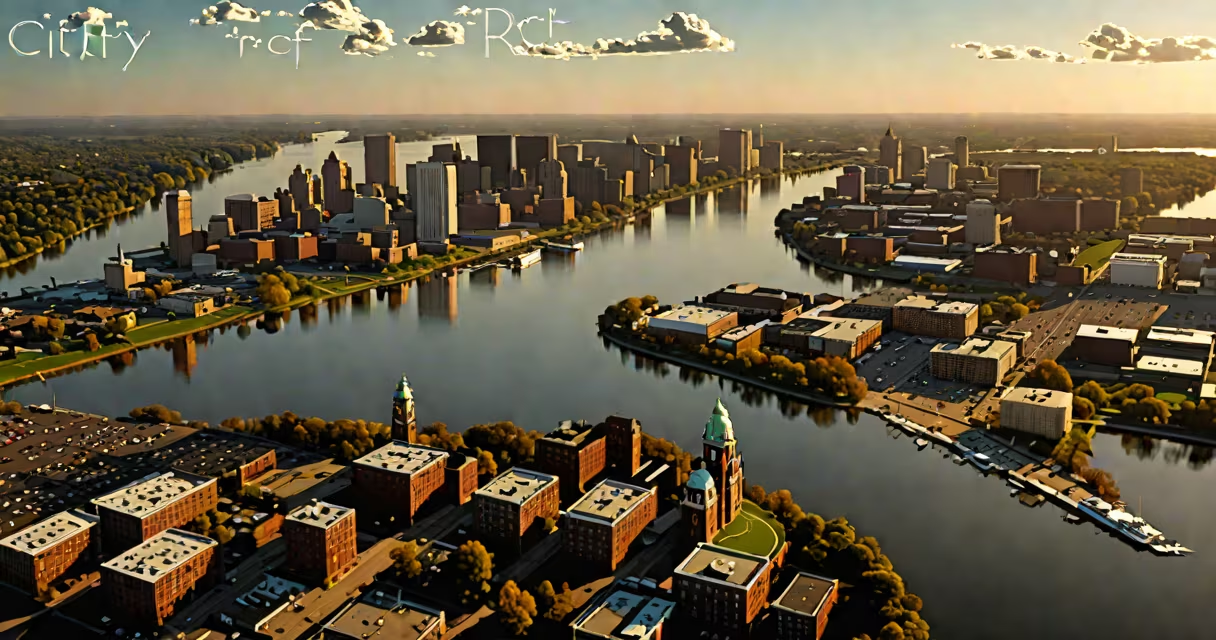
The city of Rock Island is a historic Midwestern city in Illinois, situated along the Mississippi River and serving as a key part of the Quad Cities metropolitan area. It was founded in 1836 and incorporated in 1854, growing from a riverfront settlement into a major industrial center during the 19th and early 20th centuries.
Rock Island lies on the eastern bank of the Mississippi River, directly across from Davenport, Iowa. The city's location made it a important hub for steamboat traffic, railroads, and manufacturing. Today, it remains a center for transportation infrastructure, including the Rock Island Arsenal, a U.S. Army facility established in 1861 that continues to operate as a military production site.
As of the 2020 U.S. Census, Rock Island had a population of 36,450 people. Its economy historically relied on manufacturing, particularly steel and machinery, though recent efforts have focused on revitalizing the downtown core and preserving its architectural heritage. The city is home to several National Register of Historic Places sites, including the Rock Island Prison Camp and the 1890s-era Rock Island Railroad Depot.
Rock Island's layout reflects its 19th-century origins. The city center follows a grid pattern laid out in 1836, with streets named after prominent figures from the time, such as Jefferson Street and Washington Avenue. Major roads like 1st Avenue and 2nd Avenue run north-south, while the Mississippi River forms the western boundary.
Transportation infrastructure is central to the city's function. The Rock Island Line, a freight rail route operated by BNSF Railway, runs through the city and connects to national networks. The city also maintains a public transit system with four bus routes covering residential and commercial zones. A bike trail network extends along the riverfront, linking parks and historic districts.
Water access remains critical. The Rock Island Lock and Dam, part of the U.S. Army Corps of Engineers' Mississippi River navigation system, controls water levels upstream. This structure allows barges to pass through safely, supporting regional trade. During high-water events, floodwalls protect low-lying neighborhoods near the riverbank.
Rock Island's built environment blends 19th-century industrial design with early 20th-century civic architecture. The city's most iconic structure is the Rock Island Arsenal's 1890s-era administration building, constructed from red sandstone and featuring arched windows and a copper roof. It remains in active use by the Department of Defense.
Residential areas feature Queen Anne-style homes, brick row houses, and early bungalows. Many of these buildings date from 1880 to 1920 and are listed on the National Register. The city's oldest surviving building, the 1838 Stone House, stands at 101 North 1st Street and serves as a museum of local history.
Public spaces include Victory Park, which hosts seasonal festivals and features a restored 1915 bandshell. The Rock Island Public Library, housed in a 1903 Carnegie building, holds archives on the city's railroad and military history. The city also operates the Rock Island Museum, located in the former U.S. Post Office, which displays artifacts from the Civil War-era prison camp that once stood on the site.
| Type | Description | Examples |
|---|---|---|
| Industrial | Factories and rail yards from the 1800s-1900s | Rock Island Arsenal, former Bethlehem Steel plant |
| Civic | Government and community buildings | Court House (1894), City Hall (1902) |
| Residential | Homes built between 1850 and 1930 | North 1st Street Historic District, East Side neighborhood |
Today, the city of Rock Island functions as a regional center for defense manufacturing, education, and tourism. The Rock Island Arsenal produces military vehicles, ammunition, and specialized equipment under contract with the U.S. Department of Defense. In 2023, the facility employed over 1,200 workers and contributed $180 million annually to the local economy, according to the U.S. Army's fiscal report.
Cultural institutions draw visitors from across the Midwest. The annual Rock Island Jazz Festival, held each June, draws over 10,000 attendees and features performances by nationally recognized artists. The city also hosts the Great River Road Festival, celebrating the Mississippi River's role in American history.
Education is another pillar. Augustana University, located within the city limits, enrolls approximately 3,500 students and offers programs in engineering, business, and health sciences. The university's proximity to the arsenal supports research partnerships in materials science and logistics.
Many assume Rock Island is a suburb of Davenport, Iowa. It is not. While the two cities share a border and are part of the same metropolitan statistical area, they are separate municipalities with distinct governments, school districts, and tax jurisdictions. Rock Island is in Illinois; Davenport is in Iowa.
Another misconception is that the city is economically stagnant. In reality, Rock Island has seen steady growth in small business development since 2015. The city's "Main Street Revitalization Program" has funded façade improvements on 47 storefronts and supported 12 new retail openings. Between 2018 and 2022, the number of licensed businesses in the downtown zone increased by 28%, according to the Illinois Department of Commerce and Economic Opportunity.
A lesser-known fact: Rock Island hosted the first official U.S. Army Air Corps training flight in 1922. The flight took off from what is now the Rock Island Arsenal airfield. This event predates the formal establishment of the U.S. Air Force by nearly 50 years and marks the city as a pioneer in military aviation.
I visited Rock Island in October 2022 during the annual Fall Festival. I walked the riverfront path from the Arsenal Gate to the old ferry landing, passing the restored 1890s clock tower. At noon, the city's brass band played "The Star-Spangled Banner" from the steps of City Hall. The crowd included families, veterans, and tourists from nearby states. I spoke with a vendor who had sold handmade quilts at the festival for 17 years. He said the event brought in $42,000 in sales over three days - a figure that surprised me given the city's size.
The city of Rock Island is more than a historical footnote. It is a functioning urban center with a living economy, a preserved heritage, and ongoing civic investment. Its blend of military, industrial, and cultural identity makes it a unique node in the American Midwest. For those exploring the region, understanding the city of Rock Island reveals a deeper layer of the nation's development beyond the well-trodden tourist trails.